Global Forest Distribution
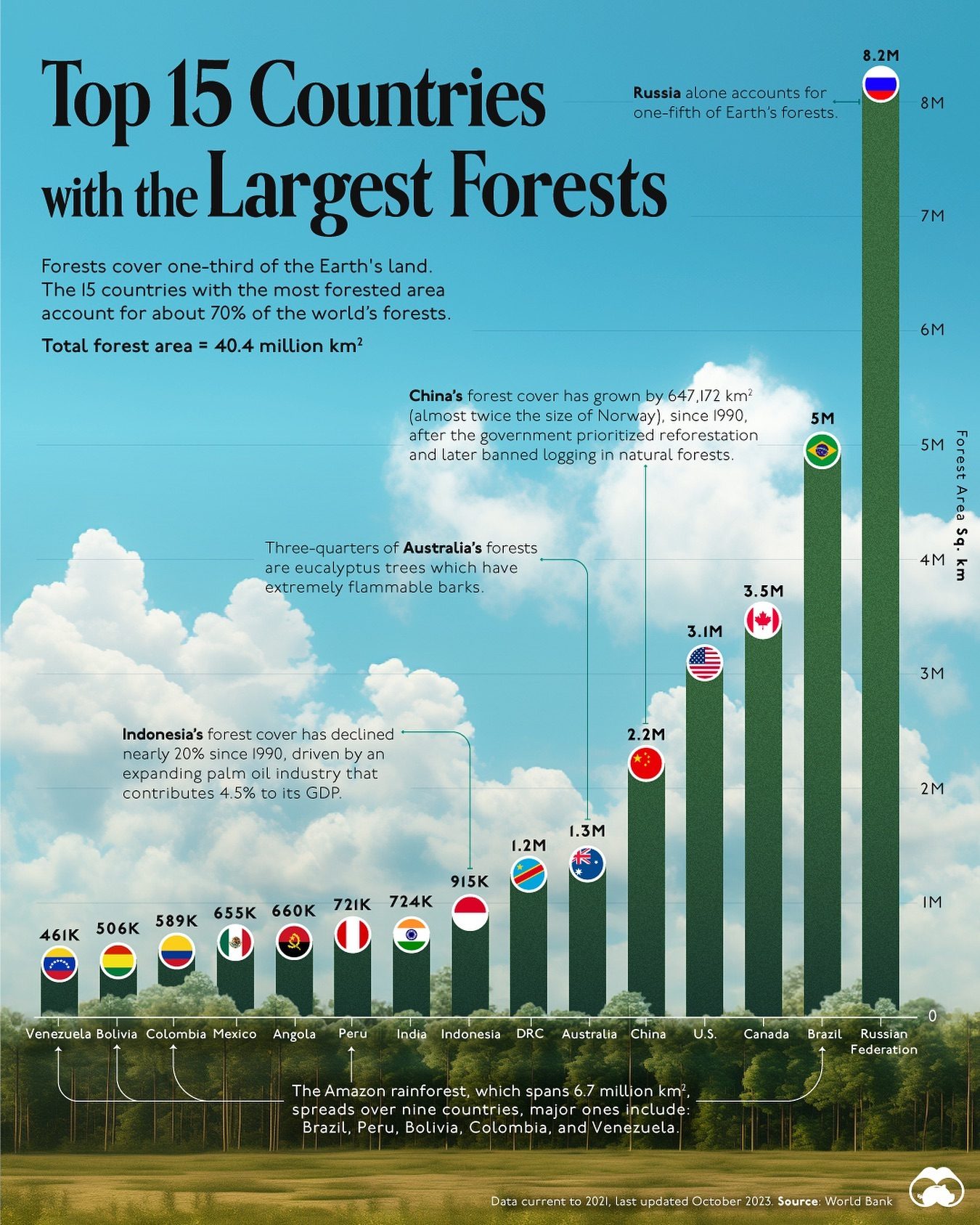
Forests are vital to our planet, covering about 30% of the Earth's land, which equates to approximately 40.4 million square kilometers (km²). This forest cover is not evenly distributed, with some countries boasting vast expanses of forest while others have far less. Russia alone accounts for one-fifth of the world's forests, making it the country with the largest forest area. The Amazon rainforest, which spans across multiple countries, is another notable example of extensive forest cover.
Why This Matters
Understanding the distribution of forests is crucial for several reasons. Forests play a significant role in regulating the Earth's climate, supporting biodiversity, and providing resources for human use. They act as carbon sinks, absorbing carbon dioxide from the atmosphere, which helps mitigate the effects of climate change. Additionally, forests provide habitats for countless species, contribute to the water cycle, and support various economic activities.
Main Discussion
Top 15 Countries with the Largest Forests
The top 15 countries with the largest forest areas are spread across the globe. Here, seven of these: Brazil, Canada, U.S., China, Australia, Indonesia, and the DRC are highlighted:
- Brazil: Home to a significant portion of the Amazon rainforest, Brazil has extensive forest cover.
- Canada: Known for its vast boreal forests, Canada ranks high in terms of forest area.
- U.S.: The United States has a diverse range of forest types, from temperate to tropical.
- China: China's forest cover has seen significant growth, with an increase of 647,172 km² since 1990. This growth is part of China's efforts to combat desertification and improve its environment.
- Australia: Australia's forest cover has also increased, with nearly 20% growth since 1990.
- Indonesia: Indonesia's forest cover has declined, primarily due to the expansion of the palm oil industry. This decline is a concerning trend, highlighting the need for sustainable practices.
- DRC: The Democratic Republic of the Congo (DRC) is home to the Congo Basin, the world's second-largest rainforest.
The countries are listed in no particular order, except for the top three, and Russia tops the list of countries with the largest forest areas. Russia's extensive forest cover makes it a critical player in global forest conservation efforts.
Forest Cover Changes
Forest cover changes significantly from one country to another. China, for instance, has seen a remarkable increase in its forest area, growing by 647,172 km² since 1990. This growth is a result of various reforestation efforts and environmental policies aimed at increasing forest cover.
On the other hand, Indonesia has experienced a decline in its forest cover. Nearly 20% of Indonesia's forest area has been lost since 1990, primarily due to the expansion of the palm oil industry. This decline highlights the need for sustainable practices and stricter environmental regulations.
Practical Tips
Understanding the distribution and changes in forest cover can help inform conservation efforts and sustainable practices. Here are some practical tips for individuals, organizations, and governments:
Individuals
- Support Sustainable Products: Choose products that are sourced sustainably and support companies that prioritize environmental conservation.
- Plant Trees: Participate in local reforestation efforts or plant trees in your community. Every tree planted contributes to increasing forest cover.
- Reduce, Reuse, Recycle: Reduce your consumption of paper and wood products, reuse items when possible, and recycle to minimize waste.
Organizations
- Sustainable Practices: Implement sustainable practices in your operations, such as using recycled materials and reducing paper waste.
- Educational Campaigns: Launch educational campaigns to raise awareness about the importance of forests and sustainable practices.
Governments
- Strong Environmental Policies: Implement and enforce strong environmental policies to protect existing forests and promote reforestation.
- International Cooperation: Collaborate with other countries to address global deforestation and promote sustainable forest management.
- Support Research: Fund research on forest conservation, sustainable practices, and the impacts of deforestation on climate change and biodiversity.
Important Takeaways
- Forest Distribution: The distribution of forests is uneven, with some countries having extensive forest cover while others have much less.
- Forest Cover Changes: Forest cover changes significantly from one country to another, with some countries seeing growth and others experiencing decline.
- Sustainable Practices: Sustainable practices are crucial for protecting existing forests and promoting reforestation.
- International Cooperation: International cooperation is essential for addressing global deforestation and promoting sustainable forest management.
Conclusion
Forests are a critical component of our planet's ecosystem, providing essential services and supporting biodiversity. Understanding the distribution and changes in forest cover is essential for effective conservation efforts and sustainable practices. By supporting sustainable products, planting trees, and advocating for strong environmental policies, individuals, organizations, and governments can all play a role in protecting and preserving our world's forests.
Watch the Reel
Questions readers ask
Which country has the largest forest area in the world?
Russia has the largest forest area, accounting for one-fifth of the world's total forest coverage. This makes Russia a significant player in global forest distribution.
What percentage of the Earth's land is covered by forests?
Forests cover approximately 30% of the Earth's land, which is about 40.4 million square kilometers. This coverage is crucial for various ecological and environmental processes.
Which countries besides Russia have extensive forest coverage?
Brazil, Canada, and the United States are among the countries with vast forest expanses. These countries, along with Russia, hold a considerable portion of the world's forest resources.
Why is understanding global forest distribution important?
Understanding the distribution of forests is essential for climate regulation, supporting biodiversity, and managing resources effectively. Forests act as carbon sinks and provide habitats for numerous species.
What is the significance of the Amazon rainforest in global forest distribution?
The Amazon rainforest, spanning multiple countries, is one of the most extensive forest areas in the world. It plays a critical role in global climate regulation and biodiversity support.
How do forests contribute to climate regulation?
Forests act as carbon sinks absorbing carbon dioxide from the atmosphere. This process helps to mitigate the effects of climate change by reducing the amount of greenhouse gases in the air.
Related deep dives
Similar reads based on topic and creator.


Recent articles
Fresh deep dives from the latest Reels we unpacked.




Comments
Be the first to comment.