Forest Area by Country: A Global Perspective
Global forests play a critical role in maintaining ecological balance, supporting biodiversity, and mitigating climate change. Understanding the distribution of these forests across the world is essential for various environmental and conservation efforts. This analysis will delve into the countries with the largest forest areas, revealing how woodland is distributed across the planet.
Context: Why This Matters
Forests are not only vital for the environment but also for the economies and cultures of the countries that host them. They provide timber, support local livelihoods, and act as carbon sinks. Moreover, the distribution of forest areas can influence global climate patterns and biodiversity. By examining the largest forest areas by country, we can better understand the global forest landscape and the implications for conservation efforts.
Main Discussion
The Global Forest Landscape
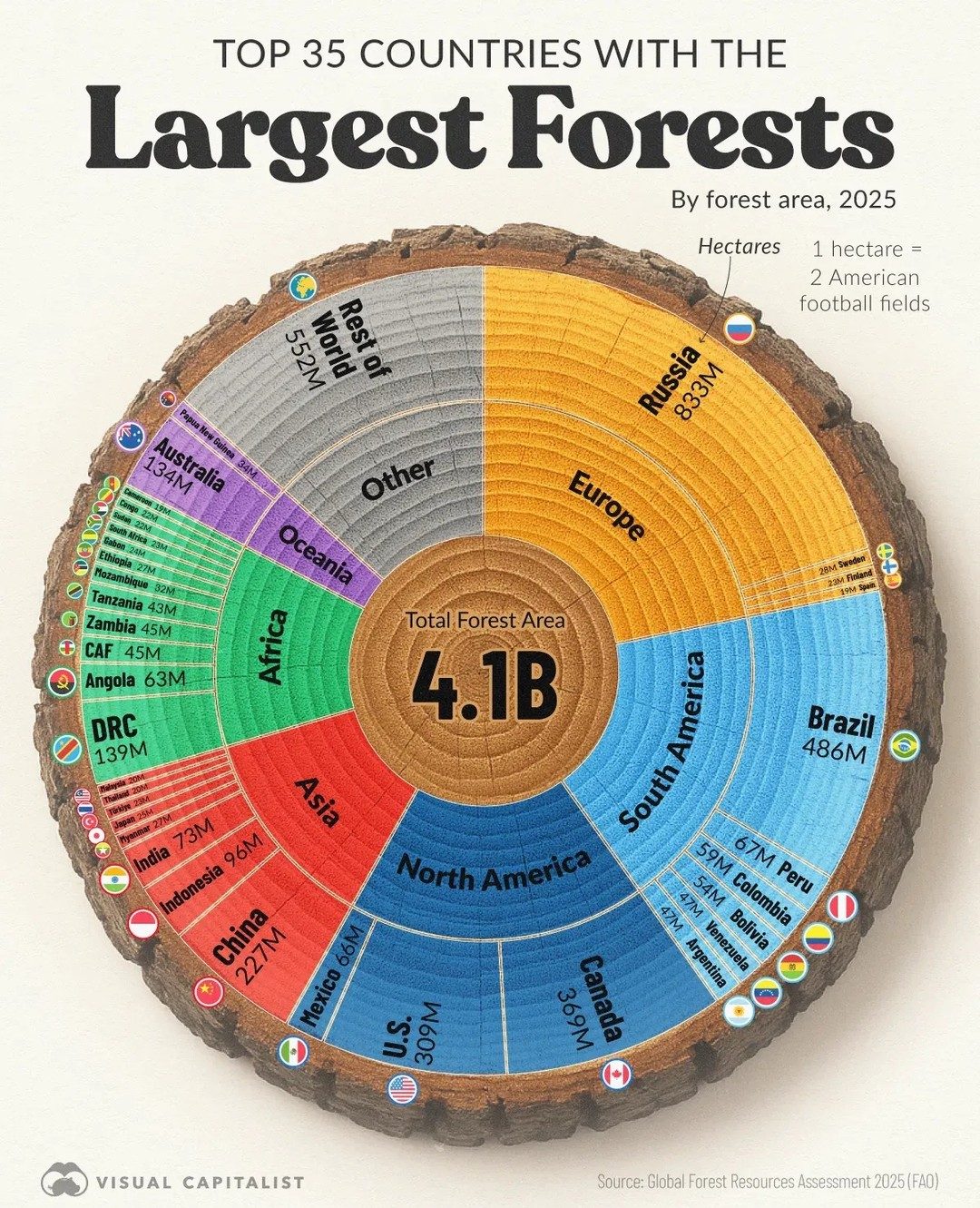
The total forest area globally is approximately 4.1 billion hectares. This vast expanse is distributed across various continents, with some countries standing out due to their significant forest cover. The top three nations—they are Russia, Brazil, and Canada—account for more than 40% of the world's forests. Russia leads with 833 million hectares, followed by Brazil with 486 million hectares, and Canada with 369 million hectares.
Russia Russia is the undisputed leader in forest area, with 833 million hectares under forest cover. This vast expanse is roughly 20% of the entire world's forests. Russia's forests, primarily located in Siberia, are a critical part of the country's ecosystem and a significant carbon sink. These forests support a diverse range of flora and fauna and are essential for maintaining the ecological balance of the region.
Brazil Brazil ranks second with 486 million hectares of forest. The Amazon rainforest, which covers a significant portion of Brazil, is the world's largest and most biodiverse forest. This forest is home to an estimated 40,000 plant species, 1,300 bird species, 3,000 types of fish, 430 mammals, and 2.5 million different insects. The Amazon plays a critical role in global climate regulation, producing about 6% of the world's oxygen and storing 90-140 billion metric tons of carbon.
Canada Canada follows with 369 million hectares of forest. The country's forests are primarily coniferous, covering nearly half of Canada's land area. These forests are crucial for Canada's timber industry and support a diverse range of wildlife, including moose, deer, and various bird species.
Other Notable Countries
Beyond the top three, several other countries have significant forest areas:
- China: With 227 million hectares, China has been actively working to increase its forest cover through reforestation efforts. The country aims to achieve a forest coverage rate of 26% by 2030.
- DRC (Democratic Republic of Congo): The DRC has 152 million hectares of forest, primarily in the Congo Basin. This region is the second-largest tropical rainforest in the world, after the Amazon.
- United States: The U.S. has 310 million hectares of forest, with significant forest areas in states like Alaska, Oregon, and Washington. These forests are home to a diverse range of species and are crucial for timber production and recreational activities.
Forest Distribution by Continent
The distribution of forests varies significantly by continent. Europe has the highest percentage of forest cover, with forests making up about 33% of its land area. North America follows with 32%, while South America and Asia have around 49% and 22% respectively. Africa and Oceania have the lowest percentages, with about 20% and 16% of their land areas covered by forests.
Comparing Forest Areas: A Visual Perspective
One effective way to understand the scale of these forests is by comparing their areas to everyday objects. For instance, 1 hectare of forest is roughly equivalent to 2.47 American football fields. This comparison helps visualize the vastness of these forest areas and underscores their significance.
Practical Tips for Understanding Forest Data
When interpreting forest data, it's essential to consider several factors:
- Data Sources: Ensure that the data comes from reliable sources, such as the Global Forest Resources Assessment 2025 (FAO).
- Methodology: Understand the methodology used to measure forest areas, as different methods can yield varying results.
- Context: Consider the context in which the forest data is presented. Factors like deforestation rates, reforestation efforts, and land use changes can significantly impact forest areas over time.
Important Takeaways
Forests are a vital component of the global ecosystem, and understanding their distribution is crucial for effective conservation and management. Here are the key points to remember:
- Russia, Brazil, and Canada are the top three countries with the largest forest areas, accounting for more than 40% of the world's forests.
- The Amazon rainforest in Brazil and the Congo Basin in the DRC are among the largest and most biodiverse forests in the world.
- Forest areas vary significantly by continent, with Europe having the highest percentage of forest cover.
- Comparing forest areas to everyday objects, such as American football fields, can help visualize their vastness and significance.
Conclusion
The distribution of forests across the globe is a complex and dynamic issue. By examining the largest forest areas by country, we gain valuable insights into the global forest landscape and the implications for conservation efforts. Understanding these distributions helps us appreciate the importance of forests in maintaining ecological balance and supporting biodiversity. Whether it's the vast Siberian forests of Russia, the biodiverse Amazon rainforest of Brazil, or the coniferous forests of Canada, each plays a unique and vital role in the global ecosystem.
As we continue to face environmental challenges, it is essential to protect and preserve these critical natural resources for future generations. By doing so, we not only safeguard the environment but also ensure the well-being of communities that depend on these forests for their livelihoods and cultural heritage.
Watch the Reel
Related deep dives
Similar reads based on topic and creator.


Recent articles
Fresh deep dives from the latest Reels we unpacked.




Comments
Be the first to comment.