Population Pyramids: A Visual Comparison of Global Demographics
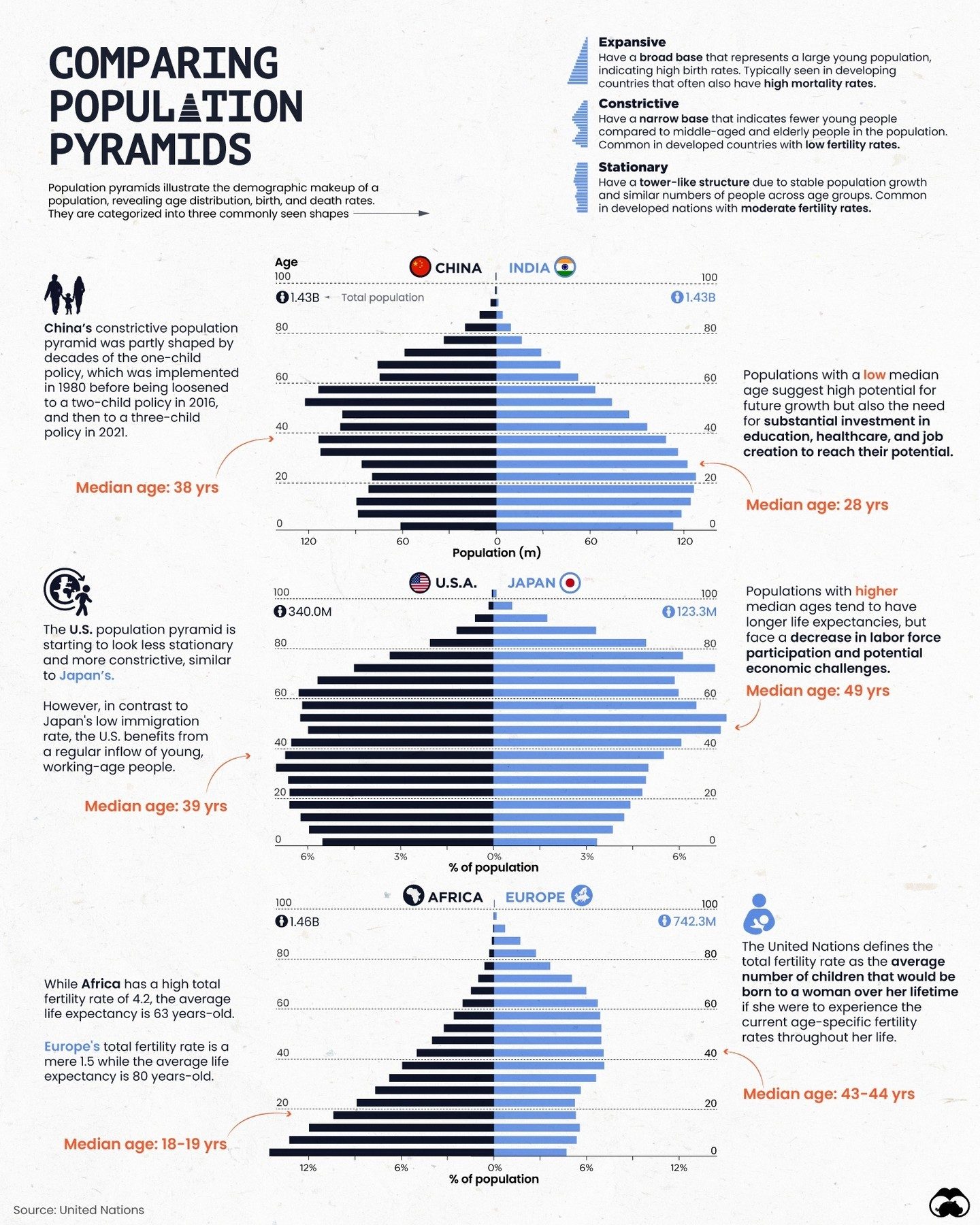
Population pyramids serve as a powerful tool for understanding a country's demographic structure. By visually representing the age and sex distribution of a population, these pyramids offer insights into fertility and mortality rates, as well as the impact of historical events and policies. This comparison of population pyramids for China, India, the U.S.A., and Japan reveals how age distributions can vary significantly across different nations and regions.
Context / Why This Matters
Understanding population pyramids is crucial for policymakers, economists, and sociologists. These pyramids help predict future population trends, assess the potential economic challenges, and plan for essential services like healthcare and education. By comparing the pyramids of various countries, we can gain a deeper understanding of how different demographic structures influence societal development and economic growth.
Main Discussion
Expansive, Stationary, and Constrictive Population Pyramids
Population pyramids can be categorized into three main types: expansive, stationary, and constrictive. Each type provides unique insights into a country's demographic dynamics.
-
Expansive Pyramids: These pyramids have a wide base, indicating a large young population. Common in developing countries, expansive pyramids suggest high birth rates and potentially high mortality rates. These populations have high potential for future growth but also require substantial investment in education, healthcare, and job creation.
-
Stationary Pyramids: These pyramids have a more balanced structure, with similar numbers of people across different age groups. Stationary pyramids are common in developed nations with moderate fertility rates and stable population growth. They are indicative of a mature population with a balance between younger and older generations.
-
Constrictive Pyramids: These pyramids have a narrower base, indicating fewer young people compared to middle-aged and elderly people. They are typical of developed countries with low fertility rates. While populations with constrictive pyramids tend to have longer life expectancies, they may also face economic challenges due to a decrease in labor force participation.
China's Population Pyramid
China's population pyramid is a unique case, partly shaped by decades of the one-child policy. Implemented in 1980, this policy was later loosened to a two-child policy in 2016 and then to a three-child policy in 2021. The policy's effects are evident in the pyramid's structure, which shows a significant decrease in the younger population. This demographic shift presents both challenges and opportunities. For instance, as the working-age population decreases, the dependency ratio (the ratio of dependents to working-age people) increases, which may strain the economy.
India's Population Pyramid
India's expansive population pyramid reflects a high birth rate and a large young population. With a median age of 28 years, India's demographic structure indicates significant potential for future growth. However, this also necessitates substantial investment in education, healthcare, and job creation to ensure that the young population can reach its potential.
The U.S.A.'s Population Pyramid
The U.S. population pyramid is starting to look less stationary and more constrictive, similar to Japan. However, in contrast to Japan, the U.S. benefits from a regular influx of young, working-age people. This influx helps maintain a more balanced demographic structure and mitigates some of the economic challenges associated with an aging population.
Japan's Population Pyramid
Japan's constrictive population pyramid reflects a developed country with a low fertility rate and a longer life expectancy. With a median age of 49 years, Japan faces potential economic challenges due to a decreasing labor force and an increasing elderly population. Policies aimed at increasing birth rates and managing the aging population are crucial for Japan's long-term sustainability.
Practical Tips
When analyzing population pyramids, it is essential to consider the following:
-
Understand the Structure: Recognize the characteristics of expansive, stationary, and constrictive pyramids to interpret the demographic dynamics accurately.
-
Consider Historical Context: Historical events and policies, such as China's one-child policy, significantly influence a country's demographic structure. Understanding these factors is crucial for accurate interpretation.
-
Assess Economic Implications: Different demographic structures have varying economic implications. For example, expansive pyramids suggest high potential for growth but also require substantial investment in essential services.
-
Evaluate Median Age: The median age provides valuable insights into a population's age distribution. Populations with higher median ages tend to have longer life expectancies but may face economic challenges due to a decreasing labor force.
Important Takeaways
- Expansive pyramids indicate high potential for future growth but require substantial investment in essential services.
- Stationary pyramids reflect stable population growth and a balanced demographic structure.
- Constrictive pyramids suggest an aging population with potential economic challenges.
- Historical policies and events significantly influence a country's demographic structure.
- Understanding demographic dynamics is crucial for effective policymaking and economic planning.
Conclusion
Comparing population pyramids of different countries provides valuable insights into demographic structures and their implications. Whether expansive, stationary, or constrictive, each type of pyramid offers unique perspectives on a nation's fertility, mortality, and overall population trends. By understanding these differences, policymakers, economists, and sociologists can make informed decisions to address current challenges and plan for future growth.
Watch the Reel
Questions readers ask
What is a population pyramid and how does it help in demographic data analysis?
A population pyramid is a graphical representation of the age and sex distribution of a population. It provides a quick visual summary of the population's age structure, showing the number or percentage of males and females in each age group. By analyzing these pyramids, we can infer fertility and mortality rates, and understand the impact of historical events and policies on population growth and distribution.
How does the population pyramid of China differ from that of India?
The population pyramid of China shows the effects of its constrictive population policy, with a notable decrease in the youth ratio due to the one-child policy implemented in the late 1970s. In contrast, India's pyramid reflects a broader age distribution with a larger youth population, indicating a more youthful population structure that is still growing.
What insights can be gained from examining the population pyramid of the USA?
The USA's population pyramid typically shows a broad base, indicating a large youth population, and a more balanced age distribution. This reflects a relatively stable population growth rate. It also reveals insights into the fertility rate and mortality rate trends. The pyramid can show how the population is aging and how the baby boomer generation is impacting the age structure.
How does Japan's population pyramid reflect its demographic challenges?
Japan's population pyramid has a narrow base and a wide top, which indicates a rapidly aging population. This is due to low fertility rates and increased life expectancy, resulting in a high proportion of elderly individuals. This structure presents significant challenges for Japan, including potential labor shortages and increased strain on healthcare and pension systems.
What are the implications of a stationary population growth rate as seen in some population pyramids?
A stationary population growth rate, as seen in some population pyramids, implies that the number of births is roughly equal to the number of deaths. This leads to a stable total population, which can have profound implications for economic growth, labor markets, and social services. Policymakers need to adapt to these shifts to sustain economic productivity and maintain adequate service levels.
How do historical events and policies impact the shape of a population pyramid?
Historical events and policies, such as wars, pandemics, or government-imposed family planning policies, can significantly alter the shape of a population pyramid. These events can lead to fluctuations in birth and death rates, which are reflected in the age distribution of the population. For example, China's one-child policy has resulted in a distinctive age structure, while wars can leave noticeable gaps in certain age cohorts.
Related deep dives
Similar reads based on topic and creator.

Recent articles
Fresh deep dives from the latest Reels we unpacked.




Comments
Be the first to comment.