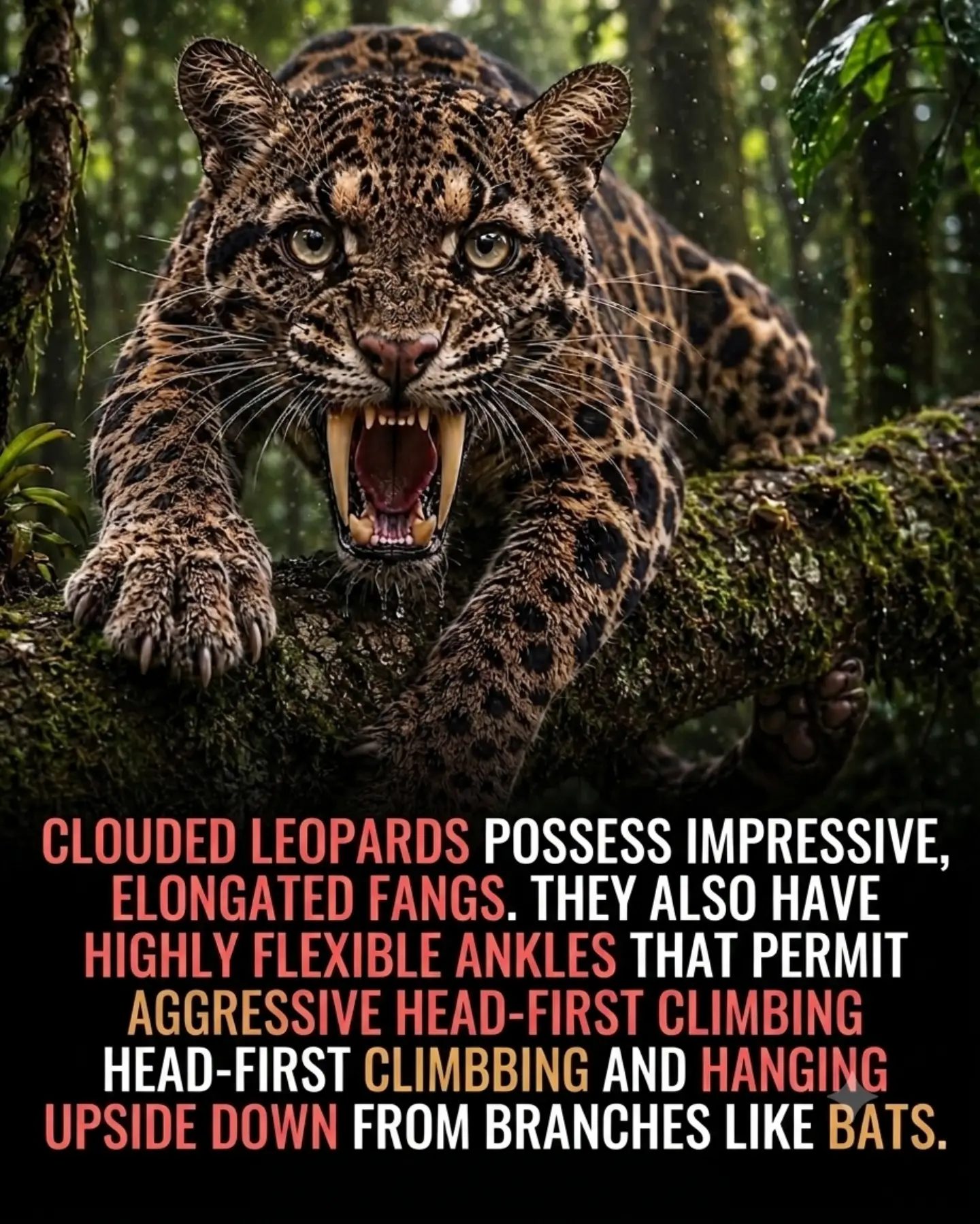
Clouded Leopards: The Canopy's Modern Saber-Tooth
The clouded leopard is a remarkable feline species, renowned for its unique adaptations that make it a master of arboreal stealth. These animals are found in dense Asian rainforests, where their specialized skills allow them to thrive in a complex, three-dimensional environment.
Context: Why this matters
Understanding the clouded leopard's adaptations provides insight into the intricate balance of power and agility in the natural world. These adaptations have evolved to optimize the leopard's life in the forest canopy, making it a formidable predator in a unique ecological niche.
Key Adaptations
Apex Weaponry
One of the most striking features of the clouded leopard is its elongated fangs. Relative to their skull size, these canines are the longest of any living feline, earning them the title of the modern saber-tooth. This powerful weaponry allows them to deliver a deadly bite, essential for hunting in the dense forest canopy where prey can be elusive and quick.
Acrobatic Anatomy
The clouded leopard's unique physical characteristics extend beyond its fangs. They possess highly flexible ankle joints that enable them to perform amazing feats of agility. These joints allow the leopard to descend tree trunks head-first and hang suspended from branches with ease, much like a bat. This ability is crucial for navigating the complex environment of the forest canopy, where precise movements and balance are essential.
Engineered for Stealth
Weighing between 30 to 50 pounds, the clouded leopard's medium build is optimized for stealth rather than brute force. Their exceptional grip, balance, and agility make them highly effective hunters in their arboreal habitat. This combination of physical adaptations allows them to move silently through the canopy, making them nearly undetectable to their prey.
A Detailed Look at the Clouded Leopard's Adaptations
Flexible Ankle Joints
The highly flexible ankle joints of the clouded leopard are a marvel of evolutionary design. These joints allow the leopard to rotate its hind feet 180 degrees, enabling it to climb down trees head-first. This unique adaptation is not found in any other big cat, making the clouded leopard one of the most agile climbers in the animal kingdom.
Exceptional Grip
In addition to their flexible ankles, clouded leopards have retractable claws and large paws that provide an exceptional grip on tree branches. These adaptations, combined with their strong, muscular bodies, allow them to navigate the forest canopy with ease. Their agility and balance are unmatched, making them highly effective predators in their natural habitat.
Stealth and Hunting
The clouded leopard's stealth is a result of its medium build and agile movements. They move silently through the canopy, using their exceptional grip and balance to approach prey undetected. This stealthy hunting style is essential for survival in the dense forest, where visibility is often limited.
Practical Tips for Observing Clouded Leopards
Best Time and Place to Spot Them
Clouded leopards are most active during the night, making them difficult to spot during the day. However, they can sometimes be seen in the early morning or late afternoon. Their primary habitats are dense Asian rainforests, particularly in Southeast Asia. National parks and reserves in countries like Malaysia, Indonesia, and Thailand are good places to look for them.
Essential Equipment
Observing clouded leopards requires patience and the right equipment. A good pair of binoculars or a spotting scope can help you get a closer look at these elusive felines. Additionally, a camera with a long lens can capture their movements and behaviors in detail. Remember to respect their habitat and keep a safe distance to avoid disturbing them.
Important Takeaways
- The clouded leopard's elongated fangs and flexible ankle joints make it a formidable predator in the forest canopy.
- Their medium build and agile movements enable them to move silently and stealthily through the dense foliage.
- The clouded leopard's unique adaptations have evolved to optimize their life in the complex, three-dimensional environment of the rainforest canopy.
- Observing clouded leopards requires patience, the right equipment, and respect for their habitat.
Conclusion
The clouded leopard is a true master of arboreal stealth, with a unique set of adaptations that make it a specialized, canopy-dwelling predator. Its elongated fangs, flexible ankle joints, and exceptional grip and balance allow it to thrive in the dense Asian rainforests. Understanding these adaptations provides a deeper appreciation for the incredible diversity and complexity of the natural world.
Watch the Reel
Questions readers ask
What makes the clouded leopard's fangs unique?
The clouded leopard's fangs are notably elongated, relative to their skull size, and are adapted for a specialized diet and hunting techniques. These fangs allow the leopard to deliver a powerful bite and hold onto prey, which is crucial for their arboreal hunting methods.
How do the flexible ankle joints of a clouded leopard assist in hunting?
The flexible ankle joints of a clouded leopard enable it to climb trees with exceptional agility and move in multiple directions. This adaptability helps the leopard to navigate the complex terrain of the forest canopy, making it a formidable predator in its habitat.
What techniques do clouded leopards use for stealthy movement in the forest canopy?
Clouded leopards utilize their flexible ankle joints for silent, precise movements and are known to use trees for ambush hunting. The leopards’ ability to move in different directions and hold on to branches with their strong claws and fangs aids in their stealthy hunting techniques.
Why are clouded leopards considered aggressive tree climbers?
Clouded leopards are considered aggressive tree climbers because of their exceptional climbing abilities, which are facilitated by their flexible ankle joints and long tail. These features allow them to climb swiftly and with precision, making them one of the most adept tree-dwelling predators.
What role do the clouded leopard's adaptations play in the forest canopy ecosystem?
The clouded leopard's adaptations, such as their elongated fangs, flexible ankle joints, and stealthy movements, allow them to effectively hunt in the forest canopy. This helps maintain a balance within the ecosystem, as they control the populations of their prey species, which are typically smaller animals.
How do the clouded leopard's hunting methods differ from those of other big cats?
Unlike other big cats, clouded leopards have evolved specialized features for an arboreal lifestyle. Their ability to climb trees efficiently, combined with their stealthy movements and powerful fangs, enables them to hunt in the forest canopy. This tree-dwelling behavior is unique among big cats.
What is the significance of the clouded leopard's hunting adaptations in modern times?
The clouded leopard's hunting adaptations are a testament to the species' resilience and evolutionary success in their specific ecological niche. Understanding these adaptations helps highlight the importance of preserving the clouded leopard's habitat and the intricate relationships within the forest canopy ecosystem.
Related deep dives
Similar reads based on topic and creator.




Recent articles
Fresh deep dives from the latest Reels we unpacked.




Comments
Be the first to comment.