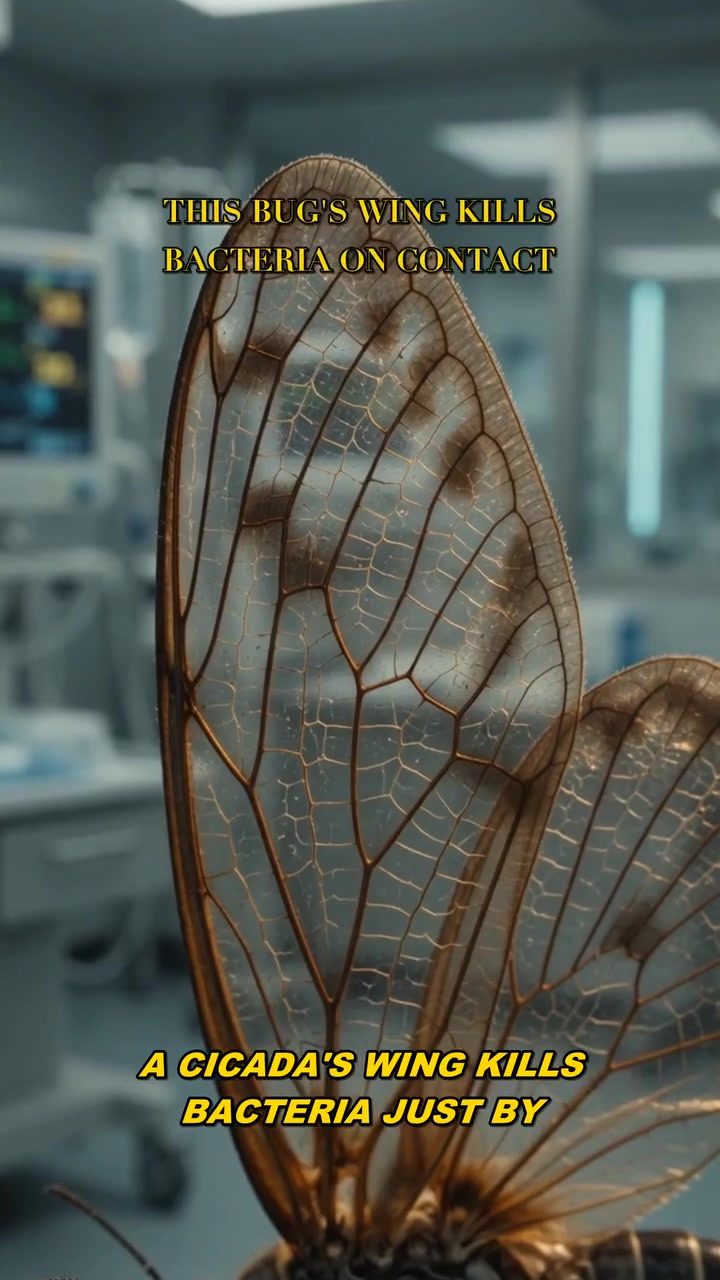
Cicada Wings and the Fight Against Drug-Resistant Bacteria
Cicada wings possess an extraordinary natural defense mechanism that has captured the attention of scientists and engineers alike. These wings are covered in millions of microscopic spikes, each measuring under 200 nanometers in height. These spikes are thousands of times thinner than a human hair, making them incredibly effective at killing bacteria on contact. The outer membrane of a bacterium stretches across these spikes like a sheet pulled over nails, eventually tearing open and destroying the cell.
Why This Matters
The discovery of this natural defense mechanism is significant in the broader context of antibiotic resistance. Drug-resistant superbugs pose a growing threat to public health, as traditional antibiotics become less effective. The cicada wing's ability to kill bacteria without the use of chemicals offers a promising alternative. This mechanism is particularly intriguing because it relies solely on physical structure, making it a potential solution that bacteria cannot easily adapt to.
The Science Behind Cicada Wings
Microscopic Structure
Each cicada wing is adorned with millions of microscopic spikes. These spikes are so small that they can tear through the membrane of a bacterium, effectively killing it. The process is purely mechanical, involving no chemical reactions. This unique structure has been observed and studied extensively, with scientists confirming its effectiveness by coating the wings in gold and observing that bacteria still die upon contact.
Bacteria Killing Mechanism
When a bacterium lands on the wing, its outer membrane stretches across the spikes. This stretching continues until the membrane can no longer sustain the tension and tears open. The cell ruptures, and the bacterium is destroyed. This mechanical action is incredibly effective and does not rely on any chemical properties.
Engineering Replication
Engineers have successfully replicated this natural defense mechanism. Using a process called glancing angle deposition, they have created artificial surfaces with the same spiked nanostructure. These surfaces have been tested on various materials, including metal and plastic, and have shown the same bacteria-killing properties. This replication opens up a wide range of applications, particularly in healthcare settings.
Practical Applications
Hospital Equipment and Medical Implants
One of the most promising applications of this technology is in hospital equipment and medical implants. Surfaces that can kill bacteria on contact without the use of antibiotics would be a game-changer in preventing and controlling infections. These surfaces could significantly reduce the risk of hospital-acquired infections, which are a major concern in healthcare settings.
Beyond Healthcare
While the immediate applications are focused on healthcare, the potential for this technology extends far beyond. Any surface that requires sterilization or bacteria control could benefit from this innovation. From food preparation areas to public transportation, the possibilities are vast.
Important Takeaways
Cicada wings offer a natural and effective solution to the problem of drug-resistant bacteria. Their unique structure and mechanical action provide a defense mechanism that bacteria cannot easily adapt to. By replicating this structure on artificial surfaces, engineers have opened up new avenues for controlling bacterial infections without the need for antibiotics. This innovation holds the promise of significantly reducing the impact of superbugs in various settings, from hospitals to public spaces.
Conclusion
The cicada wing's ability to kill bacteria on contact is a fascinating example of nature's ingenuity. By understanding and replicating this mechanism, we can develop new strategies to combat drug-resistant bacteria. The potential applications are vast, and the benefits could be far-reaching. As we continue to explore and innovate, the cicada wing serves as a powerful reminder of the potential hidden in the natural world.
Watch the Reel
Questions readers ask
How do cicada wings naturally kill bacteria?
Cicada wings have tiny spikes that are exceptionally effective at destroying bacteria. These spikes puncture the bacterial cell membrane, causing it to rupture and leading to the death of the bacterial cell.
What makes cicada wings a potential solution to antibiotic resistance?
Cicada wings offer a promising alternative to traditional antibiotics by providing a physical mechanism to kill bacteria. This approach may help combat drug-resistant bacteria that have become immune to conventional antibiotics.
Can cicada wing-inspired surfaces be used in practical applications?
Yes, researchers are exploring the use of cicada wing-inspired surfaces in various applications. These surfaces could be integrated into medical devices, hospital equipment, and even food packaging to help prevent the spread of bacteria and reduce infections.
How effective are cicada wings against different types of bacteria?
Cicada wings have shown effectiveness against a wide range of bacteria, including those that are resistant to antibiotics. The microscopic spikes on the wings can puncture and destroy bacterial cells, making them a versatile tool in the fight against bacterial infections.
What are the advantages of using cicada wings as an antibacterial solution?
Cicada wings offer a natural, non-chemical method to combat bacteria. This approach reduces the risk of contributing to further antibiotic resistance and provides an environmentally friendly solution to bacterial infections.
Are cicada wings the only natural antibacterial surfaces in the insect world?
While cicada wings are notable for their remarkable antibacterial properties, other insects also possess unique defense mechanisms. For example, some beetles and dragonflies have surfaces that can repel or kill bacteria, contributing to the broader field of bio-inspired antibacterial research.
How can cicada wing technology be integrated into existing healthcare practices?
Cicada wing technology can be integrated into healthcare by developing surfaces that mimic the antibacterial properties of cicada wings. These surfaces can be used in hospital settings to reduce the spread of infections, on medical devices to prevent bacterial growth, and in wound dressings to promote healing and prevent infections.
Related deep dives
Similar reads based on topic and creator.




Recent articles
Fresh deep dives from the latest Reels we unpacked.




Comments
Be the first to comment.