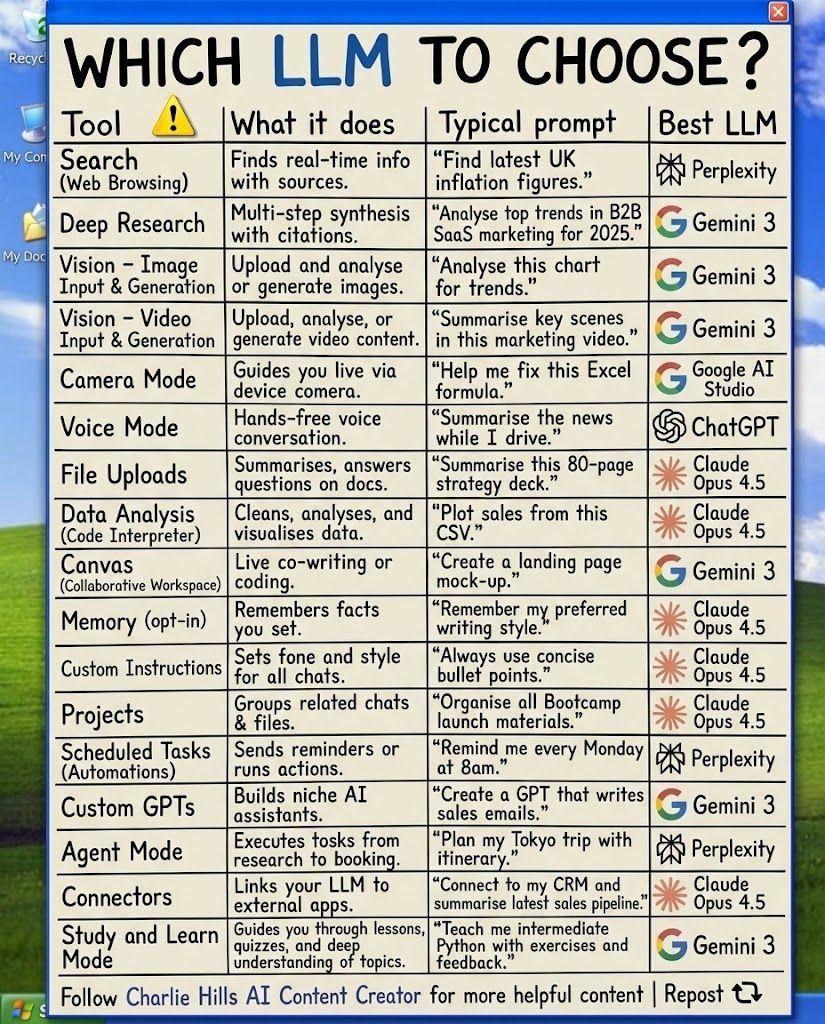
Using the Right Large Language Model for the Job
In the rapidly evolving world of artificial intelligence, Large Language Models (LLMs) have become indispensable tools for a wide range of tasks. However, not all LLMs are created equal, and using one LLM for everything might not be the most efficient approach. Different LLMs excel in different areas, and choosing the right one for the job can significantly enhance productivity and results.
Why This Matters
With the plethora of LLMs available, it's crucial to understand the strengths and use cases of each. Whether you're working on text generation, image analysis, or code interpretation, selecting the appropriate LLM can save time, improve accuracy, and offer a better user experience. This article will guide you through the process of choosing the right LLM for your needs, focusing on some of the most popular and effective models available, such as Gemini, Claude, Perplexity, and Google AI Studio.
Comparing Popular LLMs
Gemini
Gemini is a versatile LLM that stands out for its robust performance in various areas. One of its key strengths is its ability to handle deep research tasks efficiently. Whether you're conducting in-depth analysis, gathering extensive information, or seeking to generate comprehensive reports, Gemini's advanced capabilities can deliver high-quality results. Additionally, Gemini excels in voice mode and file uploads, making it a versatile tool for users who need to process different types of data seamlessly.
Claude
Claude, and its advanced version, Claude Opus 4.5, is another powerful LLM that offers excellent performance in text generation and summarization. It's particularly useful for tasks that require generating sales emails, creating landing pages, and summarizing documents. Claude's ability to produce coherent and contextually relevant text makes it a go-to choice for content creators and marketers.
Perplexity
Perplexity is known for its strong performance in code interpretation and analysis. If your tasks involve working with code snippets, debugging, or generating code, Perplexity is a reliable tool to consider. Its deep understanding of programming languages and logical structures makes it a valuable asset for developers and data scientists.
Google AI Studio
Google AI Studio offers a broad range of functionalities, making it a versatile choice for various AI tasks. It excels in vision-based tasks, such as image analysis and object detection. Additionally, Google AI Studio provides robust support for custom GPTs, allowing users to create tailored AI models for specific needs. Its comprehensive suite of tools makes it a popular choice for users who require a multi-purpose AI solution.
ChatGPT
ChatGPT, a widely recognized LLM, offers excellent performance in conversational AI and text generation. Its ability to understand and generate human-like text makes it a valuable tool for customer support, chatbots, and virtual assistants. ChatGPT's versatility and user-friendly interface have made it a favorite among users for everyday AI tasks.
Practical Tips for Choosing the Right LLM
Assess Your Needs
Before selecting an LLM, it's essential to assess your specific needs and the type of tasks you'll be performing. Consider whether you require deep research capabilities, text generation, code interpretation, or vision-based tasks. Understanding your requirements will help you narrow down the best LLM for your job.
Consider Integration and Compatibility
Ensure that the LLM you choose can integrate seamlessly with your existing tools and workflows. Compatibility with other software applications and ease of use are important factors to consider. Look for LLMs that offer robust APIs and documentation to facilitate smooth integration.
Evaluate Performance and Accuracy
Performance and accuracy are critical when choosing an LLM. Review user feedback, benchmarks, and case studies to gauge the effectiveness of different models. Consider factors such as response time, error rates, and the ability to handle complex tasks.
Experiment and Iterate
Don't hesitate to experiment with different LLMs to find the one that best suits your needs. Many LLMs offer free trials or demo versions, allowing you to test their capabilities before making a commitment. Iterate based on your experiences and feedback to find the most efficient LLM for your tasks.
Important Takeaways
Choosing the right LLM for the job is essential for maximizing productivity and achieving high-quality results. Each LLM has its strengths and use cases, and understanding these can help you select the best tool for your needs. Whether you're working on deep research, text generation, code interpretation, or vision-based tasks, there is an LLM tailored to your requirements.
Conclusion
In conclusion, using the right LLM for the job can significantly enhance your workflow and improve the quality of your outputs. By assessing your needs, considering integration and compatibility, evaluating performance, and experimenting with different models, you can find the most effective LLM for your tasks. Whether you opt for Gemini, Claude, Perplexity, Google AI Studio, or another model, choosing the right tool will help you leverage the full potential of AI in your projects.
Watch the Reel
Questions readers ask
What are the key factors to consider when choosing a Large Language Model (LLM)?
Several key factors should guide your decision. These include the specific task you need the LLM to perform, such as text generation, image analysis, or code interpretation. Additionally, consider the model's accuracy, speed, and ease of use. It's also important to think about the LLM's compatibility with your existing tools and workflows.
Which LLM is best for text generation tasks?
For text generation tasks, models like Claude and Perplexity are often recommended. Claude, for instance, is known for its coherent and contextually relevant text generation, making it a strong choice for creating articles, reports, or creative writing pieces. Perplexity, on the other hand, excels in generating informative and engaging content, and is adept at handling a wide range of topics.
How can I compare different LLMs to find the best fit for my needs?
To compare different LLMs, you can refer to an LLM comparison chart. This chart should outline the strengths and weaknesses of each model, including their performance in various tasks, processing speed, and user interface. Additionally, you can consult user reviews and case studies to get a practical perspective on how each model performs in real-world applications.
What makes Gemini LLM stand out among other models?
Gemini LLM stands out due to its versatility and advanced capabilities. It is designed to handle a wide range of tasks, from text generation to image analysis, with a high degree of accuracy. Gemini's ability to integrate seamlessly with other Google tools through Google LLM Studio makes it a powerful choice for users already invested in the Google ecosystem.
Can LLMs be used for image analysis, and if so, which one is recommended?
Yes, some LLMs are specifically tailored for image analysis tasks. Gemini, for example, is known for its strong performance in this area. It can analyze and interpret visual data with high accuracy, making it a valuable tool for tasks such as object recognition, image classification, and visual content generation.
What is Google LLM Studio, and how does it help in selecting the right LLM?
Google LLM Studio is a comprehensive platform designed to help users select and integrate the right LLM for their needs. It provides a range of tools and resources, including an LLM selection guide, comparison charts, and tutorials. By using Google LLM Studio, users can easily navigate the range of available LLMs and find the one that best fits their specific requirements and workflows.
Related deep dives
Similar reads based on topic and creator.


Recent articles
Fresh deep dives from the latest Reels we unpacked.




Comments
Be the first to comment.