Battery Technology Comparison and the Future of Energy Storage
Battery technology continues to evolve, with significant advancements expected over the next few years. This article will discuss the projected capacities and geographic distribution of emerging battery technologies, focusing on data from Benchmark Minerals and looking ahead to 2025. The key technologies to watch are sodium-ion, redox-flow, and solid-state batteries. This overview will cover each technology's unique advantages and projected capacities in major regions globally, with particular attention to China's leading role in this sector.
Context / Why this Matters
The global demand for energy storage solutions is skyrocketing, driven by the need to integrate renewable energy sources, electrify transportation, and stabilize power grids. Battery technology is at the heart of this revolution, and understanding the landscape of next-generation batteries is crucial for stakeholders in the energy and technology sectors.
Next-generation battery technologies are poised to transform the energy market. Sodium-ion, redox-flow, and solid-state batteries each offer unique advantages and challenges. Recognizing their projected capacities and geographic production distributions will provide valuable insights for investors, policymakers, and energy professionals.
Main Discussion
Next-Gen Battery Technologies
Sodium-Ion Batteries
Sodium-ion (Na-ion) batteries are gaining traction as a more affordable and environmentally friendly alternative to lithium-ion batteries. These batteries rely on sodium instead of lithium, offering lower costs and better performance in cold weather. However, they come with lower energy density, making them less suitable for high-energy applications like electric vehicles.
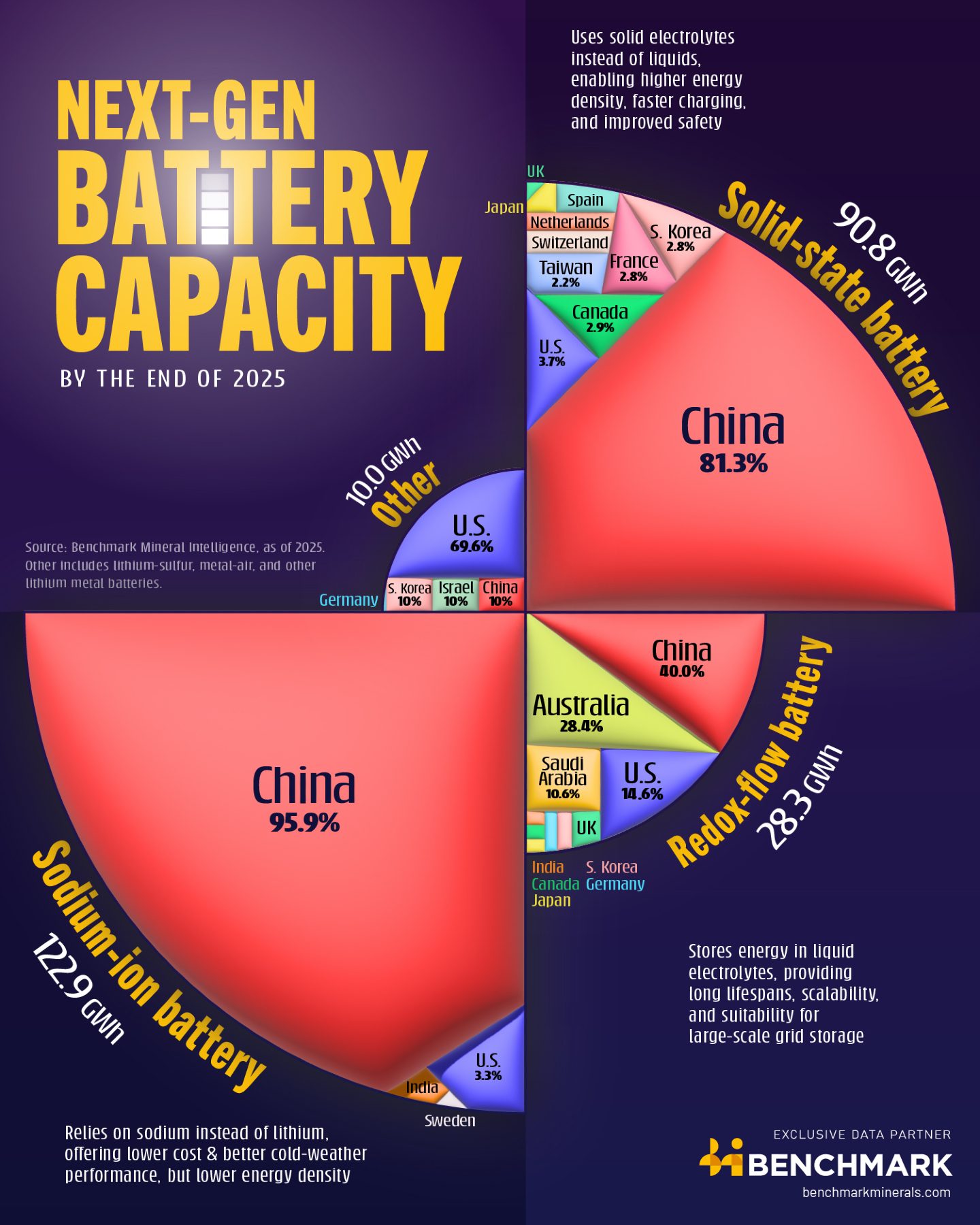
By 2025, the projected global capacity for sodium-ion batteries is expected to reach 123 GWh. This is a significant milestone, given their relatively recent emergence in the market. China is poised to lead the way, accounting for 95.9% of the global capacity, illustrating the country's dominance in the battery production sector.
Redox-Flow Batteries
Redox-flow batteries are particularly well-suited for large-scale energy storage applications. They store energy in liquid electrolytes, providing long lifespans, scalability, and suitability for grid storage. These attributes make them ideal for renewable energy integration and grid stabilization.
The projected global capacity for redox-flow batteries is 28.3 GWh by 2025. China, with a 40.0% share, is once again leading the charge. Other significant contributors include Japan, the United States, and various European countries, each with varying capacities in the low single-digit percentages.
Solid-State Batteries
Solid-state batteries represent a leap forward in battery technology, offering higher energy density, faster charging times, and improved safety. They use solid electrolytes instead of liquid, eliminating the risk of leaks and fires. Although still in development, they have the potential to revolutionize industries such as electric vehicles and portable electronics.
Solid-state batteries are projected to have a capacity of 90.8 GWh by 2025, with China accounting for 81.3% of the global production. The United States and other countries are also investing in this technology, but China's lead is unmistakable.
Geographic Distribution
China's dominance in battery production is evident across all three technologies. By 2025, China is projected to account for 95.9% of sodium-ion battery capacity, 40.0% of redox-flow battery capacity, and 81.3% of solid-state battery capacity. This dominance underscores China's strategic focus on battery technology as a cornerstone of its energy and economic policies.
Other countries are also making significant strides. The United States, for example, is expected to account for 69.6% of solid-state battery capacity, while Japan, Germany, and various other countries contribute to the overall global capacity with varying percentages.
Practical Tips
Investing in Battery Technology
For investors looking to capitalize on the battery technology boom, focusing on sodium-ion and solid-state batteries may yield the highest returns. These technologies offer clear market advantages and are expected to see rapid growth in capacity.
Policy and Regulatory Considerations
Policymakers should prioritize research and development in battery technologies, particularly in solid-state and redox-flow batteries. Government support can drive innovation, create jobs, and enhance energy security. Additionally, incentives for domestic production and investment in renewable energy integration are essential for long-term sustainability.
Strategic Partnerships
Companies and countries should consider strategic partnerships to leverage expertise and resources. Collaborations between leading battery producers, technology firms, and research institutions can accelerate the development and deployment of next-generation batteries.
Important Takeaways
China's Dominance
China's lead in battery production is undeniable, with a projected 95.9% share of sodium-ion, 40.0% of redox-flow, and 81.3% of solid-state battery capacities. This dominance is driven by significant investments in research, manufacturing, and infrastructure.
Technological Diversification
The battery landscape is diversifying, with sodium-ion, redox-flow, and solid-state technologies each offering unique advantages. This diversification is essential for meeting various energy storage needs, from portable electronics to large-scale grid storage.
Global Participation
While China leads, other countries, including the United States, Japan, and several European nations, are also making significant strides. Global participation in battery technology development and production will be crucial for sustaining innovation and meeting future energy demands.
Conclusion
The future of energy storage is poised for significant growth, with next-generation battery technologies playing a pivotal role. Sodium-ion, redox-flow, and solid-state batteries each offer unique advantages and are expected to see substantial capacity increases by 2025. China's dominance in this sector is evident, but global participation and strategic partnerships will be essential for driving innovation and meeting future energy needs. Understanding the projected capacities and geographic distributions of these technologies will provide valuable insights for investors, policymakers, and energy professionals.
Watch the Reel
Questions readers ask
What makes sodium-ion batteries a significant area of focus for China's battery technology advancements?
Sodium-ion batteries are a key focus for China due to their potential for lower costs and improved safety compared to traditional lithium-ion batteries. China's abundant sodium resources make these batteries a strategic choice, and by 2025, the country is projected to have 123 GWh in sodium-ion capacity, showcasing its leadership in this technological area.
How does China plan to lead the global battery market by 2025?
China is investing heavily in next-generation battery technologies, including sodium-ion, redox-flow, and solid-state batteries. With substantial government support and a strong domestic supply chain, China aims to dominate the global market, with significant capacities in these advanced battery types by 2025.
What are the key advantages of redox-flow batteries, and why is China investing in this technology?
Redox-flow batteries offer long cycle life, scalability, and the ability to decouple power from energy. China is investing in this technology to enhance its energy storage capabilities, particularly for large-scale renewable energy integration and grid stabilization.
How does China's current lithium-ion battery production compare to its next-gen battery technologies?
China is already a global leader in lithium-ion battery production, but it is rapidly expanding its capabilities in next-gen battery technologies. By 2025, China's next-gen battery capacities are expected to significantly increase, with sodium-ion batteries leading the charge, while solid-state and redox-flow batteries also gaining prominence.
Why is solid-state battery technology important for China's future in the battery market?
Solid-state batteries promise higher energy densities, improved safety, and faster charging times. China's investment in this technology aims to secure its position at the forefront of battery innovation, ensuring it remains competitive in the global market as demand for advanced energy storage solutions continues to grow.
What role does the Chinese government play in the country's battery technology advancements?
The Chinese government provides substantial support for the development and production of next-gen battery technologies. This includes funding research initiatives, offering incentives for domestic production, and implementing policies that favor the adoption of advanced energy storage solutions. Such support is crucial for China's goal to lead the global battery market by 2025.
What are the projected capacities for China's next-gen battery technologies by 2025, and how does this compare to the rest of the world?
By 2025, China is projected to have significant capacities in next-gen battery technologies, with 123 GWh in sodium-ion capacity alone. This places China at the forefront of global battery production, outpacing other regions in terms of both quantity and technological advancement. The country's dominance in the battery market is expected to continue to grow.
Related deep dives
Similar reads based on topic and creator.


Recent articles
Fresh deep dives from the latest Reels we unpacked.




Comments
Be the first to comment.