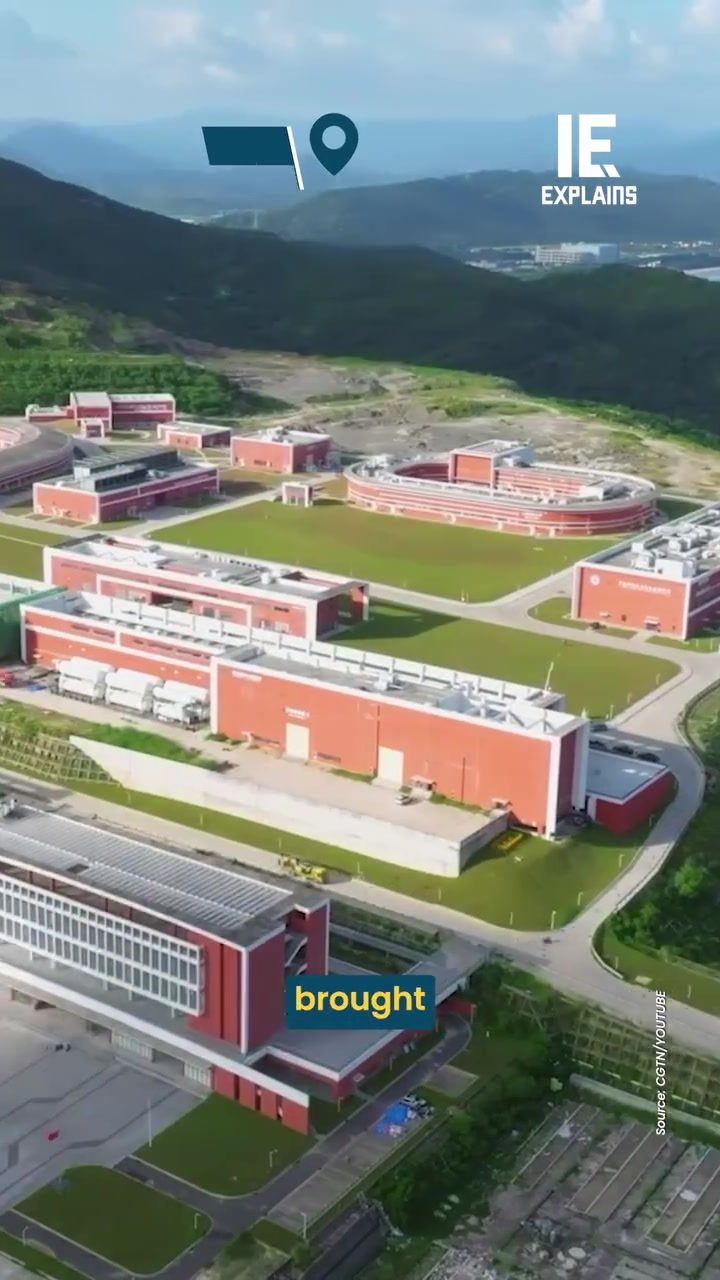
China's Linear Accelerator
China has brought online a record-breaking particle accelerator that can produce the world's most intense beams of charged atoms. The High-Intensity Heavy Ion Accelerator Facility (HIAF) in Huizhou, southern China, represents a significant advancement in scientific research. Situated in Huizhou, Guangdong province, this 2.6 billion yuan (about 384.1 million US dollars) facility marks a new era in particle acceleration technology.
Context / Why this matters
The construction of HIAF began in 2010 and spanned over 16 years. Researchers at the Institute of Modern Physics in Lanzhou, Gansu, and their collaborators developed the facility. This massive project combines a 100-meter long linear accelerator, a 570-meter circumference circular accelerator, and storage rings into a single complex, making it a state-of-the-art scientific facility.
Main discussion
The Significance of HIAF
HIAF is designed to produce the world's most intense beams of charged atoms, which is a groundbreaking achievement in the field of particle acceleration. The facility can pack up to eight times as many atoms into each pulse compared to the previous world record set by a German particle accelerator in Darmstadt. This is a significant milestone, emphasizing the intensity and precision of the facility.
Technical Specifications
The machine's capabilities are remarkable. It can beat the world record three times over for oxygen and seven and a half times for bismuth. The magnets in HIAF ramp at an impressive 12 Tesla per second, operating inside a vacuum as empty as the surface of the moon. This ensures that the particles can travel without interference, maintaining the highest possible intensity.
The Importance of Intensity
The primary focus of HIAF is intensity. By increasing the number of atoms in each pulse, researchers can achieve more precise and detailed observations. This intensity is crucial for various scientific experiments, including those in nuclear physics, materials science, and astrophysics. The ability to generate such intense beams opens new avenues for research and discovery.
The Development and Construction
Constructing HIAF was a monumental task that involved numerous researchers and collaborators. The facility's design combines a linear accelerator, a circular accelerator, and storage rings, each playing a crucial role in the overall functionality. The linear accelerator accelerates the particles to high speeds, while the circular accelerator and storage rings help maintain and control the particle beams.
The facility was constructed in Huizhou, a city in Guangdong province, chosen for its strategic location and resources. The project cost 2.6 billion yuan (approximately 384.1 million US dollars), reflecting the significant investment in scientific infrastructure.
Future Applications
The potential applications of HIAF are vast and varied. Researchers can use the facility to study fundamental questions in physics, such as the structure of matter and the forces that hold it together. Additionally, the intense beams of charged atoms can be used to create new materials with unique properties, advancing fields like materials science and nanotechnology.
Practical tips
If you are involved in scientific research, particularly in particle physics, you might find the following tips useful:
- Leveraging Advanced Technology: Utilize cutting-edge technology and facilities, such as HIAF, to enhance the precision and scope of your experiments.
- Collaboration: Collaborate with other researchers and institutions to pool resources and expertise, much like the team behind HIAF did.
- Funding: Secure significant funding for long-term projects that have the potential to yield groundbreaking results.
Important takeaways
- HIAF represents a significant advancement in particle acceleration technology, capable of producing the world's most intense beams of charged atoms.
- The facility's design combines a linear accelerator, a circular accelerator, and storage rings, each playing a crucial role in maintaining and controlling the particle beams.
- The primary focus of HIAF is intensity, which is crucial for various scientific experiments and research.
- The construction of HIAF involved numerous researchers and collaborators, reflecting the importance of collaboration in scientific research.
Conclusion
The High-Intensity Heavy Ion Accelerator Facility (HIAF) in Huizhou, China, is a testament to human ingenuity and the relentless pursuit of scientific knowledge. With its unparalleled intensity and precision, HIAF opens new frontiers in particle physics and related fields. As researchers continue to explore the capabilities of this remarkable facility, the world can expect groundbreaking discoveries and innovations that will shape the future of science.
Watch the Reel
Questions readers ask
What makes China's HIAF the most powerful particle accelerator in the world?
China's High-Intensity Heavy Ion Accelerator Facility (HIAF) is the most powerful due to its unprecedented beam intensity, which is up to 8 times higher than any previous particle accelerator. This intensity allows for more precise and detailed observations in scientific research.
Where is the HIAF facility located and who developed it?
The HIAF facility is located in Huizhou, Guangdong province, in southern China. It was developed by researchers at the Institute of Modern Physics in Lanzhou, Gansu, along with their collaborators, with construction beginning in 2010.
What components make up the HIAF facility?
The HIAF facility comprises a 100-meter long linear accelerator and a 570-meter circumference circular accelerator, along with a storage ring. These components work together to accelerate and maintain the intensity of the particle beams.
What is the cost of the HIAF facility?
The HIAF facility cost approximately 2.6 billion yuan to construct, which is roughly 384.1 million US dollars.
What advantages does the HIAF facility offer for scientific research?
The HIAF facility enables researchers to conduct more precise and detailed observations across various scientific fields due to its high beam intensity. This allows for deeper insights and potentially groundbreaking discoveries.
How does the HIAF facility compare to other particle accelerators?
The HIAF facility surpasses other particle accelerators in terms of beam intensity, making it the most powerful in the world. Its advanced technology and design allow it to produce more intense beams of charged atoms, enhancing its capabilities for scientific research.
Related deep dives
Similar reads based on topic and creator.



Recent articles
Fresh deep dives from the latest Reels we unpacked.




Comments
Be the first to comment.