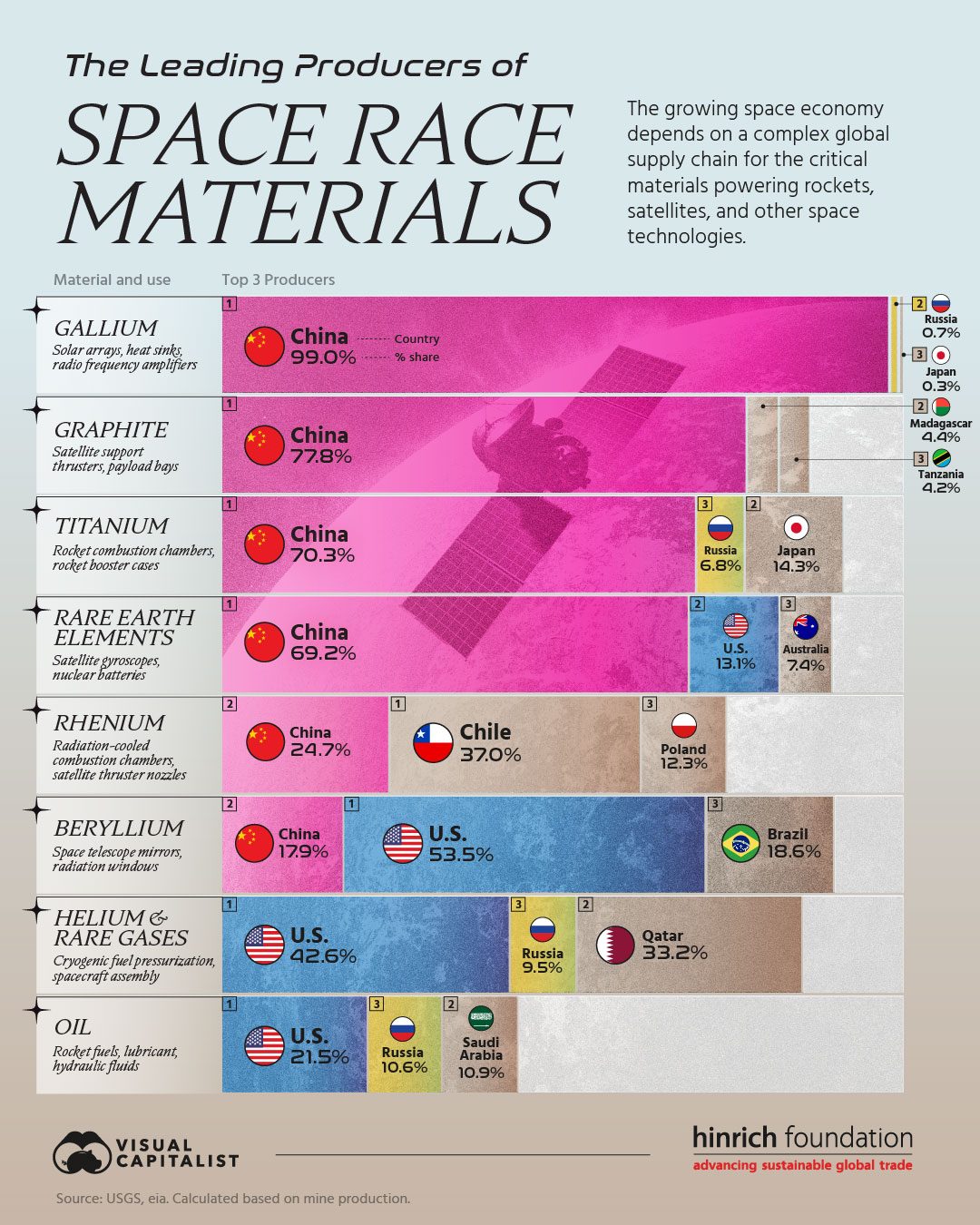
The Space Race: Key Materials and Their Suppliers
The modern space race is driven by a complex web of materials, each crucial for powering rockets, satellites, and other advanced technologies. The supply chain for these materials is a strategic and intricate network. The supply chain is dominated by a few key countries, with China leading the production of several essential materials.
Context / Why this matters
The materials powering the space race are not just about technology; they are about geopolitics and economic strategy. The countries that control the supply of these materials hold significant influence over the global space industry. Understanding the landscape of these key materials and their producers is essential for grasping the dynamics of the modern space race.
Main discussion
The Key Materials
The modern space race relies on eight key materials:
- Gallium: A critical component in semiconductor technology, particularly in the production of integrated circuits used in spacecraft and satellites.
- Rare Earth Elements (REEs): Essential for various technologies, including permanent magnets used in electric motors and electronics.
- Graphite: Used in the production of heat shields, fuel cells, and various structural components.
- Titanium: Valued for its strength-to-weight ratio, making it ideal for aerospace and defense applications.
- Rhenium: A key component in high-temperature superconductors and catalysts.
- Beryllium: Used in X-ray equipment and as an alloying agent in copper to create beryllium copper, which has excellent thermal conductivity and is used in heat sinks for electronics.
- Helium & Rare Gases: Essential for cooling superconducting magnets and other critical components.
- Oil: As a primary energy source, essential for fueling rockets and powering space infrastructure.
The Leading Producers
China: Dominant in Multiple Materials
China is the dominant producer of four out of the eight key materials: Gallium, Rare Earth Elements, Graphite, and Titanium. This dominance positions China as a pivotal player in the global space race, influencing everything from satellite technology to rocket propulsion.
- Gallium: China's dominance in Gallium production is crucial for semiconductor technology, which is vital for the electronics used in space missions.
- Rare Earth Elements: China controls a significant portion of the global supply of REEs, making it a key player in the production of advanced technologies that rely on these elements.
- Graphite: China's lead in Graphite production is essential for the aerospace industry, where Graphite is used in heat shields and fuel cells.
- Titanium: China's production of Titanium is critical for aerospace and defense applications, where the material's strength and light weight are highly valued.
The United States: Key Producer of Critical Resources
The United States is a significant producer of Helium & Rare Gases and Oil, both of which are vital for space technologies.
- Helium & Rare Gases: The U.S. is a leading producer of Helium, which is used to cool superconducting magnets and other critical components in space technologies.
- Oil: As the primary energy source, oil is essential for fueling rockets and powering space infrastructure. The U.S. plays a significant role in the global oil market, making it a crucial player in the space race.
Russia and Japan: Contributors to the Space Race
Russia and Japan are also involved in the production of key materials, particularly Titanium, adding to the global supply chain's complexity.
Practical tips
To better understand the dynamics of the space race, consider the following:
- Track Global Production: Stay updated on the production statistics and market trends for key materials like Gallium, Rare Earth Elements, and Titanium.
- Geopolitical Considerations: Understand the geopolitical implications of material production. The countries controlling these materials hold significant leverage in the space industry.
- Technological Innovations: Keep an eye on technological advancements that could reduce the reliance on certain materials or introduce new, more abundant resources.
Important takeaways
- China's Dominance: China's leadership in the production of key materials like Gallium, Rare Earth Elements, Graphite, and Titanium makes it a central figure in the space race.
- U.S. Influence: The United States' production of Helium & Rare Gases and Oil positions it as a critical player in the space industry.
- Global Supply Chain: The complex supply chain involves multiple countries, each contributing to the production of essential materials. This interdependence highlights the strategic importance of material production in the space race.
Conclusion
The materials powering the modern space race are not just technological necessities; they are geopolitical assets. The countries leading in the production of these materials hold significant influence over the global space industry. Understanding the landscape of these key materials and their suppliers is essential for anyone interested in the future of space exploration and technology. As the space race continues, the dynamics of material production and supply will remain a critical aspect of global strategy and innovation.
Watch the Reel
Questions readers ask
Why is China considered a key player in the modern space race?
China is a key player in the modern space race due to its dominance in the production of several crucial materials. These include gallium, rare earth elements, graphite, and titanium, which are essential for powering rockets, satellites, and other advanced technologies.
Which materials produced by China are particularly important for the space industry?
China's production of rare earth elements, gallium, graphite, and titanium is particularly important for the space industry. These materials are used in various space technologies, from powering rockets to manufacturing satellites.
How does China's dominance in specific materials influence the global space industry?
China's dominance in the production of these materials gives it significant influence over the global space industry. Countries and companies reliant on these materials for their space programs must navigate China's policies and supply chains, making it a pivotal player in geopolitical and economic strategies.
What role does gallium play in space technology?
Gallium is a vital material in space technology, particularly in the production of semiconductors and solar cells. These components are crucial for the functioning of satellites and other space-based technologies, making gallium a key material in the space race.
Why are rare earth elements important in the production of rockets?
Rare earth elements are important in the production of rockets due to their unique properties. They are used in various components, including guidance systems, batteries, and fuel cells, making them indispensable for the performance and reliability of rockets.
How does China's graphite production contribute to the space race?
China's graphite production is significant for the space race because graphite is a key material in spacecraft batteries. It also serves as a crucial component in constructing high-strength, lightweight materials for rockets and satellites.
Related deep dives
Similar reads based on topic and creator.


Recent articles
Fresh deep dives from the latest Reels we unpacked.




Comments
Be the first to comment.