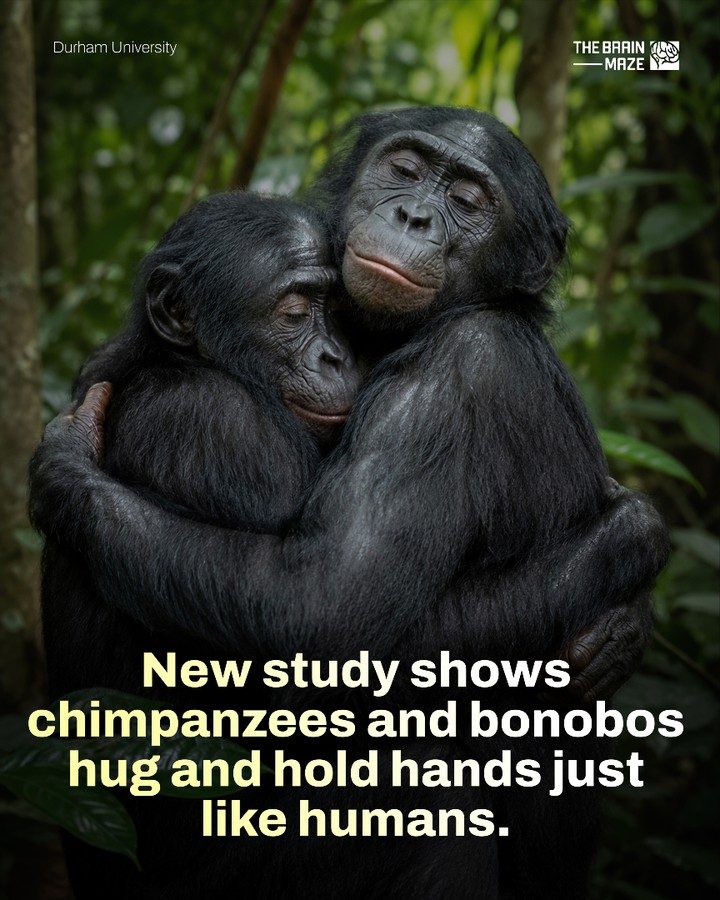
Chimpanzees and bonobos, our closest living relatives, share more with us than just genetic similarities. A recent study from Durham University reveals that these great apes use reassuring social touch in ways that are remarkably similar to humans. This includes behaviors such as hugging, hand-holding, and gentle contact, which help reduce tension, particularly before competition. These findings provide intriguing insights into the ancient evolutionary origins of empathy, cooperation, and social bonding.
Humans often underestimate the emotional depth of animals. Social touch, such as hugging and hand-holding, plays a crucial role in human relationships, providing comfort and reducing stress. The Durham University study suggests that chimpanzees and bonobos employ similar tactile gestures to achieve the same effects. This revelation not only highlights the emotional complexity of these animals but also offers a window into the evolutionary roots of human behavior.
Why This Matters
The study's findings are significant for several reasons. Firstly, they underscore the importance of social bonding in the evolution of primates. By demonstrating that these behaviors are present in our closest relatives, the study suggests that empathy and cooperation may have evolved much earlier than previously thought. Secondly, it challenges the notion that complex social behaviors are uniquely human, encouraging a more inclusive view of animal intelligence and emotion.
Main Discussion
Social Touch in Chimpanzees and Bonobos
The study from Durham University focuses on the social behaviors of chimpanzees and bonobos, two species known for their complex social structures. These apes exhibit a range of social behaviors, including grooming, hugging, and hand-holding, which serve to strengthen social bonds and reduce tension.
Reassuring Touch Before Competition
One of the most fascinating findings of the study is that these reassuring gestures are often used before competitions. Just like humans might seek comfort from a friend before a challenging task, chimpanzees and bonobos use social touch to calm themselves and their companions. This behavior, which is clearly intended to reduce stress and anxiety, suggests that these apes have a deep understanding of their own emotions and those of their peers. This level of emotional intelligence is rarely attributed to animals.
Evolutionary Origins of Empathy
The fact that chimpanzees and bonobos use social touch in ways similar to humans provides valuable insights into the evolutionary origins of empathy. Empathy—the ability to understand and share the feelings of another—is a critical aspect of human social bonding. The study's findings suggest that the roots of empathy may be much older than previously thought, with our primate ancestors already exhibiting behaviors that foster social cohesion and cooperation.
Practical Tips
Understanding Animal Behavior
For those interested in animal behavior, this study offers a new perspective on the emotional lives of primates. To better understand these behaviors, it's important to observe animals in their natural habitats and pay close attention to their social interactions. Look for signs of reassuring touch, such as hugging or grooming, and consider the context in which these behaviors occur. Are they used more frequently during times of stress or competition? Understanding these nuances can provide deeper insights into the emotional complexity of these animals.
Applying to Human Interactions
Recognizing the importance of social touch in our closest relatives can also enhance our understanding of human interactions. Whether it's a comforting hug from a friend or a reassuring pat on the back from a colleague, these physical expressions of support play a crucial role in our social lives. By understanding the evolutionary origins of these behaviors, we can appreciate their significance and perhaps even improve our own social interactions.
Important Takeaways
- Similar Behaviors: Chimpanzees and bonobos use reassuring social touch, such as hugging and hand-holding, in ways that are similar to humans.
- Stress Reduction: These behaviors help reduce tension, particularly before competitions, suggesting a deep emotional understanding.
- Evolutionary Insights: The study highlights the ancient evolutionary origins of empathy, cooperation, and social bonding, suggesting these traits may be much older than previously thought.
Conclusion
The study from Durham University provides a fascinating new perspective on the emotional lives of chimpanzees and bonobos. By highlighting their use of reassuring social touch, the study not only deepens our understanding of these remarkable animals but also offers insights into our own human behaviors. Whether you're a primatologist, an animal behaviorist, or simply someone interested in the deeper aspects of social interactions, these findings are bound to be of great interest. As we continue to explore the emotional and social lives of our closest relatives, we may uncover even more about ourselves and the nature of empathy, cooperation, and social bonding.
Watch the Reel
Questions readers ask
What are some ways chimpanzees and bonobos use social touch?
Chimpanzees and bonobos use social touch to bond and reduce stress, much like humans. They engage in behaviors such as hugging, hand-holding, and gentle physical contact. These gestures are often observed before challenging events or competitions, helping to create a sense of unity and reassurance.
Why is the Durham University study significant?
The Durham University study is significant because it highlights the similarities between human and ape behavior. By showing that chimpanzees and bonobos use comforting physical interactions, the study provides a glimpse into the evolutionary roots of empathy, cooperation, and social bonding in humans and apes.
How do chimpanzees and bonobos use social touch differently from humans?
While both humans and apes use social touch for comfort and bonding, the study from Durham University shows that chimpanzees and bonobos use these tactile gestures in specific situations, such as before challenging events or competitions. This suggests that the contexts in which social touch is used may differ between humans and apes, even though the basic behaviors are similar.
What can the social touch behaviors of chimpanzees and bonobos tell us about human behavior?
The social touch behaviors observed in chimpanzees and bonobos offer insights into the ancient roots of human behavior. By recognizing that these great apes use similar comforting gestures, we can infer that the foundations of empathy, cooperation, and social bonding have been present in human ancestors for a very long time.
What is the role of social touch in ape societies?
Social touch in ape societies, as demonstrated by the Durham University study, serves as a crucial mechanism for maintaining social cohesion and reducing tension. When chimpanzees and bonobos engage in behaviors like hugging and hand-holding, they are actively strengthening their social bonds and preparing themselves for potential challenges.
Are there any differences in social touch behaviors between chimpanzees and bonobos?
While both species engage in social touch, there might be nuances in how they express these behaviors. For instance, bonobos are known for their more peaceful and egalitarian society, and their social touch behaviors might reflect this, with a strong emphasis on conflict resolution and cooperation. Chimpanzees, on the other hand, might use these gestures in a more hierarchical context, especially around competition.
Related deep dives
Similar reads based on topic and creator.




Recent articles
Fresh deep dives from the latest Reels we unpacked.




Comments
Be the first to comment.