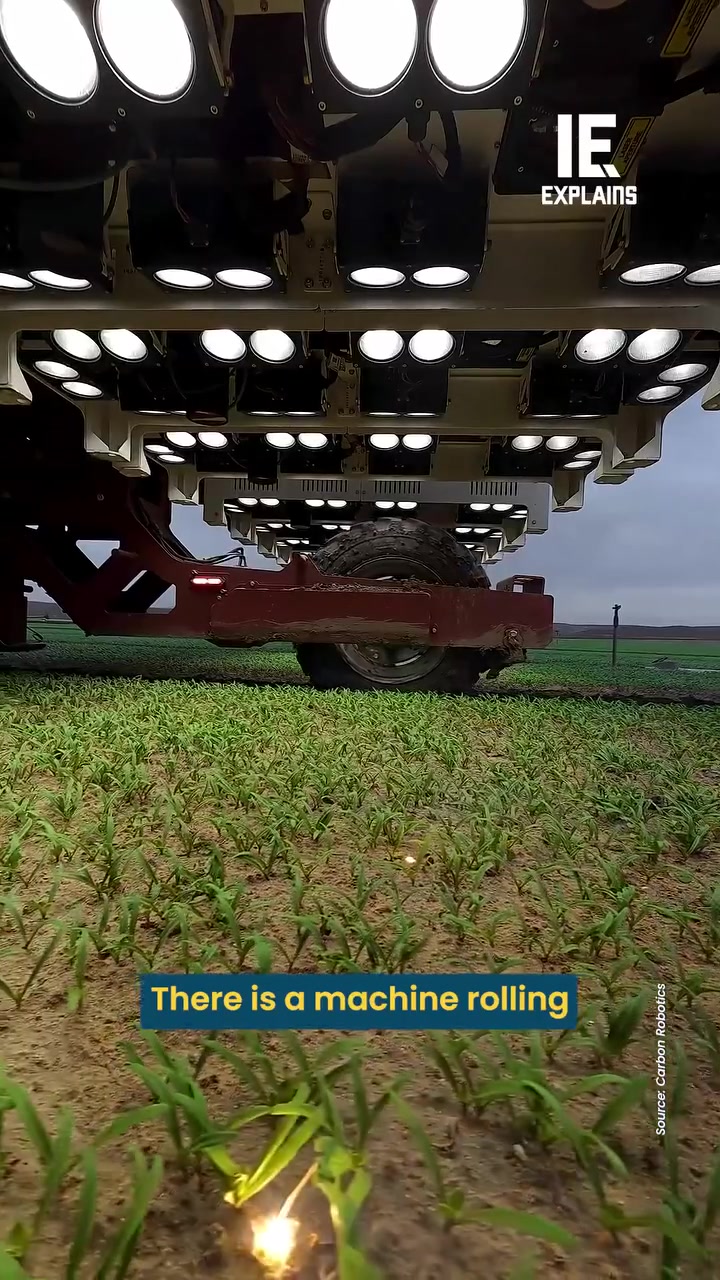
Farmers across the globe are employing a new ally in the age-old battle against weeds: an AI- powered laser that is redefining weed control. It's Carbon Robotics Laser Weeder G2 that has been deployed to more than 100 farms across 15 countries.
How Machine Lasers are Mowing Through Farm Weeds
Lasers have long been known for their precision. This has translated into a effective and sustainable alternative to chemical pesticides and manual removal. The Laser Weeder G2, a machine designed by Carbon Robotics, targets and kills weeds with diode lasers. Attached to a tractor, it rolls through fields, scanning the plants below with LED lights. The Weeder G2 is more than just a laser gun on wheels. Machine learning is the core of the system. NVIDIA chips power the AI, which scans the plants at a rapid pace and identifies whether the plant is a crop or weed. If the guilty one was identified, it gets a 240-watt laser shot. Environmentalists and weed management alike should find this appealing. It kills weeds by boiling the water inside their cells, topping them off at the root. The laser's effectiveness is impressive, as nothing touches the ground as weeds are targeted with sub-millimeter accuracy killing up to 99% of weeds. Best of all, it's dramatically reducing the amount of labor and money farmers spend on herbicides. Labor bills have been cut by up to 80%
The Laser Revolution
Tech has been gradually making its way onto farms for decades. GPS-guided planting, drone surveillance, and automated irrigation. But the laser weeder represents a new era of precision agriculture. The impact is what makes this laser tech stand out. Forget the water and chemical runoff, and the possibility of poisoned pesticides getting into your food. Light is the active ingredient here, as the Laser Weeder G2 shoots out a 240-watt diode laser to penetrate the mercury of the plant. Water molecules boil and the weed dies. This surfacing technology allows farmers to stay on top of weeds even when there are labor shortages or problems with herbicide resistance. They can also avoid herbicides, which can hurt the land and their long-term profits. In February 2024, Carbon Robotics announced that they released a large plant model trained on over 150 million labeled plants. This means that the program can now learn to recognize new plants in a matter of seconds.
Relabeling to roll out
Previously, it took around a day to relabel a new weed. This created barriers, as it would require hand labeling and a large amount of data. This is where this small step is a major leap for agriculture. It is now possible for a farmer to point at a plant in the app and the machine will know how to handle it. Farmers can now easily add weeds to the AI database, allowing it to recognize and target new weeds.
Laser Accuracy
Lasers target the growth point of the plant, meaning weeds can be eliminated with enough precision to not harm neighboring plants or soil quality This allows for undisturbed soil and root systems, while also targeting high uptick weeding.
Laser Transformation
This laser-weeding technology is a game-changer for farmers. According to Carbon Robotics, the device can cut weed control costs by up to 80%. The range of sizes available (from 8 feet to 40 feet) makes it accessible to a wide range of farms, not just the mega-farms. Farmers have already seen significant labor cost reductions—one US grower reported his labor bill dropping from $700,000 to about $300,000 after utilizing the laser weeding.
Field to App
The technology is not confined to the fields. Farmers can interact with the machine through an app. Previously, it was necessary to manually correct large quantities of new weeds to the data set. This has been reduced to nothing but a few taps and swipes on the app. It's not just about speed, though. This app means that farmers can directly engage in the training of AI. They can share best practices that will be useful for other users. The power is in the hands of those who really understand the habits of the weeds.
Field experiences
The AI requires training and the training is done by the farmers using the Laser Weeder G2. This additional step to the farmer’s day is actually saving them a lot of time in the future by making the system more accurate. Farmers are now 100% responsible for the training of AI on their farm. This means the system is even better tailored to their specific field, weeds, and crops.
The Plant Database
The AI system in the Laser Weeder G2 is supported by a database of already recognized plants. Farmers continue to update and grow the database with new information. How does the AI know if a plant is a crop or weed? It's trained on a database of over 150 million labeled plants. Now farmers can add and categorize new weeds to a shared database using the app.
What farmers see on their field
With the cost of labor on the rise, many farmers are seeking new ways to manage the weeds on their land. The Laser Weeder G2 is one of those solutions. Farmers can now customize and improve the AI system. When the farmer points the Laser Weeder G2 system to a new weed, it will learn from this experience. This is a crucial addition, as weeds can mutate and change over time, and farmers need a system that is as adaptable as the weeds are. When it comes to weed control, the future is light. As the Laser Weeder G2 continues to evolve, it will be a valuable piece of equipment for farmers looking to save money, reduce labor, and minimize their environmental impact. As the tech and the database become more sophisticated, so will the potential of the Laser Weeder G2.
Watch the Reel
Questions readers ask
How does the Laser Weeder G2 differentiate between crops and weeds?
The Laser Weeder G2 uses AI powered by NVIDIA chips to scan plants. It identifies whether a plant is a crop or a weed by analyzing the plant's characteristics. The system is trained on a vast database of labeled plants.
Can the Laser Weeder G2 be used on any type of farm?
The Laser Weeder G2 has been deployed to over 100 farms across 15 countries, suggesting it has a wide range of applicability. However, the specific crops and weeds it can handle will depend on the AI's training data.
How does the laser actually kill the weeds?
The laser targets the weed with a 240-watt diode laser shot, which boils the water inside the weed's cells. The weed dies as a result of the internal boiling.
What is the benefit of using the Laser Weeder G2 over traditional herbicides?
The Laser Weeder G2 offers several benefits over traditional herbicides. It reduces the need for chemical pesticides, which can be harmful to the environment and potentially end up in food. It also reduces labor costs by up to 80% and addresses issues with herbicide resistance.
How accurate is the Laser Weeder G2 in targeting weeds?
The Laser Weeder G2 is highly accurate, targeting weeds with sub-millimeter precision. This means it can kill up to 99% of weeds without harming neighboring plants or soil quality.
Can farmers easily add new weeds to the AI database for the Laser Weeder G2 to recognize?
Yes, farmers can now point at a plant in the app and the machine will know how to handle it. This means that the AI can learn to recognize and target new weeds in a matter of seconds, making it much easier for farmers to adapt to new weed types.
Related deep dives
Similar reads based on topic and creator.


Recent articles
Fresh deep dives from the latest Reels we unpacked.


Comments
Be the first to comment.