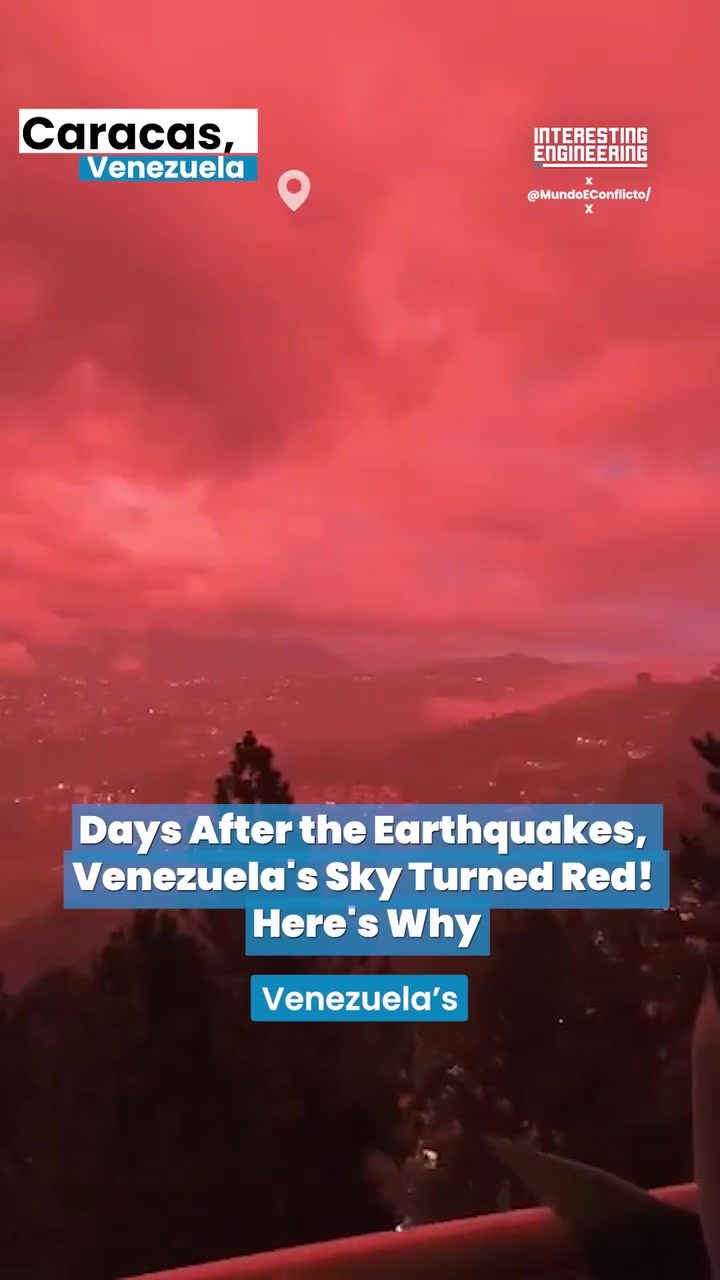
The Blood-Red Sky Over Caracas: Atmospheric Physics or Earthquake Aftermath?
Days after Venezuela's devastating earthquakes, the sky over Caracas turned a dramatic blood-red, sparking widespread speculation online. Many people linked this unusual phenomenon to the recent seismic activity, but scientists have provided a different explanation. This dramatic display was not a direct result of the earthquakes, but rather a consequence of normal atmospheric physics.
Why This Matters
Understanding the natural phenomena behind such dramatic events is crucial for distinguishing between causes and effects, particularly in regions prone to both natural disasters and atmospheric anomalies. The coincidence of a vivid red sky following an earthquake can lead to misinterpretation and fear, but scientific explanations help alleviate these concerns. The phenomenon also highlights the importance of scientific literacy in understanding and interpreting natural events.
The Science Behind the Red Sky
Atmospheric Scattering and Saharan Dust
The vivid red hue over Caracas can be attributed to a combination of factors, primarily atmospheric scattering and the presence of Saharan dust. When the sun is at a low angle, as it is during sunrise or sunset, its light passes through more of the Earth's atmosphere. This longer path causes shorter wavelength light (like blue and green) to be scattered out of our direct line of sight, a phenomenon known as Rayleigh scattering. This leaves the longer wavelengths, like red and orange, which are then more visible to us.
Rayleigh Scattering
Rayleigh scattering is a fundamental concept in atmospheric optics. It explains why the sky appears blue during the day and why sunsets and sunrises often have warm, red hues. The scattering of light by molecules in the atmosphere is more pronounced for shorter wavelengths, which is why blue light is scattered in all directions, making the sky appear blue. Conversely, during sunrise or sunset, the red and orange wavelengths dominate because they are scattered less and travel a longer path through the atmosphere.
Saharan Dust and Airborne Particles
The presence of Saharan dust and other airborne particles further intensified the red hues. These particles, which can travel thousands of miles, act as additional scattering agents. They reflect and scatter the sunlight, enhancing the red and orange colors. This effect is often more noticeable in regions downwind of deserts, where the dust can be particularly dense.
The Role of the Earthquake
While the timing of the red sky was striking and coincidental, experts confirmed that the vivid sunset had no direct connection to the earthquakes. Earthquakes do not have the ability to alter atmospheric conditions to such an extent that they cause dramatic changes in sky color. The seismic activity and the atmospheric phenomenon were simply coincidental events that occurred around the same time.
Practical Tips for Understanding Atmospheric Phenomena
Stay Informed with Reliable Sources
When unusual natural phenomena occur, it's essential to rely on scientific explanations rather than speculation. Sources like Interesting Engineering, MundoConflicto, RT.com, and BGatesIsPsycho provide valuable insights and analyses based on scientific principles. These sources help to debunk myths and provide accurate information. Always check multiple reliable sources to verify the explanations.
Use Scientific Tools and Resources
To better understand atmospheric phenomena, consider using scientific tools and resources. There are numerous apps and websites that provide real-time data on atmospheric conditions, including air quality, dust levels, and weather patterns. These tools can help you interpret what you're seeing and provide context for unusual events.
Share and Discuss with Others
Engaging in discussions with others can help clarify misunderstandings and reinforce accurate information. Sharing reliable sources and scientific explanations with friends, family, and community members can foster a better understanding of natural phenomena. Online forums, social media groups, and local community meetings are excellent platforms for these discussions.
Important Takeaways
Understanding the natural phenomena behind the dramatic red sky in Caracas underscores the importance of scientific literacy and reliable information. The red sky over Caracas was a result of normal atmospheric physics, enhanced by Saharan dust and low-angle sunlight, rather than a direct consequence of the earthquakes. This understanding helps to differentiate between natural atmospheric conditions and seismic events, providing clarity and context for these phenomena.
Conclusion
The blood-red sky over Caracas following the earthquakes serves as a reminder of the intricate interplay between atmospheric conditions and natural disasters. By understanding the science behind such phenomena, we can better interpret and contextualize these events, avoiding misinterpretations and fears. Staying informed with reliable sources, using scientific tools, and engaging in discussions can enhance our understanding and appreciation of natural phenomena.
Watch the Reel
Questions readers ask
What caused the red sky over Caracas after the earthquakes?
The red sky over Caracas was not caused by the earthquakes themselves. It was a result of atmospheric scattering, where dust and particles in the atmosphere scatter sunlight, causing the sky to appear red. This is a normal phenomenon and can be observed in other locations with similar atmospheric conditions.
Is it true that the red sky was an aftereffect of the earthquakes?
No, the red sky in Caracas was not a direct effect of the earthquakes. It was simply a coincidental occurrence. The earthquakes did not cause the red sky, but the timing led many people to associate the two events.
Why did the red sky over Caracas look 'blood-red'?
The 'blood-red' appearance of the sky over Caracas can be attributed to the specific type of atmospheric scattering and the composition of the particles in the air. The scattering of sunlight by Saharan dust particles, which can be transported long distances, can create this vivid red color.
Are there other instances of this red sky phenomenon in the world?
Yes, the dramatic red sky phenomenon is not unique to Caracas. It can occur in other places around the world, especially in areas where atmospheric conditions are similar, such as regions with high levels of dust or other particles in the air. For example, this phenomenon has been observed in many desert regions and areas affected by volcanic eruptions.
How does atmospheric scattering cause the sky to appear red?
Atmospheric scattering is the process by which light is redirected by particles in the atmosphere. Shorter wavelengths of light (like blue and green) are scattered more widely, while longer wavelengths (like red and orange) are scattered less and can travel further, making the sky appear red, especially during sunrise or sunset.
Related deep dives
Similar reads based on topic and creator.
Recent articles
Fresh deep dives from the latest Reels we unpacked.




Comments
Be the first to comment.