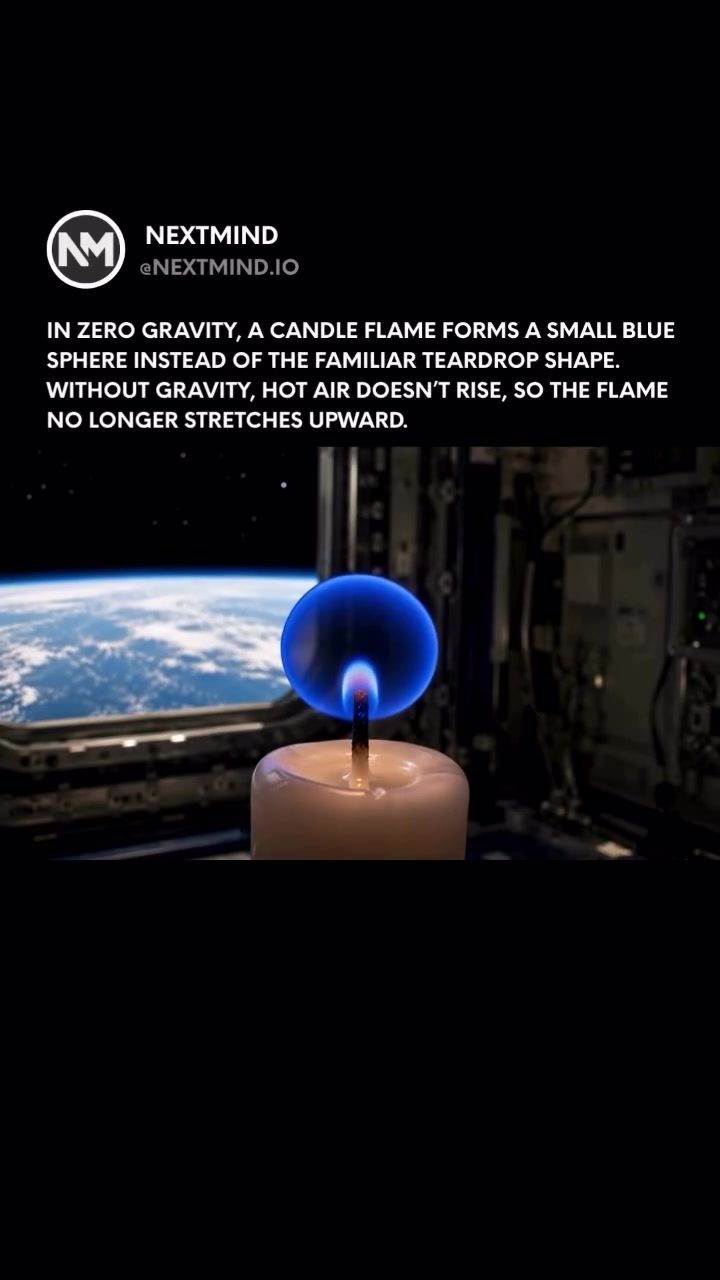
Candle Flames in Zero Gravity
In the vast expanse of space, where the rules of gravity no longer apply, a candle flame exhibits a behavior vastly different from what we observe on Earth. A typical candle flame on Earth forms a familiar teardrop shape, with hot air rising and cool air rushing in to replace it. However, in zero gravity, this familiar shape is altered, transforming into a small, blue sphere.
Why This Matters
Understanding how flames behave in different environments, such as zero gravity, has significant implications for various fields, including space exploration, fire safety in space habitats, and even combustion science. The differences in flame behavior can influence the design of life support systems, propulsion technologies, and safety protocols for astronauts. By studying these phenomena, researchers can develop more efficient and safer technologies for space travel and habitation.
Main Discussion
The Science Behind Flame Behavior
On Earth, the teardrop shape of a candle flame is due to convection. Hot air rises because it is less dense than cool air. This rising hot air pulls in cooler air from the sides, creating a continuous cycle that shapes the flame. However, in the absence of gravity, this process does not occur in the same way.
Zero Gravity and Convection
In zero gravity, convection currents are greatly diminished. Without gravity, hot air does not rise, and cool air does not sink. This absence of convection means that the flame's shape is determined by other factors, primarily the diffusion of oxygen. In a microgravity environment, oxygen reaches the flame evenly from all directions, resulting in a more complete and efficient combustion process. This complete combustion leads to the formation of a small, blue sphere instead of the familiar teardrop shape.
The Role of Oxygen
The blue color of the flame in zero gravity is due to the more complete combustion process. Complete combustion occurs when there is an abundant supply of oxygen, allowing the flame to burn more efficiently. In contrast, incomplete combustion on Earth often results in soot and a yellow-orange flame. The even distribution of oxygen in zero gravity ensures that the candle burns with little to no soot, producing a calm, glowing blue orb.
Practical Applications and Implications
This unique behavior of flames in zero gravity has several practical applications. For instance, understanding how oxygen diffuses around a flame in microgravity can help in designing more efficient combustion systems for space propulsion. Additionally, it can inform the development of safer fire containment and extinguishing systems in space habitats, where traditional methods may not be effective.
Practical Tips
Experimenting with Zero Gravity
While conducting experiments in zero gravity is typically reserved for specialized labs or space missions, there are ways to simulate this environment on Earth. Parabolic flight, also known as a "vomit comet" flight, offers brief periods of microgravity. These flights are often used by researchers to study various phenomena in zero gravity, including combustion.
Simulating Zero Gravity at Home
For those interested in exploring zero gravity phenomena at home, there are simpler methods, though they won't provide true zero gravity. Dropping a candle from a height can create a brief moment of microgravity as it falls, allowing you to observe changes in the flame shape. However, this is a risky experiment and should only be attempted with proper safety measures.
Safety Precautions
When experimenting with fire in any environment, safety should always be a top priority. Ensure that all experiments are conducted in a well-ventilated area and that appropriate fire safety measures are in place. Always have a reliable fire extinguisher nearby and follow local regulations for handling flammable materials.
Important Takeaways
- In zero gravity, a candle flame forms a small, blue sphere due to the absence of convection currents and the even distribution of oxygen.
- The more complete combustion process in zero gravity results in a flame that burns without soot, creating a calm, glowing blue orb.
- Understanding flame behavior in zero gravity has significant implications for space exploration, fire safety, and combustion science.
- Simulating zero gravity can be done through parabolic flights or simple drop experiments, though the latter should be approached with caution.
Conclusion
The behavior of a candle flame in zero gravity highlights the profound differences in physical phenomena when gravity is absent. By understanding these differences, researchers can develop more efficient and safer technologies for space travel and habitation. Whether through controlled experiments in specialized labs or through simulations, exploring flame behavior in zero gravity offers valuable insights into the fundamental principles of combustion and convection.
Watch the Reel
Questions readers ask
Why does a candle flame become spherical in space?
In space, the absence of gravity means that hot gases from the flame do not rise and cool air does not rush in from the sides. This lack of convection causes the flame to form a roughly spherical shape.
How does a candle flame on Earth differ from one in space?
On Earth, a candle flame is teardrop-shaped due to the buoyant force of hot air rising. In space, the flame is small, blue, and spherical because there is no buoyancy to elongate the flame.
Why is studying candle flames in space important for safety?
Understanding how flames behave in microgravity is crucial for developing effective fire safety measures in space habitats. It helps in designing better safety protocols and life support systems for astronauts.
What color is a candle flame in zero gravity?
In zero gravity, a candle flame appears blue. This is due to the complete combustion of the fuel in the absence of gravity, which results in a more efficient burn.
How does microgravity affect combustion?
In microgravity, combustion is more efficient and slower due to the lack of buoyancy-driven convection. This results in a more complete burn and a different flame shape compared to combustion on Earth.
What practical applications does understanding space combustion have?
Understanding space combustion can aid in developing advanced propulsion technologies, improving fire safety in space habitats, and enhancing combustion processes on Earth.
Are there any experiments conducted on candle flames in space?
Yes, experiments such as the Space Candle Experiment have been conducted to observe and study the behavior of candle flames in microgravity, providing insights into combustion and fire safety in space.
Related deep dives
Similar reads based on topic and creator.




Recent articles
Fresh deep dives from the latest Reels we unpacked.




Comments
Be the first to comment.