Canada's Natural Resources
Canada's natural resources are a cornerstone of the country's economy, contributing significantly to its global standing. With a combined value of $1.7 trillion in 2023, these resources span a wide range of commodities, including minerals, energy, and forestry. This article explores Canada's most significant natural resource reserves, highlighting their importance and scale.
Context / Why this matters
Natural resources play a crucial role in Canada's economic landscape, driving investment, employment, and exports. Understanding the extent and value of these resources provides insight into the country's economic strength and its position in the global market. This knowledge is vital for policymakers, investors, and industry professionals alike, as it informs strategic decisions and long-term planning.
Canada's natural resource wealth is particularly notable in several key areas:
-
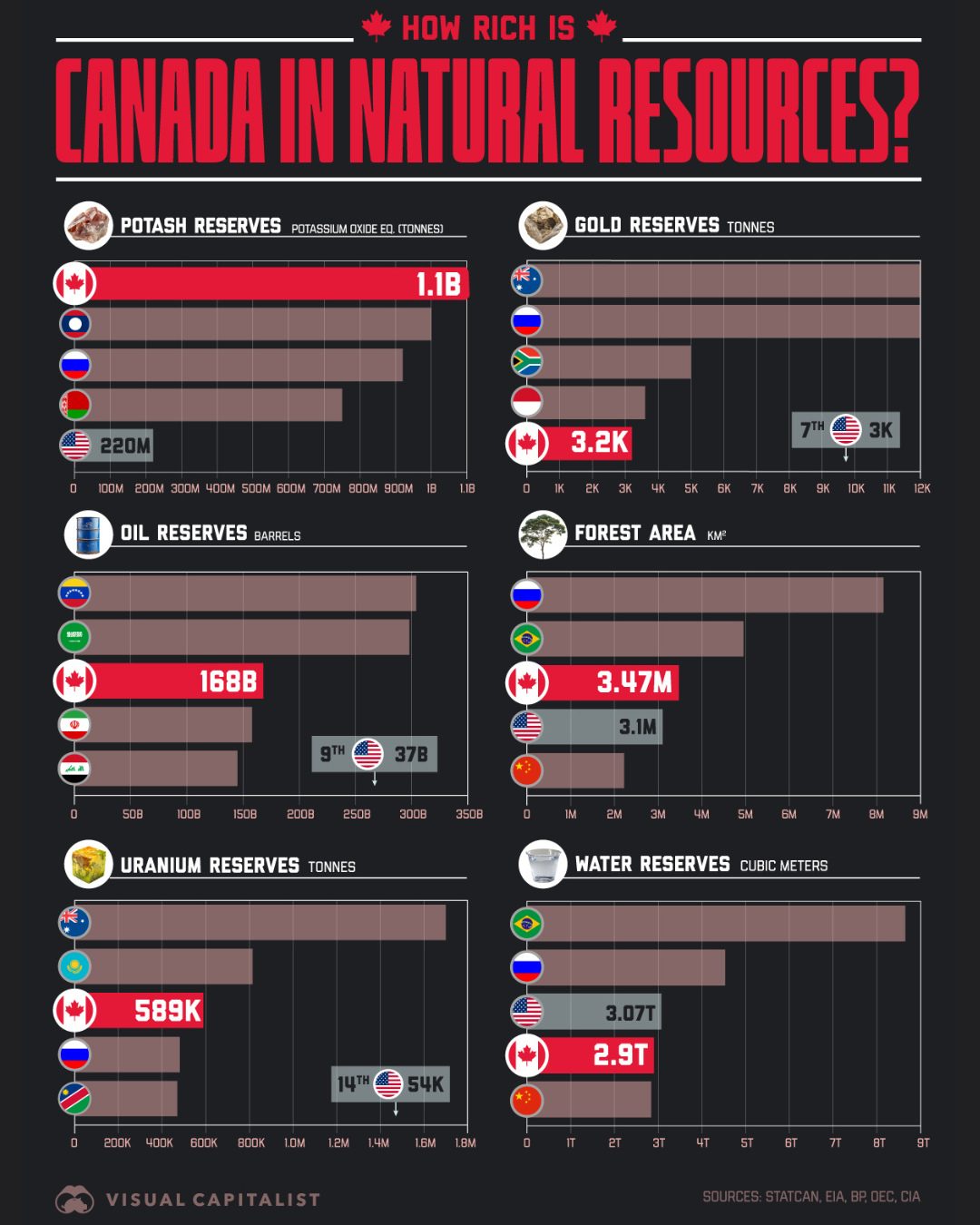
Potash: With significant potash reserves totaling 1.1 billion tonnes, Canada is a global leader in this essential mineral used in fertilizer production.
-
Forestry: Canada's forest area spans an impressive 3.1 million square kilometers, making it one of the world's largest forest reserves. This vast resource supports a thriving timber and pulp industry.
-
Oil: The country's oil reserves amount to 1,688 billion barrels, positioning Canada as a major player in the global energy market.
-
Uranium: Canada's uranium reserves stand at 589,000 tonnes, supporting its role as a key supplier in the nuclear energy sector.
-
Water: While specific data on water reserves is not provided, Canada is known for its abundant freshwater resources, which are critical for various industries and ecosystems.
Main discussion
Potash Reserves
Potash is a vital mineral used primarily in agricultural fertilizers. Canada's potash reserves are among the largest in the world, estimated at 1.1 billion tonnes. These reserves are concentrated in the provinces of Saskatchewan and Manitoba, making the region a global hub for potash mining and production. The high-quality potash deposits in Canada are essential for meeting global demand for agricultural fertilizers, particularly in regions with intensive farming practices. The production and export of potash contribute significantly to Canada's economy, generating jobs and revenue.
Key Points About Potash
- Quality: Canada's potash deposits are known for their high purity, making them highly sought after in the global market.
- Production: The country is one of the world's leading producers of potash, with several major mining operations.
- Export: A significant portion of Canada's potash production is exported to countries with large agricultural sectors, including the United States, China, and India.
Forest Resources
Canada's forest area covers approximately 3.1 million square kilometers, encompassing about 30% of the country's total landmass. This vast expanse of forests is a critical natural resource, supporting various industries, including lumber, pulp and paper, and biofuels. The forestry sector is a significant contributor to Canada's economy, providing jobs and economic growth in rural and urban areas.
Key Points About Forest Resources
- Biodiversity: Canada's forests are home to a rich diversity of plant and animal species, making them crucial for biodiversity conservation.
- Sustainability: Canadian forest management practices emphasize sustainability, with strict regulations and reforestation efforts ensuring the long-term viability of the resource.
- Industrial Use: Forest resources are used in various industries, from construction to packaging, contributing to both domestic and global markets.
Oil Reserves
Oil is one of Canada's most valuable natural resources, with proven reserves totaling 1,688 billion barrels. The majority of these reserves are located in Alberta's oil sands, making Canada the fourth-largest proven oil reserve holder in the world. The oil industry is a significant driver of Canada's economy, generating substantial revenue and employment opportunities.
Key Points About Oil Reserves
- Oil Sands: Alberta's oil sands are unique in their composition, containing a mix of bitumen, sand, and water. Advanced extraction techniques are used to separate bitumen from the sand, allowing for the extraction of crude oil.
- Environmental Considerations: The extraction of oil from the oil sands is energy-intensive and can have environmental impacts, including land disturbance and greenhouse gas emissions. However, ongoing research and technological advancements aim to mitigate these effects.
- Global Market: Canada's oil reserves are crucial for meeting global energy demand, with a significant portion of the production exported to countries like the United States, China, and India.
Uranium Reserves
Canada's uranium reserves stand at 589,000 tonnes, positioning the country as a key global player in the nuclear energy sector. Uranium is a critical resource for nuclear power generation, which is a low-carbon energy source. Canada's uranium reserves are primarily located in the Athabasca Basin in Saskatchewan, known for its high-grade uranium deposits.
Key Points About Uranium Reserves
- Energy Source: Uranium is essential for nuclear power generation, which provides a significant portion of the world's low-carbon energy.
- Technological Advances: Innovations in mining and extraction technologies have improved the efficiency and sustainability of uranium production.
- Export: Canada is a major exporter of uranium, supplying fuel to nuclear power plants worldwide. This contributes to the country's economy and supports global energy needs.
Water Resources
While specific data on water reserves is not provided, Canada is renowned for its abundant freshwater resources. The country's numerous lakes, rivers, and groundwater reserves are vital for various industries, including agriculture, energy, and manufacturing, as well as for supporting ecosystems and human consumption.
Key Points About Water Resources
- Freshwater Supply: Canada's freshwater resources are crucial for sustaining life and supporting various economic activities. The country has about 20% of the world's surface freshwater, making it a critical global resource.
- Environmental Conservation: Protecting Canada's water resources requires sustainable management practices to ensure the health of freshwater ecosystems and the communities that depend on them.
- Industrial Use: Water is essential for various industrial processes, including mining, manufacturing, and energy production. Efficient water management is key to balancing industrial use with environmental sustainability.
Practical tips
Here are some practical considerations for those interested in Canada's natural resources:
- Investment Opportunities: Understanding the scale and value of Canada's natural resources can open up investment opportunities in various sectors, including mining, forestry, and energy.
- Environmental Impact: While Canada's natural resources drive economic growth, it is essential to consider the environmental impact of their extraction and utilization. Sustainable practices and technological advancements are crucial for minimizing environmental effects.
- Government Regulations: Familiarize yourself with government regulations and policies related to natural resource extraction and management. These regulations aim to balance economic growth with environmental sustainability.
- Industry Partnerships: Collaborating with industry partners can provide insights and opportunities for innovation in natural resource management and utilization.
- Public Awareness: Stay informed about developments in Canada's natural resource sectors through industry reports, news, and public consultations. This knowledge can help you make informed decisions about investment and engagement.
Important takeaways
- Canada's natural resources, valued at $1.7 trillion in 2023, are a cornerstone of the country's economy, driving investment, employment, and exports.
- Potash, forestry, oil, and uranium are among Canada's most significant natural resource reserves, each playing a critical role in the global market.
- Sustainable management practices are essential for ensuring the long-term viability of these resources while minimizing environmental impacts.
- Understanding the scale and value of Canada's natural resources can open up investment opportunities and inform strategic decisions in various sectors.
Conclusion
Canada's natural resources are a vital component of its economic landscape, contributing significantly to global markets. By understanding the scale and value of these resources, we can appreciate their importance and the need for sustainable management practices. From potash and forestry to oil and uranium, Canada's natural resources drive economic growth, support industries, and provide essential commodities to the world. As we look to the future, continued innovation and sustainable practices will be crucial for ensuring the long-term viability of these resources and their positive impact on the economy and environment.
Watch the Reel
Questions readers ask
What are the most valuable natural resources in Canada for 2023?
In 2023, Canada's most valuable natural resources include potash, uranium, and oil. The country is a leading global producer of these commodities, which significantly contribute to its economy. Additionally, Canada's forestry sector is a major player in the global market, further bolstering the nation's economic standing.
How does Canada rank in global natural resource production?
Canada is one of the world's top producers of several key natural resources. It is a leading producer of potash and uranium, and it is also among the largest oil producers globally. In the forestry sector, Canada is a major player, ranking high in global wood and pulp production.
What is the total value of Canada's natural resources in 2023?
The combined value of Canada's natural resources in 2023 is estimated to be $1.7 trillion. This substantial value underscores the importance of these resources to Canada's economy and its role in global trade.
How do Canada's natural resources impact its economy?
Canada's natural resources drive significant economic activity, including investment, employment, and exports. The extraction, processing, and export of these resources support numerous jobs and industries, making them a cornerstone of the country's economic power.
Which sectors are the most significant in Canada's resource economy?
The most significant sectors in Canada's resource economy are minerals, energy, and forestry. These sectors include the production and export of commodities such as potash, uranium, oil, and various forest products. Each of these sectors plays a crucial role in Canada's economic landscape.
What role do natural resource exports play in Canada's economy?
Natural resource exports are a key driver of Canada's economy, contributing significantly to its global trade. The export of commodities such as oil, potash, wood, and uranium generates substantial revenue and supports a wide range of industries and jobs across the country.
How does Canada's forestry industry contribute to its natural resource economy?
Canada's forestry industry is a major contributor to its natural resource economy, generating billions in revenue annually. The industry supports numerous jobs in rural communities and is a significant driver of Canada's exports, particularly in the global wood and pulp markets.
Related deep dives
Similar reads based on topic and creator.

Recent articles
Fresh deep dives from the latest Reels we unpacked.




Comments
Be the first to comment.