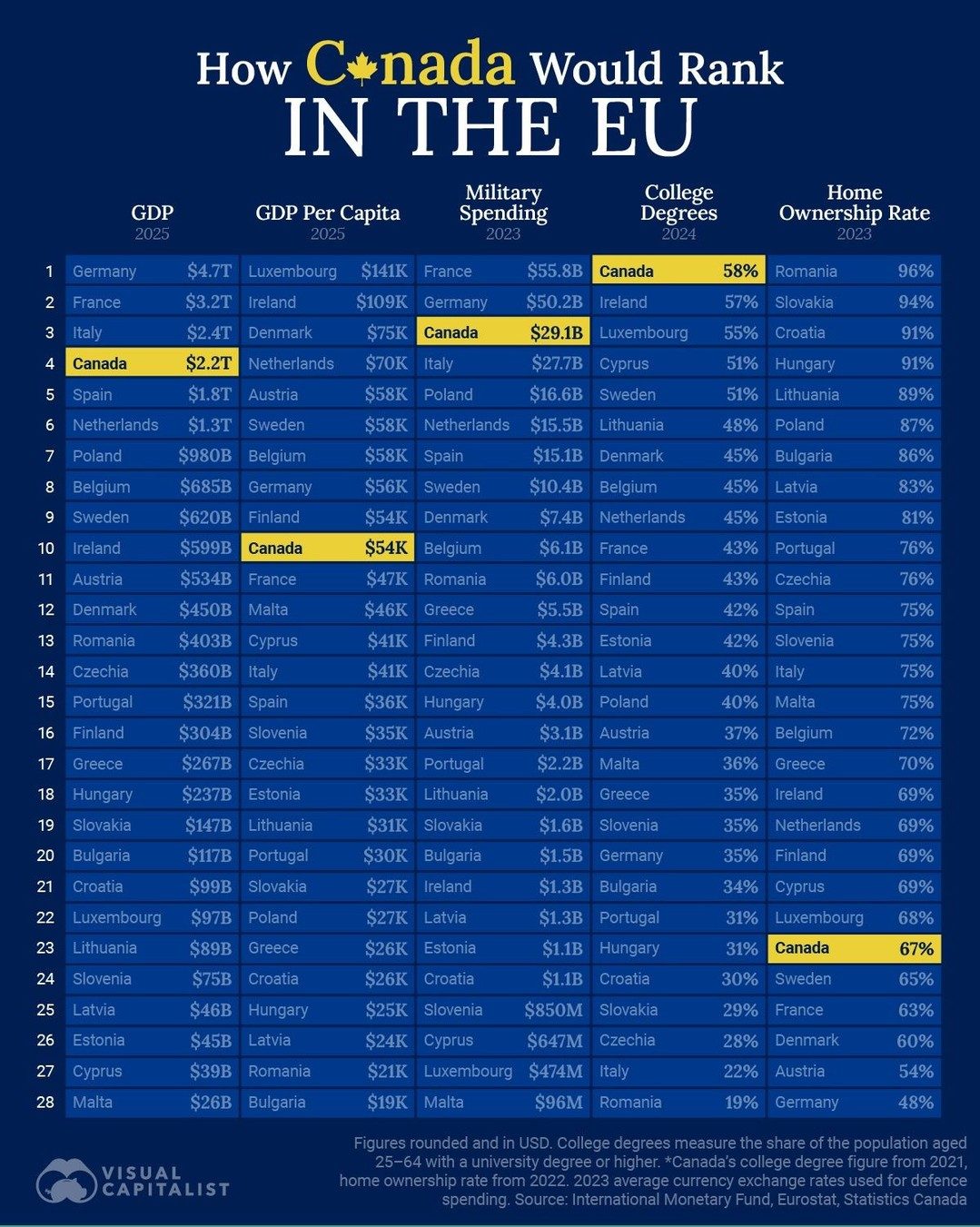
Given its relatively small population, Canada outperforms most European Union (EU) countries in economic output. It also has the highest percentage of adults with university degrees. This article compares Canada's standing across five key metrics against EU nations and discusses why these comparisons matter.
Context / Why this matters
Understanding how Canada compares to EU countries provides valuable insights. It highlights Canada's economic strengths and educational achievements. This is important for policy-makers, investors, and anyone interested in global economic trends. For example, Canada’s high GDP per capita indicates a strong, prosperous economy. Its high rate of university-educated adults points to a well-educated workforce, which is crucial for innovation and economic growth.
Main discussion
GDP and GDP per Capita
Canada's GDP is substantial, ranking 4th among the 27 EU countries. This is impressive given Canada's smaller population compared to many EU nations. Canada's GDP per capita is also notable, ranking 4th. This metric indicates the average economic productivity per person, and Canada's high ranking shows that its economy is efficient and productive.
Military Spending
Military spending is a key indicator of a country's defense capabilities and commitment to global security. Canada's military spending is relatively moderate, ranking 8th. This suggests a balanced approach to defense, investing enough to maintain security without overspending.
College Degrees
Canada boasts the highest share of university-educated adults among the EU countries. This is a significant achievement, reflecting a strong education system and a population that values higher education. A well-educated populace is crucial for a knowledge-based economy, driving innovation and competitiveness.
Ownership Rate
The ownership rate, which includes homeownership and other types of asset ownership, is another important metric. Canada ranks 4th in this category, indicating a high level of personal wealth and economic stability. This metric is closely tied to quality of life and financial security.
Additional Metrics
While the main focus is on GDP, GDP per capita, military spending, college degrees, and ownership rate, other metrics like healthcare, infrastructure, and social welfare can also play a significant role. These factors contribute to a country's overall well-being and economic performance.
Practical tips
For Policymakers
Increase Investment in Education: Given Canada's strong performance in higher education, policymakers should continue to invest in and improve the education system. This will ensure that the country maintains its competitive edge in the global economy.
Balance Military Spending: Canada's moderate military spending suggests a balanced approach. Policymakers should ensure that defense budgets are sufficient to maintain national security without diverting resources from other critical areas like healthcare and education.
For Investors
Focus on High-Growth Sectors: Investors should consider sectors that benefit from a highly educated workforce, such as technology and healthcare. These sectors are likely to see significant growth and innovation.
Consider Long-Term Economic Stability: Canada’s high GDP per capita and ownership rate indicate a stable and prosperous economy. Investors can benefit from long-term investments in this market.
For Individuals
Pursue Higher Education: With Canada's strong emphasis on higher education, individuals should consider pursuing university degrees to enhance their career prospects and contribute to the country's innovation and growth.
Plan for Long-Term Financial Goals: The high ownership rate in Canada suggests that long-term financial planning, such as buying a home or investing in assets, can lead to financial stability and security.
Important takeaways
Canada's performance across key economic and social metrics highlights its strengths and areas for improvement. The country's high GDP, GDP per capita, and ownership rate indicate a strong, prosperous economy. Its high rate of university-educated adults points to a well-educated workforce, crucial for innovation and economic growth. The moderate military spending suggests a balanced approach to defense.
Conclusion
Canada's economic and educational achievements place it among the top performers globally. Its rankings in GDP, GDP per capita, military spending, college degrees, and ownership rate provide valuable insights into its strengths and areas for improvement. These metrics are crucial for understanding Canada's economic performance and its role in the global economy. By continuing to invest in education, maintaining a balanced approach to defense, and encouraging long-term financial planning, Canada can sustain its economic growth and prosperity.
Watch the Reel
Questions readers ask
How does Canada's GDP rank among EU countries?
Canada's GDP is significant despite its smaller population. It ranks higher than most EU countries, indicating a robust economy. For instance, Canada's GDP outpaces that of countries like France, Germany, and Spain, which have larger populations.
What is the significance of Canada having the highest percentage of university-graduated adults?
Canada's high percentage of adults with university degrees indicates a strong, skilled workforce. This is beneficial for both innovation and economic growth, as it shows that Canada has a highly competitive workforce.
How does Canada's economic output compare to that of Germany and France?
Canada's economic output is impressive relative to its population. It outperforms both Germany and France in terms of GDP per capita, which shows that Canada has a higher average income and a more prosperous economy.
Why is GDP per capita an important metric when comparing Canada to EU countries?
GDP per capita provides a clear picture of a country's standard of living and economic prosperity. This is especially important when comparing Canada to larger EU countries, as it shows how Canada's economy performs on a per-person basis.
How does Canada's economy compare to Luxembourg's?
Luxembourg, known for its high GDP per capita, is often cited as a comparison for Canada. However, Canada’s GDP per capita is significantly higher, reflecting a strong and competitive economy.
What are the benefits of comparing Canada's economy to that of the EU?
Comparing Canada's economy to that of the EU helps identify strengths and areas for improvement. For example, it shows that Canada excels in GDP per capita and percentage of university-graduated adults, making it an attractive target for investors and policy makers alike.
Related deep dives
Similar reads based on topic and creator.

Recent articles
Fresh deep dives from the latest Reels we unpacked.




Comments
Be the first to comment.