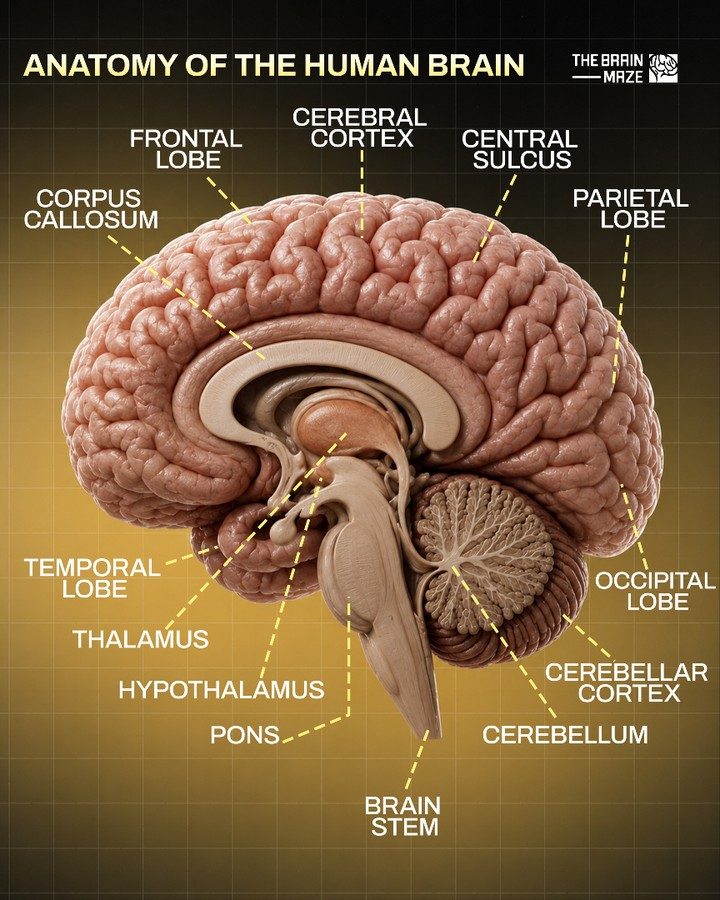
Human Brain Anatomy
The human brain is a complex organ responsible for every thought, movement, emotion, and vital body function. Understanding its anatomy involves exploring the various regions and structures that work together to facilitate these processes. Let's dive into the key components of the brain, as described by The Brain Maze.
Why This Matters
The brain's intricate structure and function are crucial for overall health and well-being. Knowing the roles of different brain regions can provide insights into various medical conditions, cognitive processes, and even emotional states. This knowledge is not just for medical professionals; it's valuable for anyone interested in understanding the human mind and its complexities.
Anatomy of the Brain
The Lobes
The brain is divided into several distinct lobes, each responsible for specific functions. The four primary lobes are:
- Frontal Lobe: Located at the front of the brain, the frontal lobe is responsible for motor function, problem-solving, planning, and expressive language. It also plays a crucial role in controlling behavior and personality.
- Parietal Lobe: Situated behind the frontal lobe, the parietal lobe processes sensory information from the body, such as touch, temperature, and pain. It's also involved in spatial awareness and navigation.
- Temporal Lobe: Positioned on the sides of the brain, the temporal lobe is involved in auditory processing, memory, and visual perception. It also plays a role in language comprehension and emotional regulation.
- Occipital Lobe: Located at the back of the brain, the occipital lobe is primarily responsible for visual processing. It interprets the visual information received from the eyes and helps us make sense of what we see.
Key Structures
In addition to the lobes, several other structures are essential for the brain's functioning:
- Cerebral Cortex: This is the outer layer of the brain, made up of gray matter. It is responsible for higher-order functions such as cognition, perception, and voluntary movement. The cerebral cortex is further divided into the frontal, parietal, temporal, and occipital lobes, each with distinct functions.
- Thalamus: Often called the "relay center" of the brain, the thalamus acts as a switchboard, relaying sensory and motor signals to the cerebral cortex. It plays a crucial role in motor control, sensory processing, and wakefulness.
- Hypothalamus: Located below the thalamus, the hypothalamus regulates essential functions like hunger, thirst, body temperature, and the release of hormones. It also plays a role in emotional regulation and the body's sleep-wake cycle.
- Cerebellum: Situated at the back of the brain, the cerebellum is responsible for motor coordination, balance, and fine-tuning of movements. It also plays a role in cognitive functions like language, attention, and memory.
- Brainstem: This structure connects the brain to the spinal cord and is responsible for critical functions like breathing, heartbeat, and the regulation of consciousness.
- Pons: Part of the brainstem, the pons acts as a bridge, connecting various parts of the brain and transmitting information between the brain and the cerebellum. It also plays a role in sleep, respiration, and the regulation of the nervous system.
- Corpus Callosum: This is a large bundle of nerve fibers that connects the left and right hemispheres of the brain, allowing for communication and coordination between the two sides. It facilitates the integration of information and higher-order cognitive processes.
- Medulla: Located in the brainstem, the medulla controls automatic functions like heart rate, breathing, and blood pressure. It is essential for the body's critical functions.
Practical Tips for Understanding the Brain
- Use Visual Aids: Diagrams and 3D models, like the ones showcased by The Brain Maze, can help visualize and understand the complex structure of the brain. Visual aids make it easier to grasp the relationships between different brain regions.
- Study in Sections: The brain is vast and intricate. Studying one section or structure at a time can help you better retain and understand the information. Start with the major lobes and then move on to other key structures.
- Relate to Real-Life Functions: Understanding the functions of different brain regions is more meaningful when connected to real-life scenarios. For instance, understanding how the frontal lobe controls movements can help you appreciate why this region often suffers from damage in stroke patients.
- Engage in Interactive Learning: Websites, apps, and interactive tools that allow you to explore the brain virtually can make learning more enjoyable and engaging. These tools often provide detailed descriptions and real-life examples that enhance understanding.
Important Takeaways
- The brain is divided into four primary lobes: frontal, parietal, temporal, and occipital, each with distinct functions.
- Key structures like the thalamus, cerebellum, and brainstem play crucial roles in various bodily functions.
- Visual aids, like anatomical diagrams and 3D models, are invaluable for understanding the brain's complex structure.
- Relating brain functions to real-life scenarios can make learning more meaningful and practical.
- Engaging with interactive tools can enhance learning and retention.
Conclusion
The human brain is a marvel of nature, with intricate structures and functions that control every aspect of our lives. By understanding the anatomy of the brain, we gain insights into how it operates and the roles of its different regions. Tools and resources, like those provided by The Brain Maze, offer invaluable guidance in exploring the brain's complexities. Whether you're a student, a healthcare provider, or simply curious about the human mind, delving into the anatomy of the brain opens up a world of fascinating knowledge and understanding.
Watch the Reel
Questions readers ask
What are the primary functions of the frontal lobe?
The frontal lobe is primarily responsible for controlling voluntary movement, planning, and executing actions, and expressing and understanding language. It also plays a significant role in decision-making, problem-solving, and moderating social behavior.
How does the occipital lobe contribute to visual processing?
The occipital lobe is dedicated to interpreting visual information received from the eyes. This includes recognizing objects, colors, and shapes, as well as processing motion and depth perception.
What is the role of the cerebellum in the brain?
The cerebellum is crucial for motor control, coordination, and balance. It helps refine movements, maintain posture, and facilitate the timing and force of movements. Additionally, it contributes to certain cognitive functions, such as language and attention.
What does the thalamus do in the brain?
The thalamus acts as a relay center, processing and transmitting sensory and motor signals from the body to the cerebral cortex. It also regulates consciousness, sleep, and wakefulness, and plays a role in certain cognitive functions and emotional states.
How does the hypothalamus regulate bodily functions?
The hypothalamus is essential for maintaining homeostasis, regulating bodily functions like hunger, thirst, and body temperature. It also controls the release of hormones from the pituitary gland, influencing growth, metabolism, and sexual development.
What is the structure and function of the brainstem?
The brainstem is composed of the midbrain, pons, and medulla. It connects the brain to the spinal cord and regulates vital functions such as breathing, heart rate, and blood pressure. It also facilitates sleep, arousal, and consciousness.
What is the corpus callosum and what does it do?
The corpus callosum is a thick band of nerve fibers that connects the left and right hemispheres of the brain, allowing them to communicate and coordinate with each other. It's crucial for integrating information from both sides of the body and processing complex tasks.
Related deep dives
Similar reads based on topic and creator.



Recent articles
Fresh deep dives from the latest Reels we unpacked.




Comments
Be the first to comment.