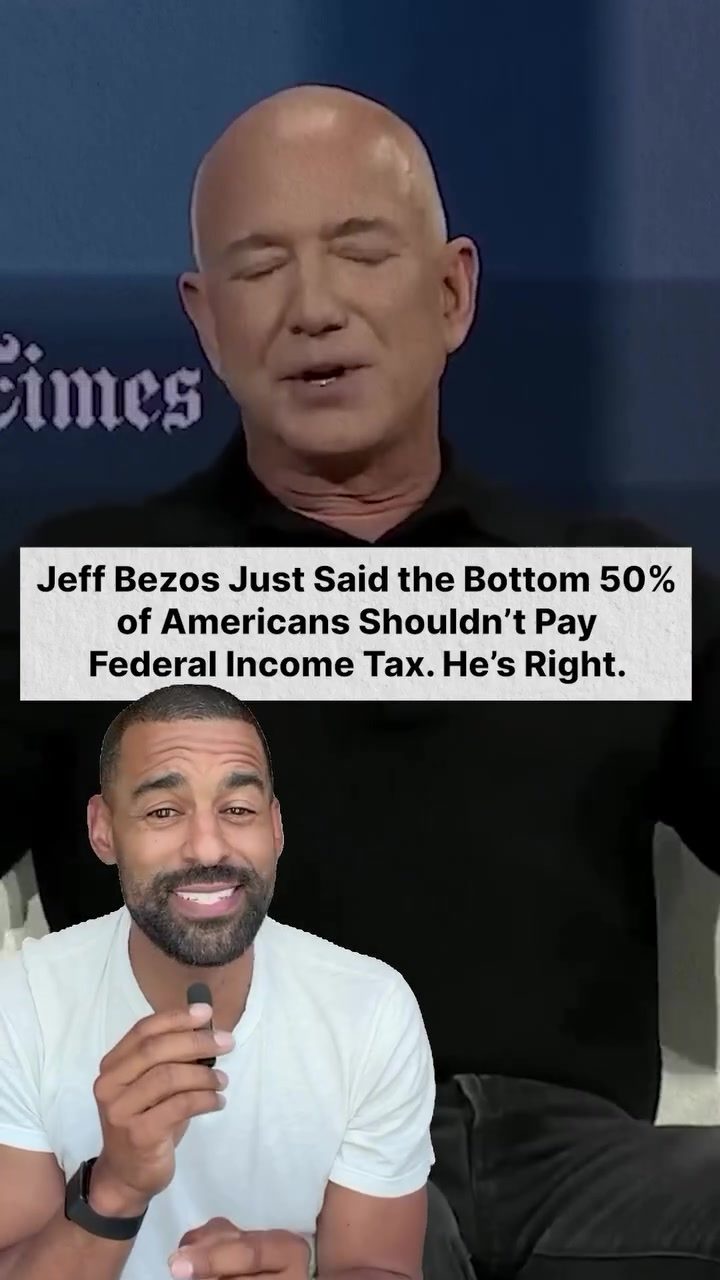
Federal Income Tax: Why the Bottom 50% Shouldn't Pay
In a recent discussion, Jeff Bezos proposed that the bottom 50% of American earners should not pay federal income tax. This idea, while controversial, is grounded in a compelling argument about wealth distribution and economic policy. Let's break down the rationale behind this proposal and explore its potential implications.
Context / Why this matters
Tax policy is a critical component of any economy, influencing everything from personal finances to national economic growth. Understanding who pays what and why is essential for grasp the broader implications of tax policies. The debate around federal income tax, particularly concerning the bottom 50% of earners, touches on fundamental questions about economic justice and public welfare.
The Current Tax Landscape
The current tax system in the United States is often criticized for its complexity and perceived inequities. The top 1% of earners contribute a significant portion of federal income tax—about 40%—while the bottom 50% contribute only 3%. This disparity raises questions about the fairness and effectiveness of the tax system.
The Case for Eliminating Federal Income Tax for the Bottom 50%
Jeff Bezos argued that the current tax system places an undue burden on lower-income Americans. For example, a nurse in Queens earning $75,000 a year pays over $1,000 a month in taxes. Eliminating federal income tax for the bottom 50% could provide significant financial relief for these individuals, allowing them to allocate more of their income towards essential needs.
Economic Impact of Lowering Taxes for the Bottom 90%
Lower-income Americans typically spend any extra income immediately, rather than investing it. This spending behavior has a direct and positive impact on the economy. According to a study by a Stanford economist, a 1% tax decrease for the bottom 90% of earners increases state GDP by 6.6%. In contrast, a similar tax cut for the top 10% has no significant impact on GDP.
The Economic Velocity Argument
When lower-income individuals have more disposable income, they spend it on necessities like rent, food, gas, childcare, and local businesses. This immediate spending injects money back into the economy, creating a cycle of economic activity known as "economic velocity." This concept is crucial for understanding why tax cuts for lower-income earners can have a more substantial economic impact.
Funding the Tax Cut
One of the primary concerns about eliminating federal income tax for the bottom 50% is how to fund such a significant change. Critics argue that taxing the wealthy more is a radical and untested concept. However, taxing non-residents, such as tourists and non-resident property owners, is already a common practice at the city level. For instance, hotel taxes and the Pierre de Terre tax in New York City illustrate how non-residents can be taxed without significantly impacting the local economy.
Practical Tips
If you're interested in understanding more about tax policy and its implications, consider the following steps:
- Educate Yourself on Tax Policies: Learn about the current tax system and how it affects different income brackets.
- Engage in Policy Discussions: Participate in discussions about tax reform and share your insights with others.
- Support Economic Research: Stay informed about studies and analyses that explore the economic impact of tax policies.
- Advocate for Change: If you believe in the benefits of eliminating federal income tax for the bottom 50%, consider advocating for policy changes at the local, state, or federal level.
Important Takeaways
- Tax Distribution: The current tax system places a significant burden on lower-income earners, who contribute a small portion of federal income tax.
- Economic Impact: Lowering taxes for the bottom 90% of earners can have a substantial positive impact on the economy through increased spending.
- Funding Mechanisms: Taxing non-residents, such as tourists and non-resident property owners, is a viable way to fund tax cuts for lower-income individuals.
- Policy Engagement: Staying informed and engaged in policy discussions can help drive meaningful change in tax policy.
Conclusion
The proposal to eliminate federal income tax for the bottom 50% of American earners is a thought-provoking idea that challenges traditional views on tax policy. By understanding the economic implications and potential funding mechanisms, we can engage in more informed discussions about tax reform and work towards a more equitable and effective tax system.
Watch the Reel
Questions readers ask
Who does the term 'bottom 50%' refer to in the context of federal income tax?
The 'bottom 50%' refers to the 50% of American earners with the lowest incomes. This group typically includes individuals and families who earn less than the median income, which is approximately $60,000 per year for a single person.
What are the potential benefits of exempting the bottom 50% from federal income tax?
Exempting the bottom 50% from federal income tax could provide immediate financial relief, allowing low earners to keep more of their income for essential expenses, potentially boosting local economies. This measure could also reduce the administrative burden on the IRS and encourage workforce participation.
How does Jeff Bezos' proposal compare to current tax policies?
Currently, the bottom 50% of earners already pay a small fraction of federal income tax due to various deductions and credits. Bezos' proposal would expand this exemption, potentially eliminating federal income tax obligations for this group entirely, a significant shift from the current policy.
What are some arguments against exempting the bottom 50% from federal income tax?
Critics argue that eliminating federal income tax for the bottom 50% could lead to a significant loss in federal revenue, potentially impacting government services and programs. Additionally, some believe it may disproportionately benefit higher earners within this group, while others argue that it may not address the broader issues of wealth inequality in the US.
How might this tax change affect the overall economy?
Stimulating local economies, this proposal could potentially increase consumer spending and encourage workforce participation. However, the overall impact on the economy is complex and depends on various factors, including how the lost revenue is recouped and the broader effects on economic productivity.
Would a nurse, earning $75,000 a year, benefit from this proposal?
If a nurse earning $75,000 a year falls within the bottom 50% of earners, they could potentially benefit from this proposal. However, this depends on the specific income distribution and the exact thresholds set for the exemption. Given that the median income for an individual is around $60,000, this scenario is plausible.
Related deep dives
Similar reads based on topic and creator.
Recent articles
Fresh deep dives from the latest Reels we unpacked.




Comments
Be the first to comment.