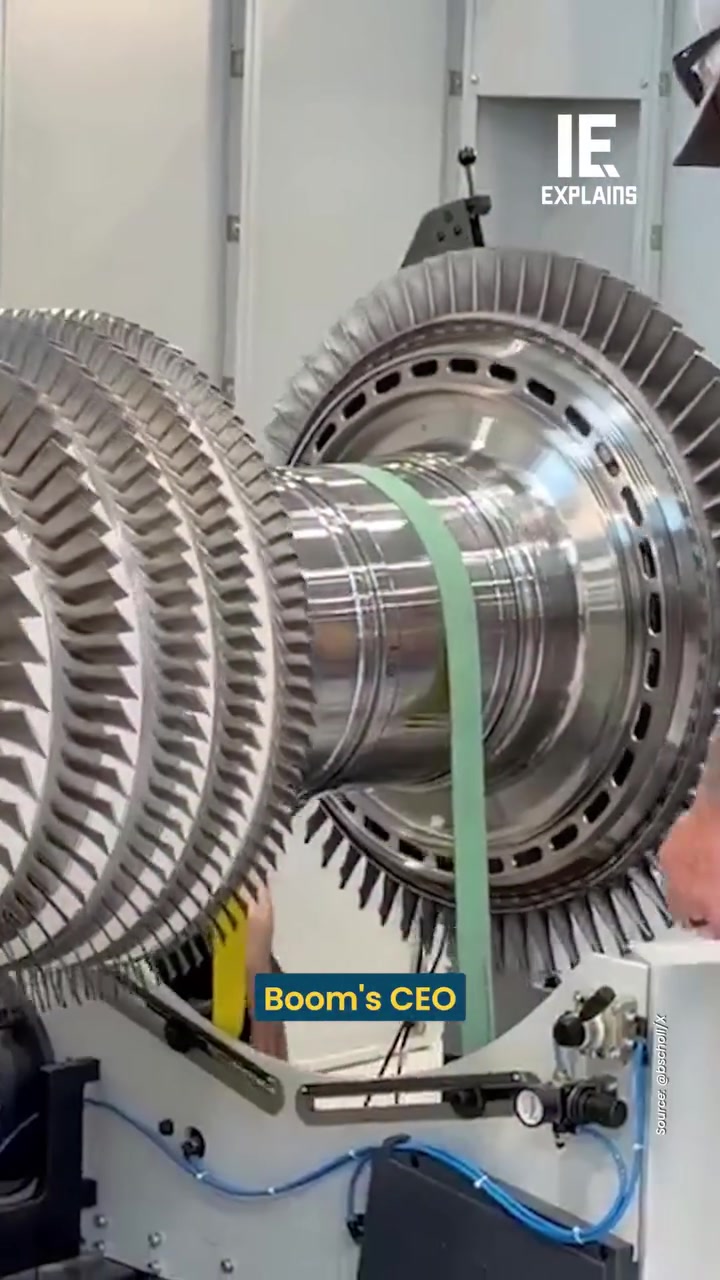
Imagining a plane engine spinning 36,000 times an hour, its blades whirring at 370 meters a second, even a tiny weight imbalance can send it tilting out of control, and nothing but precise engineering can change the outcome. Boeing's latest rotor spinning in their lab in North Carolina, spurring a fresh conversation about aerodynamic turbine blades.
Inside Boom’s Symphony Engine’s RPMS
The Symphony engine is a marvel of engineering. It's a high-pressure compressor rotor and is the part that squeezes the air stage by stage before flames. This rotor is from Boom, a startup pushing the envelope in supersonic travel. The key point is that this rotor’s blades are not bolted in place. Instead, they are part of a single, integrated disc called a blisk, derived from its classification as a blended disk. Traditional rotors have individual blades that can be easily replaced when damaged, making them more flexible for repairs. However, this bolted design adds weight and drag, which hampers performance. The Symphony engine’s design instead has a lighter, more compact, and aerodynamically cleaner rotor. When a blade is chipped on a bolted rotor, you lose that blade. When it’s chipped on a blisk, however, the whole disc either has to be repaired or scrapped. Blisks are pivotal for two critical reasons: weight and heat dispersion. By eliminating the bolting and leaving the blades as part of an integrated disc, the weight is significantly reduced. The main challenge is managing the heat which changes the rotor's readings. When the blade tips are spinning at hundreds of meters each second, any off-centre mass becomes a force that hits the bearings on every revolution. The rotor must be balanced precisely to avoid this, because the engine's performance heavily relies on the blade tips moving uniformly and evenly.
Boosting Performance with Aerospace Engineering
Boom’s approach aligns with the wider trend of aerospace engineering, where every component is under intense scrutiny to reduce weight, increase fuel efficiency, and maximize performance. The latest aero-engineering aims to extend the efficiency to supersonic planes. The use of high-pressure compressor rotors, variable guide vanes, and the precision machining of components all contribute to this goal. The whole core of Boom spins inside a 42-megawatt ground turbine. Any off-centre mass changes everything. Booms cuts its blisks in-house on a 5-axis machine. This turbofan engine's carbon footprint is vital to maintain that lowering pressure across the aerofoil is vital.
High-Precision Turbine Blade Testing
The balancing acts are done to check how the cores of the blades spin inside the 42-megawatt ground turbine. The turbine blades are aerodynamically designed to have smooth surfaces. Green bands are identified as wrapped around the turbine blades to ensure a clear reading of measurement. It is said to have to be balanced in thousands of revolutions per minute. It is highlighted that spinning at thousands of revolutions per minute, with blade tips travelling at hundreds of meters a second, any imbalance is a crucial issue. The central high-pressure compressor rotor must be balanced to ensure optimal performance. Any imbalance can cause significant vibrations, reducing the engine's efficiency and increasing wear and tear. The rotor must be balanced to the point where any mass is off-centre by just one millionth of an inch. That’s why the center of gravity of the disc must be perfectly aligned; else, it throws off everything. Boom’s 5-axis machine cuts its own blisks in-house. The rotor is then spun at thousands of revolutions per minute, where any imbalance becomes a force hitting the bearings on every rotation. The variable guide vanes are used to control the air flow. They regulate the airflow to the blades from idle to Mach 1.7, adapting to different conditions to ensure optimal engine performance.
Replacing Damaged Turbine Blades
When comparing bolted rotors to blisks, the latter are both cutting-edge and controversial. While blisks offer significant advantages in weight reduction and aerodynamic efficiency, they present a repair challenge. If a blade is damaged, the entire disc may need to be repaired or scrapped, which can be costly and time-consuming. In contrast, bolted rotors allow for easier blade replacement, making repairs more straightforward and cost-effective. The trade-off between blisks and bolted rotors hinges on the balance between performance and maintenance. For aircraft like Boom’s, where every ounce of performance matters, the advantages of blisks often outweigh the repair challenges. This is especially true in high-performance applications where weight and drag reduction are critical.
Practical Angle for Maintenance Engineers
- Preventive Maintenance: Regularly inspect and balance the rotor to ensure it remains within the required tolerance. Even minor imbalances can cause significant issues over time, and preventative maintenance helps to minimise those problems.
- Material Choice: Select materials for the blades and the disc that can withstand the high temperatures and stresses involved in engine operation. Materials with high strength-to-weight ratios and excellent thermal resistance are ideal.
- Design Considerations: Ensure the blades are designed to be aerodynamically efficient, reducing drag and improving fuel efficiency. This includes the shape of the blades and the angle of attack, which can significantly impact the engine's performance.
- Hard-to-Reach Maintenance: Make sure you have a foolproof plan for blisk maintenance; it's easier on bolted rotors, but with blisks, make sure you have a way to replace the whole disc.
Engine Efficiency: A Balancing Act
The implications for the future of aviation are clear. The balancing act of rotor blades is a delicate process, but precision and technology can help us build better planes for the future. Even with the challenges that come with this innovative technology, the benefits of lighter, more efficient engines are too great to ignore. This complexity of the balancing act reflects the broader challenges in high-speed engineering.
Watch the Reel
Questions readers ask
What exactly is a blisk and how does it differ from traditional turbine blades?
A blisk is a blended disk with integrated blades, unlike traditional turbine blades which are bolted individually. This design reduces weight and drag, making it more aerodynamically efficient. However, it also means that if a blade is damaged, the entire disc needs to be repaired or replaced.
Why is the Symphony engine's RPM so high, and what challenges does this pose?
The Symphony engine's rotor spins at 36,000 RPM to achieve supersonic speeds, which is roughly 500 RPM faster than a Formula 1 race. This extreme speed means any imbalance can cause significant issues, such as tilting out of control. The rotor must be balanced precisely to maintain uniform blade tip movement.
What are the advantages and disadvantages of using blisks in the Symphony engine?
The advantages of blisks include reduced weight and improved aerodynamics, which enhance performance. However, the main disadvantage is that if a blade is damaged, the entire disc needs to be repaired or replaced, which can be costly and time-consuming.
What are the benefits of using a 5-axis machine to cut blisks?
Boom cuts its blisks in-house on a 5-axis machine, allowing for precise machining and ensuring that the blades are perfectly balanced. This high-precision machining is crucial for maintaining the engine's performance and efficiency, especially at supersonic speeds.
What are the challenges in testing the turbine blades?
The turbine blades are tested for balance and aerodynamic performance. The blades are spun at thousands of RPMs, with blade tips traveling at hundreds of meters per second. Any imbalance can cause significant issues, so precise balancing is crucial. Green bands are used to ensure clear readings during testing.
Related deep dives
Similar reads based on topic and creator.




Recent articles
Fresh deep dives from the latest Reels we unpacked.




Comments
Be the first to comment.