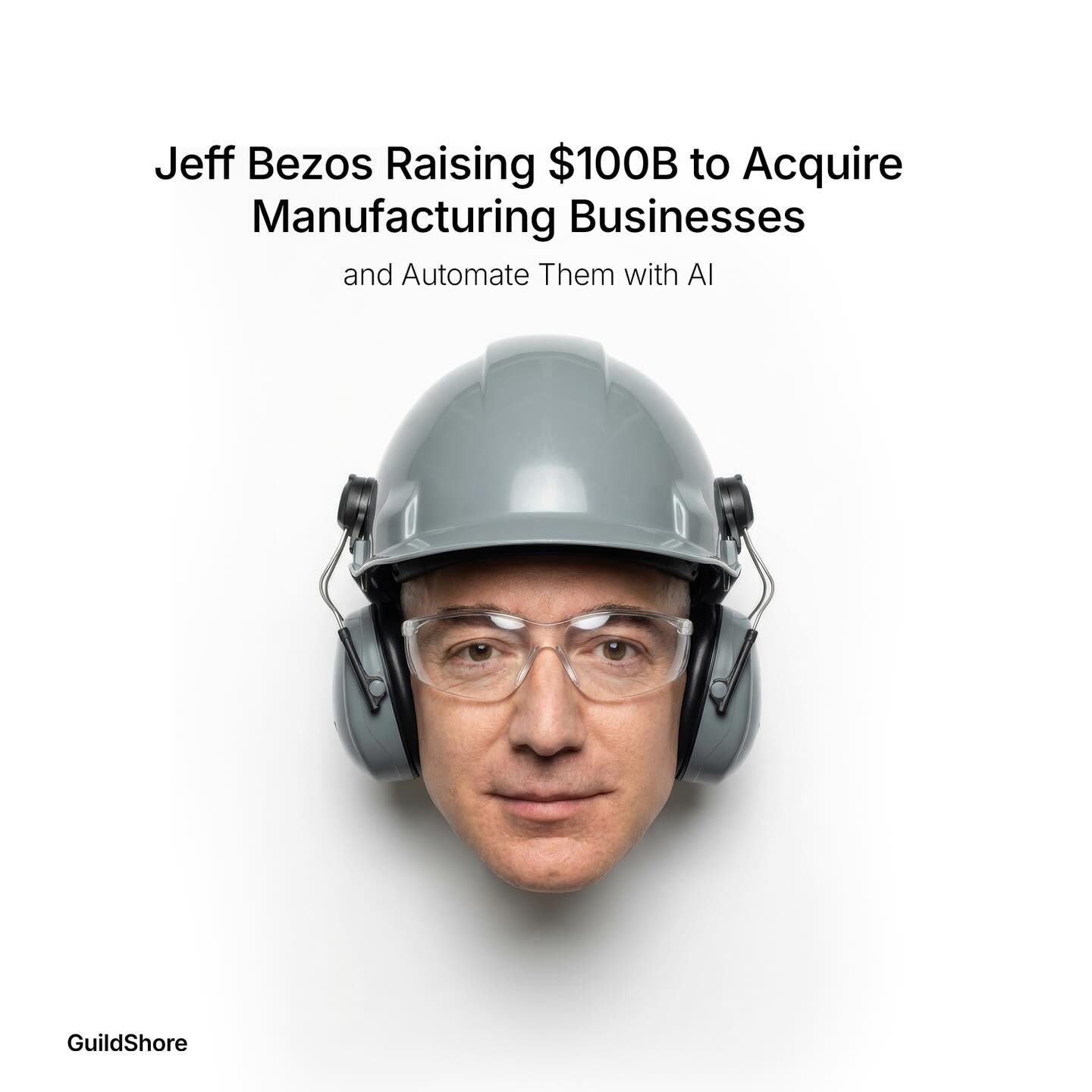
Jeff Bezos' $100 Billion Bet on Manufacturing Automation
Jeff Bezos is making waves in the manufacturing sector with plans to raise $100 billion for a "manufacturing transformation vehicle." This ambitious venture aims to acquire existing manufacturers, particularly in chipmaking, defense, and aerospace, and revamp their operations using cutting-edge AI automation.
Why This Matters
The manufacturing industry in the U.S. is a $3 trillion sector, with 2.1 million jobs projected to go unfilled by 2030. This labor gap presents a significant challenge, but it also opens up opportunities for innovation. Bezos' strategy is to leverage AI-driven automation to not only close this labor gap but to also make acquired factories radically more productive. The goal is a total overhaul of factory operations, from machine programming to supply chain management.
Manufacturing Transformation Vehicle
Strategic Vision
Bezos' vision is not about incremental efficiency gains but about a complete transformation of how factories operate. By acquiring manufacturers in high-tech industries like chipmaking, defense, and aerospace, Bezos aims to breathe new life into these sectors by integrating AI automation. This approach is expected to revolutionize the manufacturing landscape, making factories not just more efficient but also more adaptable to future challenges.
Target Industries
The focus on chipmaking, defense, and aerospace is strategic. These industries are at the forefront of technological advancement and are crucial for economic stability and national security. By modernizing these sectors, Bezos aims to ensure that the U.S. remains a global leader in these critical areas.
Scale of Investment
At $100 billion, this fund would match SoftBank’s Vision Fund as the largest ever raised and dwarf the current buyout record of $28 billion. This massive investment underscores the scale of Bezos' ambition and his confidence in the transformative power of AI automation in manufacturing.
The Role of AI in Manufacturing
AI-driven automation is at the heart of Bezos' plan. The technology offers unparalleled potential for optimizing factory operations. From predictive maintenance to real-time supply chain management, AI can dramatically enhance productivity and efficiency.
Operational Experience
Bezos has direct operational experience in this area. Amazon has deployed over one million robots across more than 300 warehouses. His personal investments in leading robotics AI startups in 2024 and 2025 further highlight his commitment to this technology.
The Fundraising Effort
To raise the $100 billion, Bezos has been meeting with sovereign wealth fund managers in the Middle East and Singapore. These regions are known for their substantial financial resources and strategic investments, making them ideal partners for such a high-stakes venture.
Practical Tips for Manufacturers
While Bezos’ plan is ambitious and targeted at large-scale acquisitions, there are practical tips for manufacturers of all sizes looking to leverage AI automation:
Assess Current Operations
Before investing in AI, it's crucial to assess your current operations. Identify areas where automation can have the most significant impact. This could be in areas like predictive maintenance, supply chain management, or quality control.
Invest in the Right Technology
Not all AI technologies are created equal. Invest in technologies that have a proven track record and are scalable. This could mean partnering with startups or established companies that specialize in AI-driven automation.
Train Your Workforce
AI is only as effective as the people who use it. Invest in training your workforce to understand and utilize AI technologies effectively. This will help ensure a smooth transition and maximize the benefits of automation.
Important Takeaways
The manufacturing sector is on the brink of a significant transformation. Bezos' $100 billion investment indicates a growing trend toward AI-driven automation. Here are the key takeaways:
- AI is set to revolutionize the manufacturing sector, particularly in high-tech industries like chipmaking, defense, and aerospace.
- The focus is on a total overhaul of factory operations, not just incremental gains.
- This transformation is driven by a massive $100 billion investment, highlighting the scale of the ambition.
- AI-driven automation can help close the labor gap and make factories more productive.
Conclusion
Jeff Bezos' $100 billion investment in manufacturing automation is a game-changer. By acquiring and modernizing existing manufacturers, Bezos aims to revolutionize the industry. This investment underscores the transformative potential of AI in manufacturing and sets a precedent for how the sector can evolve. As manufacturers, it's essential to stay informed and adapt to these changes to remain competitive in an increasingly automated world.
Watch the Reel
Questions readers ask
What is the main goal of Jeff Bezos' $100 billion manufacturing initiative?
The primary aim of Jeff Bezos' $100 billion initiative is to transform the US manufacturing sector by acquiring existing manufacturers and integrating advanced AI automation technologies. This is to address the projected labor shortage and significantly enhance factory productivity.
Which industries is Bezos targeting with his manufacturing automation plans?
Bezos is focusing on several key industries, including chipmaking, defense, and aerospace. These sectors are crucial for technological advancement and national security, making them prime candidates for AI-driven automation.
How does Bezos plan to address the labor gap in manufacturing?
Bezos intends to fill the projected labor gap of 2.1 million jobs by 2030 through extensive AI automation. By automating various manufacturing processes, Bezos aims to create a more efficient and productive workforce, reducing the reliance on human labor in certain areas.
What role will AI play in Bezos' manufacturing initiative?
AI is central to Bezos' plans. It will be used to automate various manufacturing processes, from assembly to quality control, in order to increase efficiency and output. The integration of AI-driven automation will help streamline operations and reduce the need for human intervention in repetitive tasks.
What is the significance of the manufacturing industry to the US economy?
The US manufacturing industry is a $3 trillion sector, making it a critical component of the nation's economy. By revitalizing this sector through AI automation, Bezos seeks to enhance productivity, create new job opportunities, and maintain the country's competitive edge in global markets.
How will Bezos' investment impact the future of manufacturing automation?
Bezos' billion dollar investment is set to accelerate the adoption of AI-driven automation in manufacturing. This could lead to a surge of innovation, making factories more efficient and resilient. The successful implementation of this initiative could serve as a model for other industries and countries looking to revamp their manufacturing sectors.
Related deep dives
Similar reads based on topic and creator.


Recent articles
Fresh deep dives from the latest Reels we unpacked.




Comments
Be the first to comment.