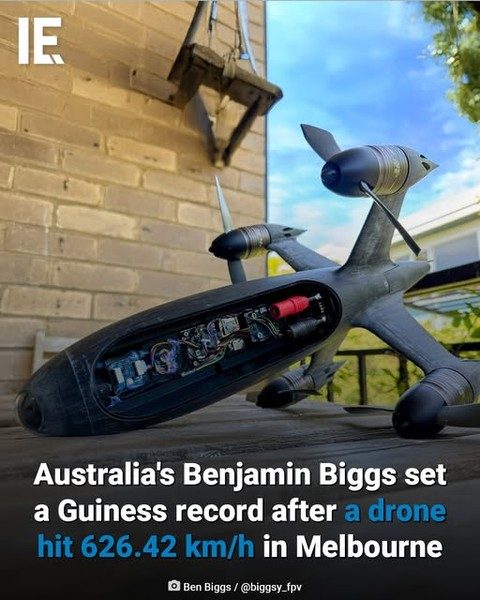
Drone Speed Record
A recent feat in the world of drones has set a new benchmark for speed. Benjamin Biggs, an Australian builder, has achieved the fastest official ground speed ever recorded for a battery-powered RC quadcopter. His drone reached an astonishing speed of 626.42 km/h (389.24 mph), earning him a Guinness World Record. This remarkable accomplishment showcases the potential of meticulous design, airflow control, and extensive testing in the realm of drone engineering.
Why This Matters
Benjamin Biggs' achievement is groundbreaking, not just for the drone community, but for the broader field of aerospace engineering. It demonstrates what can be achieved with a combination of innovative design and relentless testing, even outside of large, well-funded laboratories. This record-breaking speed sets a new benchmark for what is possible in drone technology, pushing the boundaries of what these versatile machines can accomplish.
Main Discussion
The Drone and Its Design
The drone that set the record is a testament to Benjamin Biggs' engineering prowess. Weighing in at approximately 4.4 lb (2 kg), the quadcopter is remarkably lightweight, a critical factor in achieving high speeds. Despite its light weight, the drone is capable of delivering huge peak power, a feat that is a result of obsessive design and meticulous airflow control.
A lightweight drone has several advantages. It requires less energy to achieve high speeds, which is crucial for battery-powered vehicles. The lightweight design also allows for more agile maneuvers, making the drone more versatile in various applications. The design process involved in creating this drone highlights the importance of aerodynamics and weight distribution in achieving optimal performance.
The Engineering Behind the Speed
Achieving a speed of 626.42 km/h is no small feat, especially for a battery-powered drone. The engineering behind this accomplishment involves several key factors. One of the most critical aspects is the use of high-efficiency motors and propellers. These components are designed to provide maximum thrust with minimal energy consumption, allowing the drone to reach and maintain high speeds.
The control systems and software play a crucial role as well. Precision control over the drone's movements ensures that it can handle the stresses of high-speed flight. Advanced stabilization algorithms and sensors help the drone maintain stability and responsiveness, even at such high velocities.
The Role of Testing
Relentless testing is a cornerstone of Biggs' approach. Comprehensive testing allows for continual refinement of the design, ensuring that every component is optimized for performance. This iterative process is essential for pushing the limits of what is possible with drone technology. It involves rigorous flight tests, wind tunnel simulations, and data analysis to identify and address any performance issues.
The Impact of Airflow Control
Airflow control is another critical aspect of the drone's design. Proper airflow management reduces drag, which in turn increases speed and efficiency. This involves careful design of the drone's frame, propellers, and other aerodynamic surfaces to minimize air resistance. Effective airflow control also helps in maintaining stability and control at high speeds, ensuring the drone can handle the forces involved in such rapid flight.
Practical Tips
Building a high-speed drone like the one that set the record is a complex task, but there are several practical tips that can help aspiring drone builders. Understanding the principles of aerodynamics, efficient motor selection, and lightweight materials are crucial. Additionally, investing in robust testing and data analysis can significantly enhance the performance of the drone.
Aerodynamics and Weight Distribution
Paying close attention to aerodynamics and weight distribution can greatly improve a drone's speed and efficiency. Streamlined designs, lightweight materials, and strategic weight placement are key. For instance, positioning heavier components closer to the center of mass can improve stability and reduce the risk of rotor imbalance at high speeds.
High-Efficiency Motors and Propellers
Choosing high-efficiency motors and propellers is essential for achieving high speeds. These components should be selected based on their ability to provide maximum thrust with minimal energy consumption. Advanced brushless motors and lightweight, durable propellers can significantly enhance a drone's performance.
Advanced Control Systems
Implementing advanced control systems and stabilization software can help a drone maintain stability and responsiveness at high speeds. Advanced sensors, such as gyroscopes and accelerometers, combined with sophisticated algorithms, ensure that the drone remains stable and responsive in various flight conditions.
Important Takeaways
The achievement of Benjamin Biggs highlights the incredible potential of drone technology. Several key takeaways stand out from this groundbreaking achievement:
- Pushing Limits: Biggs’ accomplishment demonstrates the incredible potential of drone technology. With the right design and testing, drones can achieve speeds that were once thought impossible.
- Importance of Testing: Continuous and comprehensive testing is essential for achieving optimal performance. It allows for the refinement of the design and ensures that every component is optimized for high-speed flight.
- Role of Aerodynamics: Aerodynamics and airflow control play a crucial role in achieving high speeds and maintaining stability. Proper design and weight distribution can significantly enhance a drone's performance.
Conclusion
Benjamin Biggs' record-breaking achievement is a monumental milestone in the world of drone engineering. It showcases the potential of innovative design, relentless testing, and advanced engineering in pushing the boundaries of what is possible. As drone technology continues to evolve, achievements like this will pave the way for even more incredible innovations, making drones more versatile and powerful tools in various applications.
Watch the Reel
Questions readers ask
What makes Benjamin Biggs' drone speed record significant?
Biggs' drone record is significant because it pushes the boundaries of what's possible for battery-powered RC quadcopters. The speed of 626.42 km/h is an impressive feat that advances our understanding of drone capabilities and aerodynamics.
How did Benjamin Biggs achieve such a high speed with his drone?
Biggs achieved this record through a combination of innovative design, meticulous airflow control, and extensive testing. His approach focused on optimizing the drone's aerodynamic efficiency and propulsion system to reach unprecedented speeds.
Why is this record important for aerospace engineering?
This record is important for aerospace engineering because it demonstrates that significant advancements can be made even outside of large, well-funded laboratories. It showcases the potential of innovative design and rigorous testing in advancing technology.
What are the key factors that contributed to the drone's speed?
The key factors that contributed to the drone's speed include its innovative design, which focused on aerodynamic efficiency, and the precise control of airflow around the drone. Biggs' extensive testing and fine-tuning were also crucial in achieving the record speed.
What kind of testing did Benjamin Biggs perform to achieve the record?
Biggs performed rigorous and extensive testing to optimize his drone's performance. This likely involved multiple iterations of design, flight tests to gather data, and adjustments to improve speed and stability. Such testing is crucial for pushing the limits of drone technology.
Related deep dives
Similar reads based on topic and creator.


Recent articles
Fresh deep dives from the latest Reels we unpacked.




Comments
Be the first to comment.