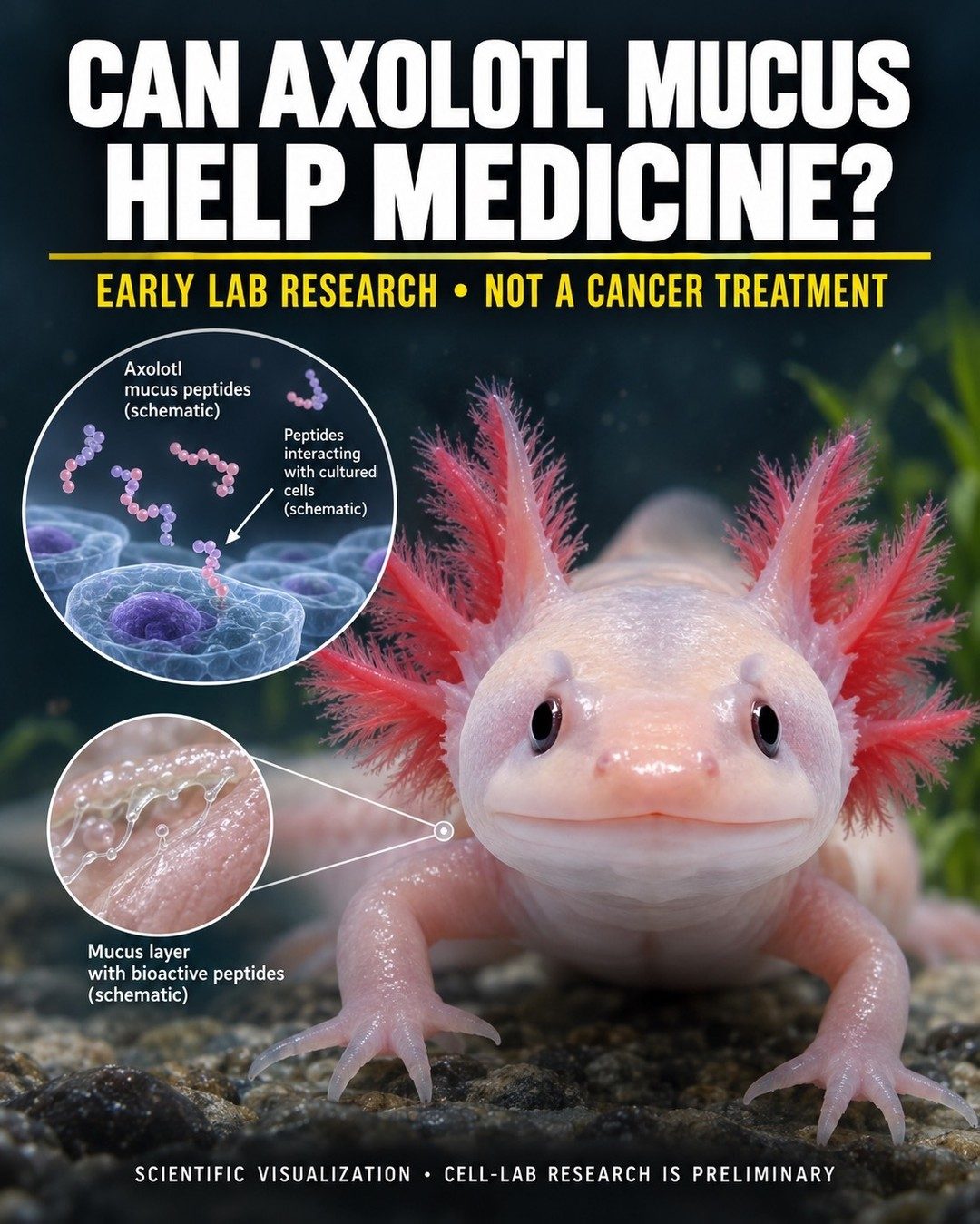
Axolotls' Mucus: A Preclinical Frontier
Axolotls are fascinating creatures and their potential medical value is now the spotlight of early lab research. Researchers are particularly interested in the salamanders' remarkable capacity to regenerate its limbs and even whole organs. And now, it's their mucus that is captivating the scientific community. This unique mucus contains peptides, which are small proteins that can interact with cultured cells. The purified bioactive molecules from this slime could potentially be utilized to produce future medications. The axolotl’s mucus isn't just any viscosity; the mucus layer with bioactive peptides are a goldmine for regenerative medicine.
Peptides: Small but Powerful
The peptides found in axolotl mucus are not your average molecules. They're bioactive, meaning they have a biological effect on other cells. Scientists are currently exploring how these peptides interact with cultured cells. However, it is too early to determine how these interactions could translate into future medical applications. The research remains at an early lab stage, focusing on understanding the basic mechanisms at play. The cell-lab research is not to be misunderstood. This molecular investigation might not solve all diseases.
The Road Ahead: From Lab to Clinic
As it stands, the research into axolotl mucus is still in its infancy. Although preliminary results are promising, this is far from a viable cancer treatment. "Cell-lab research is preliminary,". That means experiments are confined to the lab, and extensive preclinical testing is necessary before moving to clinical trials. This is a delicate and time-consuming process. Even if this route is feasible, it's not a foregone conclusion. The scientific process involves proving that the treatments are safe and effective, only then can we consider their application beyond the lab. The potential benefits of axolotl mucus research should not be overstated or rushed into clinical application. Much more needs to be known, and many more questions need answering before science can leap that far.
Scientific Visualization: Bridging Art and Science
The research uses AI-scientific visualization to bridge art and science. Rather than just diagrams, these are schematics meticulously derived from raw lab data. These illustrations enhance understanding, aiding the scientific community. "Scientific visualization", this is more than just an art form—it's a tool for research. Of course, these visualizations have limitations and necessitate interpretation. That's why the scientific community reminds us that the findings are preliminary, that the research is in early lab stages, and that although the research could one day help medication, this is not a viable cure and there is still much to uncover.
Watch the Reel
Related deep dives
Similar reads based on topic and creator.


Recent articles
Fresh deep dives from the latest Reels we unpacked.


Comments
Be the first to comment.