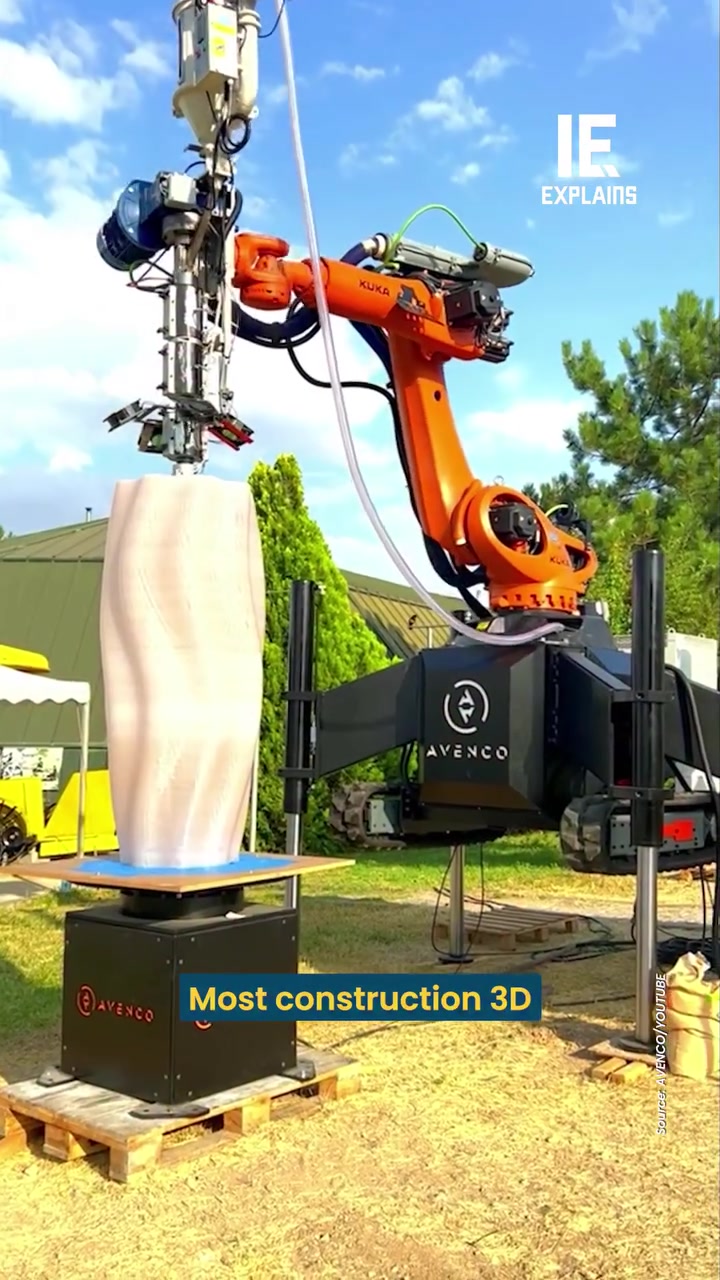
The 25-Kilo Extusionist
Built "by Avenço," this is no average printer. Its distinctive robotic arm and lack of "gantry," can print onsite like a robot, not a sacrificial cement mixer. The 1K extruder simply bolts onto an industrial-grade KUKA arm. Replacing an entire A-frame with a single bolt. But the mobile arm isn't the only thing that makes it a game-changer for construction. Closed gantries take up space. Open gantries are still walled-in by the need for long tracks while Avenço's portable printer simply rolls in. With the printer's high mobility, there's only a millimeter of deviation every ten meters. It can now print a 35-litre column every minute, making the KUKA "move in the dumbest overhangs, instead of wasting the wall thickness." In its lighter weight and material, the 2K is the opposite of the 1K. Its reel is easier to pull through the plastic, though its high speed leaves little room for error. Through extruding at 450 degrees, Avenço's 2K is the first large scale construction printer to handle soft glass and even carbon-fibre reinforced material. Both arms are capable of 25 kilos out of a single hour when running, and both able to build structures and complex shapes in mere minutes.
Site-Mobility Makes Construction Agile
Turkey's first 3D-printed building was completed in 2018, but not every building site is flat, or even on-site. The problem of moving around a site, especially for concrete printers, has always been a struggle. But with a tracked crawler, Avenço's robotic arms can even level rough ground or ride on rails. The crawler, which weighs nearly 2.3 tons, can also be set up for the arm to ride as a seventh axis and level itself. Often larger-scale printers can be set onto the side to print, but it runs into accuracy problems every 10–20 meters. With the rail track, it literally rides through a construction site. At 20 meters of a wall in a single minute, it doesn't just print buildings, but molds and even boat hulls. While previous 3D printers have utilized a gantry, their length and weight make them more of a hassle than a help. The hydraulic jacks, spider legs, that stabilize the crawler on rough ground, are a large part of why Avenço's printer can reach 10-second layers. Making it a prime option for "composite tooling," otherwise known as fiberglass molds.
Construction Printing Parts for Larger Projects
3D-printed buildings are a common project for Avenço. While it does print entire walls, the plastic-reinforced extruder can also print parts for larger projects. Be it "boat hulls, moulds, [or] furniture," or even composite tooling, the printer completely skips entire processes to provide almost immediate results. The reason it can print boat hulls is due to the variable layer height from 5 to 30 millimeters. This allows it to be stable enough to print on multiple axes, but precise enough to keep the boat hull accurate in construction. Because the composite side can handle glass and carbon fibre reinforced material, it can print a hull in a fraction of the time and require less finishing than ever before. The entire hull is built in layers, providing a rigid but light structure.
The Simplicity of the Quiet Arm
Reinforced materials are not the only ones that the Avenço can print with. Even simple materials like concrete are printed accurately and efficiently by the printer. Because the printer isn't a giant gantry, but a mounted arm, there's less to service and nothing to block off on a site. For starters, both extruders run smoothly, thanks to no moving parts, no noise, and a few hydraulics. It literally is its namesake, even extending to how the hydraulic jacks spider out to allow it to level. The giant arm, usually found in a factory, is now a portable printer. With less maintenance and more mobility, it prints at a rate even faster than a gantry would. It has no walls to keep it from overhangs or tall pillars, and it can print in even the most difficult of spaces.
The Printer's Timely Embellishments
Large scale printers, usually larger 3D printers, are always a hassle to service. But the lack of moving parts make this printer no hassle at all. For every 10-second layer, its hydraulic jacks barely make any noise. For those that are considering how the printer prints, the simple answer is it extrudes material, layer by layer. But that's not as simple as it sounds, especially when dealing with a KUKA arm. With a 3.9-kilogram weight and the ability to handle reinforced materials, the printer is capable of producing very complex objects. The harder materials provide a kind of rigidity that keeps the layers from warping. While the usual construction printers can't provide that kind of quality, these printers can.
The Colossal Threat of Mobile Printing
The thickness of the material itself is an impressive 30 millimeters. But that's not what makes this the first large-scale construction printer. The 25 kilogram cartridges they use are more than a novelty. Their specialized material allow for higher print speeds as well as higher accuracy in any material. Because the printer can handle glass and carbon fibre reinforced materials, from the start the printer is set to make a composite tooling. When you have the potential to produce carbon fibre reinforced materials with little more than a high power reel and a hydraulic arm, you can do anything from boat hulls to furniture without excess material or waste.
Cross-Industry Printing
Whether it's printing concrete walls or building incredible hulls, Avenço's robotic arm 3D printer offers a versatile solution in the print industry. Whether it is printing concrete, plastic, or even metal, the printer's high-accuracy, high-speed, and other capabilities make it a prime candidate for any printing sector.
- Mold Applications: The KUKA arm is an excellent choice for boat hulls or industrial molds. The 450-degree extruder is used to ensure the hull isn't warped or unstable, and the 20 millimeters a minute is great for large-scale molds. For the submarine hulls, the printer is an excellent choice for ensuring the boat hulls have a precise build, and the low-layer time keeps the hull stable and unwarped. The glass and carbon-fibre reinforced materials also keep the hull sturdy and lightweight.
- Concrete Construction: Avenço's printer, while it can print plastic, is mostly used for simple construction purposes such as walls or pillars. The 35-litre a minute speed and 450 degrees temperature. This printer uses no materials that would not be used for construction.
- Large Scale Projects: While there are many different uses for the printer, one of the most intriguing is its use with composite tooling. Composite tooling is anything that must be reinforced, such as car panels or boat hulls. While the printer is also great for the regular plastic or concrete projects, the high structural integrity of the carbon fibre makes it perfect for any project that requires rigidity and flexibility. Because the KUKA arm can handle any reinforced materials, the possibilities for this printer are endless. Molding boat hulls is an example of how Avenço's printer can print excellent composite structures, but the simplicity of the whole system is what makes it a great printer for any application.
The Future of Building
Turkey's first 3D-printed building shows the true extent of the Avenço printer. Since 2018, they've developed a printer that can print everything from simple concrete walls to reinforced materials. The printer is incredibly versatile, allowing for a variety of materials and purposes. This is what makes the printer such a great choice for any field of application.
Watch the Reel
Questions readers ask
What makes Avenço's 3D construction printer different from other 3D printers used in construction?
Avenço's printer stands out because it uses a robotic arm instead of a traditional gantry system. This design allows it to be highly mobile and efficient, capable of printing on uneven surfaces and in tight spaces. Additionally, it can handle a variety of materials, including soft glass and carbon-fiber reinforced composites, making it versatile for different construction needs.
How does the mobility of Avenço's printer impact its accuracy and efficiency?
The mobility of Avenço's printer is a significant advantage. It can maintain high accuracy, with only a millimeter of deviation every ten meters, and print at a rapid pace of 20 meters of a wall in a single minute. This makes it suitable for a wide range of applications, from building walls to creating complex shapes and even boat hulls.
What materials can Avenço's 3D construction printer handle, and why is this important?
Avenço's printer can handle a variety of materials, including soft glass and carbon-fiber reinforced composites. This capability is important because it allows for the creation of structures that are both strong and lightweight, which is crucial for applications like boat hulls and composite tooling.
Can Avenço's printer be used for projects other than building construction?
Yes, Avenço's printer is versatile and can be used for a variety of projects beyond traditional building construction. It can print parts for larger projects, such as boat hulls, molds, and furniture. This versatility makes it a valuable tool for different industries.
What kind of crawler system does Avenço's printer use, and how does it help with site mobility?
Avenço's printer uses a tracked crawler system that can level rough ground or ride on rails, enhancing its mobility on construction sites. This system, along with hydraulic jacks that stabilize the crawler, allows the printer to maintain high accuracy and efficiency, making it suitable for complex and large-scale projects.
Why does Avenço's printer require less finishing work compared to traditional methods?
Avenço's printer can print structures in layers, providing a rigid but light structure. This method reduces the need for extensive finishing work, as the layers are already stable and accurate. Additionally, the printer's ability to handle a variety of materials, including composites, further reduces the need for additional finishing.
Related deep dives
Similar reads based on topic and creator.




Recent articles
Fresh deep dives from the latest Reels we unpacked.



Comments
Be the first to comment.