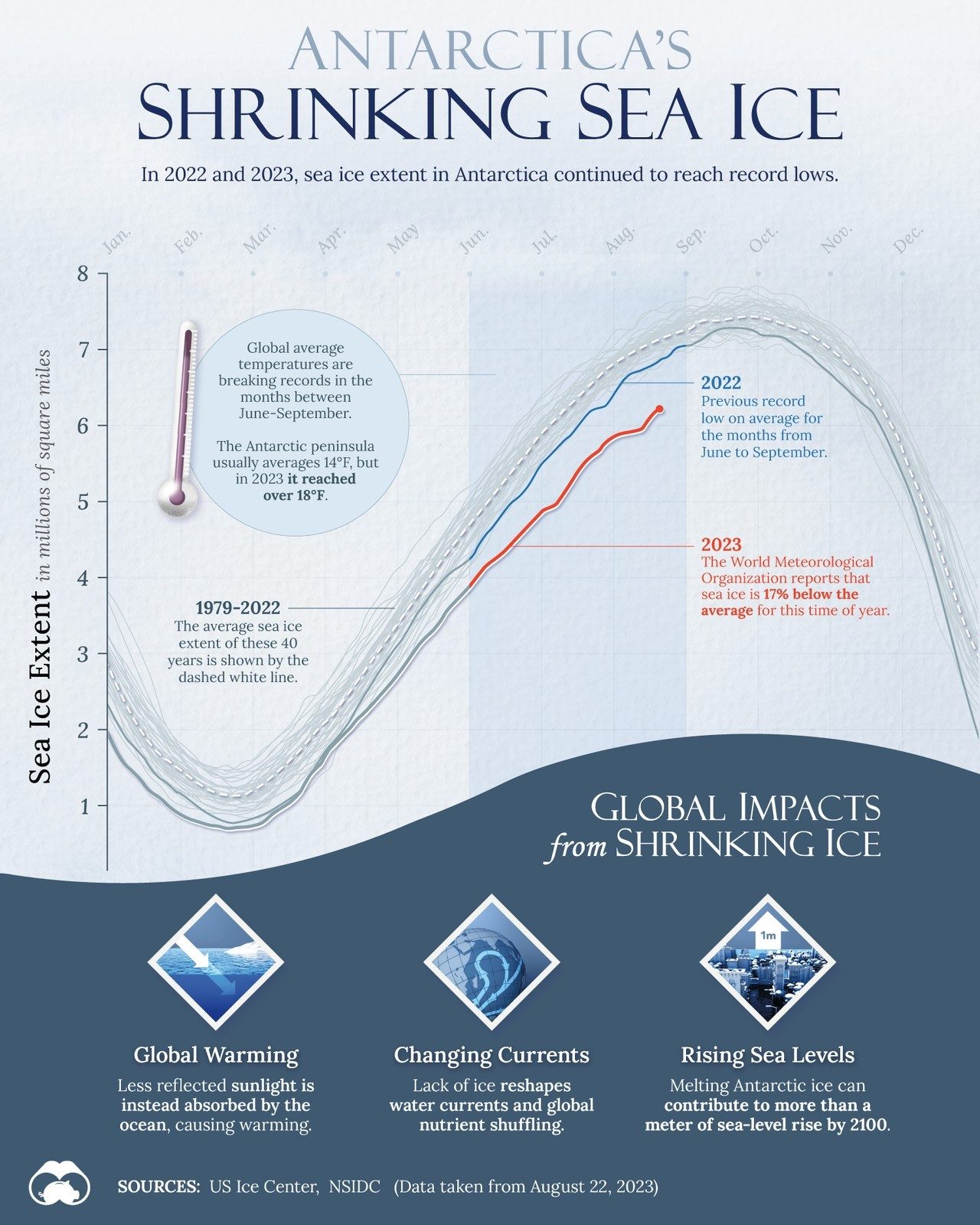
Antarctica’s Shrinking Sea Ice
Antarctica's sea ice has been a subject of intense study for decades. In 2022 and 2023, scientists have observed record-breaking decreases in the extent and concentration of this ice, raising significant concerns about global climate impacts. Understanding the current state of Antarctica’s sea ice is crucial for grasping the broader implications for our planet.
Why This Matters
The shrinking sea ice in Antarctica is not just a phenomenon affecting the southernmost continent; it has far-reaching effects on global climate patterns. The National Oceanic and Atmospheric Administration (NOAA) and the National Snow and Ice Data Center (NSIDC) provide critical data that help visualize and understand these changes. By tracking sea ice extent and concentration, researchers can better predict and mitigate the impacts on global warming, ocean currents, and sea levels.
Sea Ice Extent and Global Impacts
Record Lows in 2022 and 2023
The most alarming observation in recent years is the record lows in sea ice extent recorded in 2022 and 2023. This trend is particularly notable between June and September, during which global temperatures have been breaking records. The World Meteorological Organization reports that sea ice is 17% below the average for this time of year. This significant reduction highlights the accelerating pace of climate change and its direct impact on polar regions.
Global Warming
One of the primary effects of shrinking sea ice is enhanced global warming. Sea ice reflects a significant amount of sunlight back into the atmosphere, a process known as albedo. As the ice melts, less sunlight is reflected, and more is absorbed by the ocean. This absorption causes the ocean to warm, contributing to a positive feedback loop where warmer oceans further accelerate ice melt.
Changing Ocean Currents
The lack of sea ice also reshapes water currents and global nutrient distribution. Ocean currents are driven by differences in temperature and salinity, which are influenced by the presence of ice. When sea ice melts, it releases freshwater into the ocean, altering these currents. This can disrupt the global conveyor belt of nutrients, affecting marine ecosystems and fisheries worldwide.
Rising Sea Levels
Perhaps the most concerning impact is the contribution of melting Antarctic ice to rising sea levels. The Antarctic ice sheet contains enough ice to raise global sea levels by over a meter by 2100. As the ice sheet melts, it contributes to sea-level rise, posing a significant threat to coastal communities and low-lying islands around the world.
Sea Ice Concentration Changes
August 2023 Data
In August 2023, sea ice concentrations have dwindled to levels not seen in at least 30 years. This translates to a loss of over 1 million square miles of sea ice compared to the median extent from 1981 to 2010. The reduction is evident in both East and West Antarctica, with the ice loss particularly prominent in areas that typically hold more sea ice.
Comparisons Over Time
To understand the magnitude of this change, it's essential to compare current sea ice concentrations to historical data. The average sea ice extent from 1979 to 2022 is shown by a dashed white line on many tracking graphs. This line represents the baseline against which recent data is measured. The significant deviation from this baseline in 2023 underscores the rapid and alarming rate of sea ice loss.
Practical Tips for Staying Informed
Staying informed about Antarctica’s sea ice changes is vital for understanding broader climate trends. Here are some practical tips:
- Follow Reliable Sources: Rely on data from reputable organizations like NOAA and NSIDC for the most accurate and up-to-date information.
- Monitor Climate Reports: Regularly check climate reports and updates from organizations like the World Meteorological Organization.
- Use Visualization Tools: Utilize infographics and visualization tools to better understand the data and its implications. These tools can help make complex data more accessible and understandable.
- Engage with Climate Initiatives: Participate in local and global climate initiatives to stay informed and take action.
Important Takeaways
- Record Lows: The sea ice extent in 2022 and 2023 reached record lows, particularly between June and September.
- Global Impacts: Shrinking sea ice contributes to global warming, alters ocean currents, and raises sea levels.
- Data Consistency: Comparison with historical data highlights the rapid rate of sea ice loss.
- Ongoing Monitoring: Continuous monitoring and data analysis are crucial for understanding and mitigating the impacts of climate change.
Conclusion
Antarctica’s shrinking sea ice is a stark reminder of the far-reaching effects of climate change. The data from NOAA and NSIDC, along with visualizations, provide a clear picture of the current state and future projections. Understanding these changes is the first step in addressing the global impacts and taking action to mitigate the consequences. By staying informed and engaged, we can work towards a more sustainable future.
Watch the Reel
Questions readers ask
What caused the record lows in Antarctica's sea ice in 2022 and 2023?
The record lows in Antarctica's sea ice in 2022 and 2023 are primarily attributed to global warming trends. Rising global temperatures have led to increased melting, resulting in a significant decline in both the extent and concentration of sea ice around the continent.
How does the decline in Antarctica's sea ice affect global climate patterns?
The decline in Antarctica's sea ice can alter ocean currents, which play a crucial role in regulating global temperatures. Changes in these currents can lead to shifts in weather patterns and impact ecosystems worldwide. Additionally, the loss of sea ice contributes to a rise in global sea levels, posing threats to coastal communities.
What data sources provide insights into the changes in Antarctica's sea ice?
The National Oceanic and Atmospheric Administration (NOAA) and the National Snow and Ice Data Center (NSIDC) are key sources for tracking changes in Antarctica's sea ice. They provide valuable data on sea ice extent and concentrations, helping scientists and researchers understand the current trends and their implications.
What is the significance of the August trends in Antarctica's sea ice?
August is a critical month for monitoring Antarctica's sea ice because it marks the end of the Antarctic winter, when the sea ice typically reaches its maximum extent. The trends observed in August can indicate the overall health of the sea ice and provide insights into the long-term impacts of climate change on the region.
How does the decline in Antarctica's sea ice compare to that in the Arctic?
Both the Arctic and Antarctic sea ice have been declining, but the patterns and rates of decline differ. The Arctic has shown a more consistent and rapid decline in sea ice, largely due to rising temperatures and other factors. In contrast, Antarctica's sea ice has exhibited more variability, with significant record lows in 2022 and 2023 standing out as alarming indicators of change.
What are the broader implications of the changes in Antarctica's sea ice for the planet?
The changes in Antarctica's sea ice can have profound effects on global climate. The influx of freshwater from melting ice can alter ocean currents, impacting weather patterns and marine life. Furthermore, the loss of sea ice can accelerate global warming by reducing the Earth's reflectivity, allowing more solar radiation to be absorbed by the oceans.
Why are scientists closely monitoring the concentrations of Antarctica's sea ice?
Scientists closely monitor the concentrations of Antarctica's sea ice to gain a deeper understanding of its thickness and distribution. This information is vital for assessing the overall health of the ice and predicting future changes. By tracking these concentrations, researchers can better anticipate how the ice will respond to ongoing climate changes and the potential impacts on the planet.
Related deep dives
Similar reads based on topic and creator.



Recent articles
Fresh deep dives from the latest Reels we unpacked.




Comments
Be the first to comment.