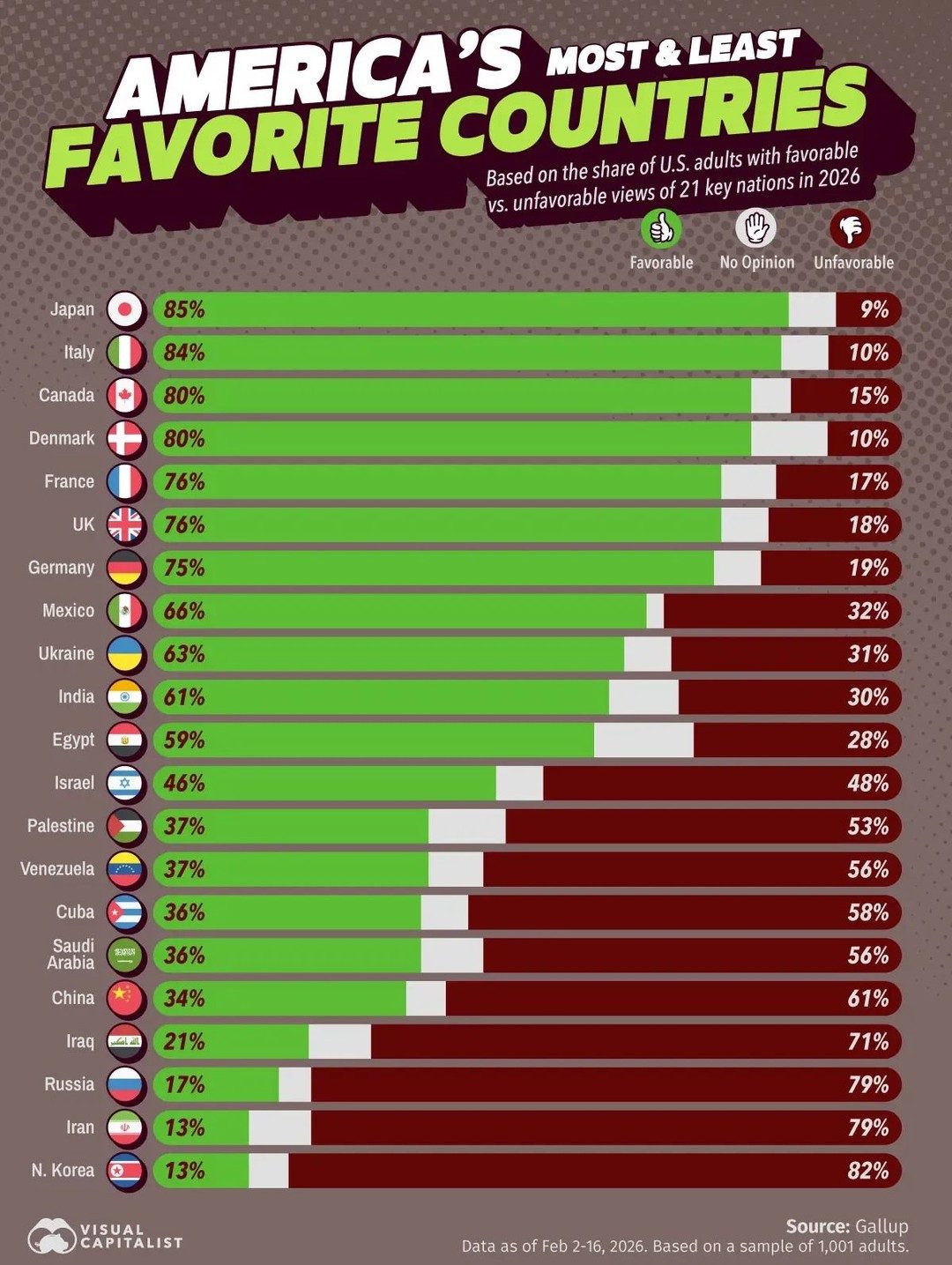
Country Favorability Rankings by Americans
Japan stands out as the most favorably viewed country among Americans, with an impressive 85% of U.S. adults holding a positive opinion. This places Japan at the top of the list, followed closely by Canada and Denmark, both with an 80% favorable rating. Meanwhile, North Korea, Iran, and Russia rank as the least popular countries. Let’s delve into the favorability rankings of 21 major countries based on Gallup survey data from February 2026.
Why This Matters
Understanding how Americans view different countries provides valuable insights into global perceptions and alliances. These rankings can influence diplomatic relations, trade agreements, and international policies. For instance, high favorability ratings can lead to stronger alliances and cooperation, while low ratings may indicate areas of tension or mistrust. By examining these rankings, we can better understand the dynamics of international relations and the factors that shape public opinion.
Main Discussion
Top-Ranked Countries
At the top of the list, Japan's favorability rating of 85% highlights its strong relationship with the United States. Japan has long been a strategic ally and a key partner in trade and military cooperation. The favorable views reflect a deep-seated respect and admiration for Japan's culture, technology, and economic achievements.
Canada and Denmark tie for second place with an 80% favorability rating. Canada, a close neighbor and ally, shares strong cultural, economic, and military ties with the United States. Denmark, known for its progressive policies and high quality of life, also enjoys a positive image among Americans. These high ratings underscore the importance of shared values and mutual interests in fostering positive international relations. France and the United Kingdom follow closely with 76% each. Despite occasional diplomatic tensions, both countries maintain strong cultural and historical ties with the United States. These favorable ratings indicate a deep-rooted appreciation for the historical and cultural connections between these nations.
Mid-Range Countries
Further down the list, Germany and Mexico rank with 75% and 66% favorability ratings, respectively. Germany, a key player in the European Union, is respected for its economic stability and leadership. Mexico, a neighbor and important trading partner, has seen fluctuations in its favorability due to ongoing debates over immigration and trade policies. Both countries play crucial roles in the global economy and international affairs, making their positive ratings significant.
Ukraine, India, and Egypt follow with 63%, 61%, and 59% favorability ratings, respectively. These countries have seen varying levels of attention from the American public due to recent geopolitical events. Ukraine’s favorability is likely influenced by its ongoing conflict with Russia, while India’s positive rating reflects its growing economic power and cultural influence. Egypt, a key ally in the Middle East, benefits from its strategic importance and long-standing relationship with the United States.
Lower-Ranked Countries
Israel and Palestine hold 46% and 37% favorability ratings, respectively. The complex geopolitical landscape and ongoing conflicts in the Middle East contribute to these varied ratings. Saudi Arabia and Cuba follow with 36% and 34% favorability ratings. Saudi Arabia’s favorability is influenced by its role as a key oil supplier and ally in the Middle East, while Cuba’s rating is shaped by its isolationist policies and political tensions with the United States.
Least Favorable Countries
At the bottom of the list, China and Russia rank with 34% and 21% favorability ratings, respectively. Both countries have complex relationships with the United States, marked by economic competition and strategic rivalries. Iran and North Korea hold the lowest favorability ratings, both at 13%. These countries are often viewed with suspicion due to their nuclear ambitions and human rights records.
Historical Context
Canada and the United Kingdom have recorded their lowest favorability ratings since Gallup began tracking them, indicating a shift in public opinion. Factors such as trade disputes, policy differences, and cultural changes may contribute to these declining ratings. Conversely, Japan's consistently high rating suggests a stable and positive relationship, despite occasional diplomatic challenges.
Practical Tips
For those involved in international relations, diplomacy, or trade, understanding these favorability rankings can provide valuable insights. Here are some practical tips:
- Engage in Cultural Exchange: Promote cultural exchange programs, educational initiatives, and tourism to foster a deeper understanding and appreciation between countries.
- Address Policy Differences: Work on addressing policy differences through diplomatic dialogue and negotiation to build stronger relationships.
- Highlight Economic Benefits: Emphasize the economic benefits of cooperation and trade to gain public support for international agreements.
- Leverage Media and Public Relations: Use media and public relations strategies to shape positive narratives about international partnerships and alliances.
Important Takeaways
- Japan leads the list with an 85% favorability rating, reflecting strong ties with the United States.
- Canada and Denmark follow closely, highlighting the importance of shared values and mutual interests.
- Mid-range countries like Germany and Mexico showcase the significance of economic and trade partnerships.
- Israel and Palestine, along with Saudi Arabia and Cuba, have varied ratings due to complex geopolitical dynamics.
- China and Russia, along with Iran and North Korea, are the least favored, reflecting ongoing tensions and rivalries.
- Understanding these rankings can help shape international policies and foster stronger global alliances.
Conclusion
The favorability rankings of countries among Americans provide a snapshot of global perceptions and international relations. Japan’s high rating underscores a strong alliance, while the varying ratings of other countries reflect complex geopolitical dynamics. For those involved in international affairs, understanding these rankings can offer valuable insights into public opinion and help shape effective diplomatic strategies. By addressing policy differences, promoting cultural exchange, and highlighting economic benefits, we can work towards fostering stronger and more positive international relationships.
Watch the Reel
Questions readers ask
Which country is the most favorably viewed by Americans in 2026?
Japan is the most favorably viewed country by Americans in 2026, with a remarkable 85% of U.S. adults expressing a positive opinion. This high favorability rating places Japan at the top of the list, reflecting strong positive sentiment towards the country.
What are the key factors influencing Americans' views on other countries?
Americans' views on other countries are shaped by a variety of factors. These include diplomatic relations, trade agreements, and international policies. Additionally, cultural exchanges, media portrayals, and global events play significant roles in shaping these opinions.
Which countries are ranked as the least favorably viewed by Americans in 2026?
In 2026, North Korea, Iran, and Russia are ranked as the least favorably viewed countries by Americans. These low rankings reflect significant negative sentiment towards these nations among U.S. adults, as indicated by the Gallup survey data.
Why is it important to track Americans' opinions on global countries?
Tracking Americans' opinions on global countries provides a snapshot of international relations and can influence diplomatic decisions, trade agreements, and international policies. For instance, high favorability ratings between countries can lead to stronger alliances, while low ratings can indicate areas of tension.
How does the favorability of Canada compare to that of Japan in the U.S.?
Canada is favorably viewed by Americans, with 80% of U.S. adults holding a positive opinion of the country. While Canada's favorability rating is lower than Japan's, it is still among the highest and reflects a strong positive relationship between the two countries.
What data source is used for the 2026 favorability rankings?
The 2026 favorability rankings are based on Gallup survey data from February 2026. This data provides a reliable and comprehensive snapshot of Americans' opinions on various countries, offering insights into global perceptions and international relations.
Related deep dives
Similar reads based on topic and creator.

Recent articles
Fresh deep dives from the latest Reels we unpacked.




Comments
Be the first to comment.