AI vs. Human Performance
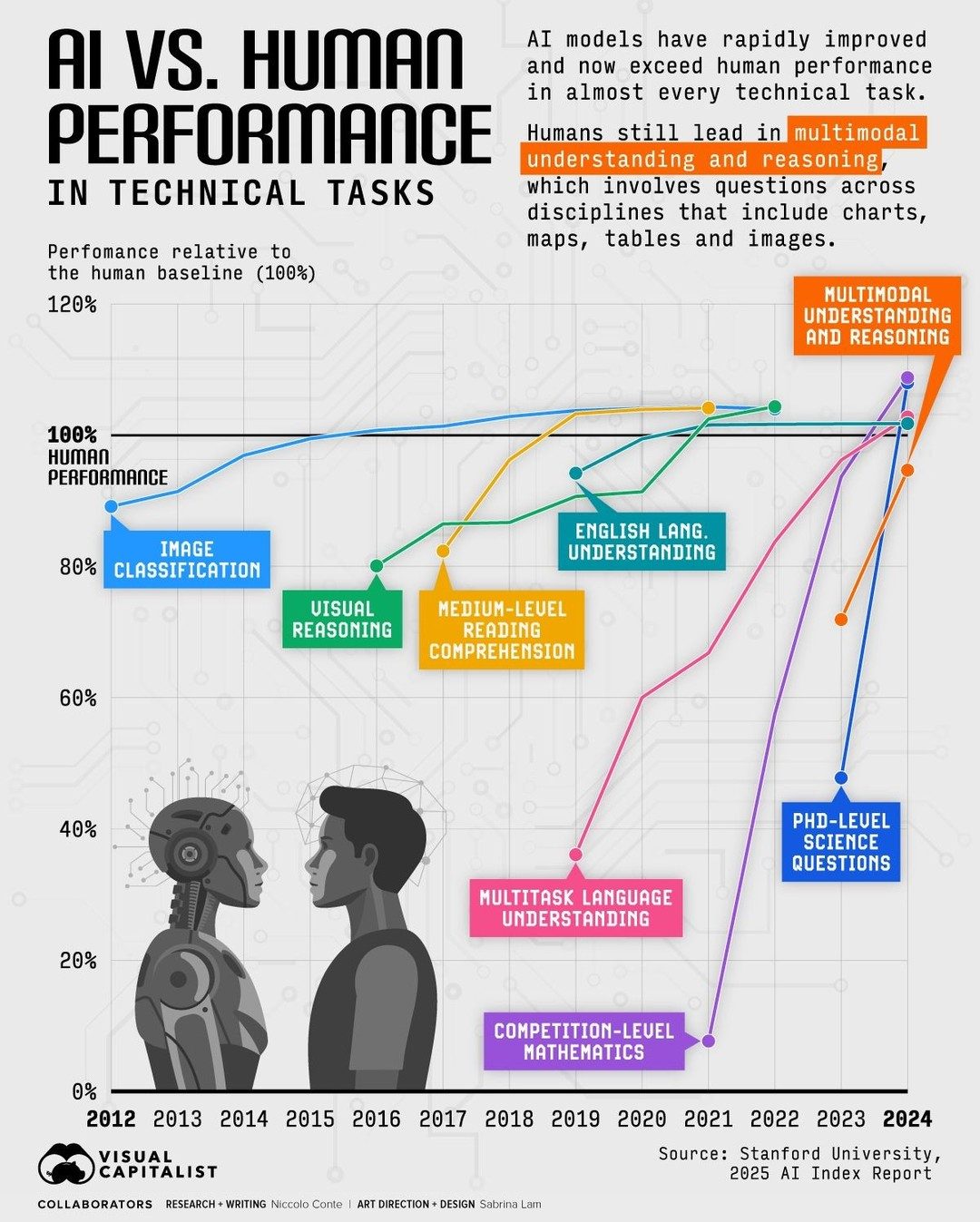
AI systems have surged ahead in recent years, closing the gap with human performance in a variety of technical tasks. This trend is highlighted by an informative infographic that compares AI and human capabilities across eight different benchmarks, tracking progress from 2012 to 2024.
Why This Matters
Understanding the evolving capabilities of AI is crucial for several reasons. Firstly, it helps us grasp the potential and limitations of AI in various fields. Secondly, it informs policy decisions, technological advancements, and even ethical considerations. As AI continues to advance, it's essential to stay informed about where it excels and where it still lags behind human performance.
Main Discussion
Key Benchmarks
The infographic focuses on several key technical tasks where AI and human performance are compared:
- Image Classification: This involves identifying and categorizing objects within images. AI has made significant strides in this area, often surpassing human accuracy.
- Visual Reasoning: This benchmarks the ability to understand and interpret visual information, going beyond simple recognition to deeper understanding.
- Medium-Level Reading Comprehension: This measures the ability to understand written text at a level comparable to a middle school student.
- English Language Understanding: This assesses the ability to comprehend and interpret English language text.
- Multitask Language Understanding: This evaluates the ability to handle multiple language-related tasks simultaneously.
- PhD-Level Science Questions: This benchmark tests the ability to answer complex scientific questions at a PhD level.
- Mathematics: This measures problem-solving skills in mathematical tasks.
- Multimodal Understanding and Reasoning: This evaluates the ability to understand and reason across multiple modalities, such as text, images, and audio.
Performance Trends
The infographic shows performance trends over time, highlighting how AI has closed the gap with human performance in these benchmarks. Here are some key observations:
- 2012-2016: In the early years, AI lagged behind human performance in most benchmarks. However, it showed promise in areas like image classification and language understanding.
- 2017-2020: This period saw rapid advancements in AI, with significant improvements in visual reasoning, reading comprehension, and multitask language understanding.
- 2021-2024: AI surpassed human performance in several benchmarks, including image classification, visual reasoning, and medium-level reading comprehension.
Future Projections
The infographic extends the performance trends to 2024, suggesting continued advancements in AI capabilities. By 2024, AI is projected to exceed human performance in all eight benchmarks, reaching a 120% performance level relative to the human baseline.
Practical Tips
For those interested in leveraging AI's capabilities:
- Stay Informed: Keep up with the latest developments in AI to understand its current and future potential.
- Invest Wisely: Consider investing in AI technologies that show promise in areas relevant to your field.
- Ethical Considerations: Be mindful of the ethical implications of AI, especially as it surpasses human performance in critical areas.
Important Takeaways
- AI has made rapid gains, surpassing human performance in several technical tasks.
- The gap between AI and human performance is narrowing fast, with AI projected to outperform humans in all assessed benchmarks by 2024.
- Understanding AI's capabilities and limitations is crucial for making informed decisions and policy considerations.
Conclusion
The narrowing gap between AI and human performance underscores the rapid advancements in artificial intelligence. As AI continues to evolve, it will undoubtedly reshape various industries and sectors. Staying informed about these trends and understanding the capabilities of AI will be essential for navigating this rapidly changing landscape.
Watch the Reel
Questions readers ask
Which specific tasks have seen AI making significant strides compared to human performance?
AI has shown remarkable progress in tasks such as image classification, where it can now often outperform humans. Additionally, AI has improved significantly in problem-solving and reasoning tasks, demonstrating a growing ability to handle complex challenges. Reading comprehension and visual understanding have also seen notable advancements, with AI systems becoming more adept at interpreting text and images.
How does the infographic compare AI and human capabilities over time?
The infographic provides a visual comparison of AI and human performance across eight benchmarks from 2012 to 2024. It highlights the areas where AI has made significant progress, such as image classification and problem-solving, as well as areas where AI still lags behind, like certain reasoning and comprehension tasks. This comparison helps illustrate how AI is narrowing the gap with human capabilities in these key areas.
What are the eight benchmarks used to compare AI and human performance?
The eight benchmarks used in the comparison are specific tasks that measure different aspects of AI capabilities. These include image classification, problem-solving, reasoning skills, visual understanding, and reading comprehension, among others. Each benchmark provides insights into AI's strengths and weaknesses compared to human performance.
Why is it important to track AI's progress over time?
Tracking AI's progress over time is crucial for understanding its evolving capabilities and limitations. This information is vital for making informed decisions in policy, technology development, and ethical considerations. By staying informed about AI's advancements, we can better prepare for its integration into various fields and anticipate potential challenges.
Which areas still pose a challenge for AI despite significant advancements?
While AI has made strides in many areas, it still faces challenges in certain reasoning and comprehension tasks. These include complex problem-solving that requires deep understanding and context, as well as nuanced reading comprehension and visual understanding. These areas highlight where AI still falls short and needs further development.
How can understanding AI's progress inform technological advancements?
By understanding where AI excels and where it still lags, researchers and developers can focus on areas that need improvement. This knowledge can guide the development of new AI systems and algorithms, enhancing their capabilities in tasks where they currently fall behind human performance. Additionally, it helps in creating more integrated systems that can leverage AI’s strengths while mitigating its limitations.
Related deep dives
Similar reads based on topic and creator.



Recent articles
Fresh deep dives from the latest Reels we unpacked.




Comments
Be the first to comment.