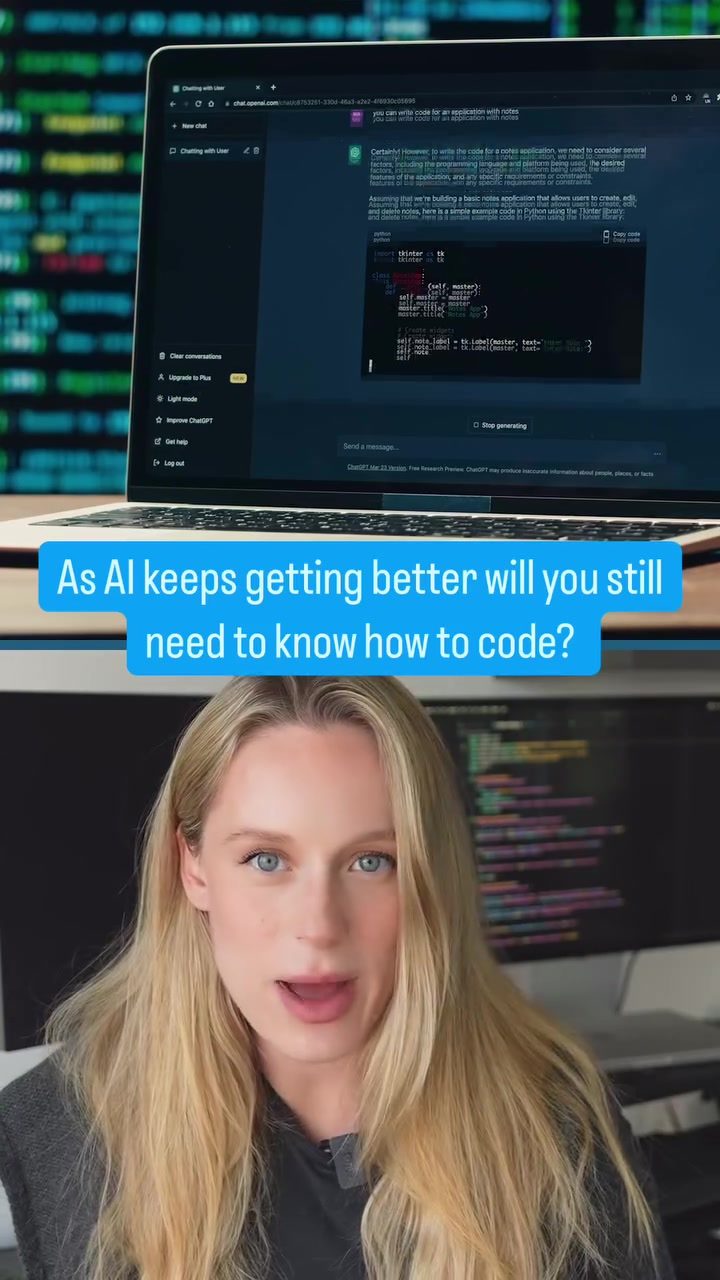
As AI Advances, Will Coding Skills Become Obsolete?
The rapid advancement of artificial intelligence has led many to wonder: will coding skills remain essential? AI's ability to write code is improving swiftly, but what does this mean for developers and the future of coding?
Why This Matters
The impact of AI on coding is significant. AI code generators, powered by transformer models, are trained on vast code repositories from open-source projects and proprietary APIs. These models excel at pattern recognition, rapidly generating boilerplate code, algorithms, and even entire functions. However, it's crucial to understand that these models don't comprehend the code they generate. They rely on probabilistic text generation, predicting the next token based on context, which can lead to misinterpreted edge cases or suggested code with hidden security flaws.
The Current State of AI in Coding
AI's Capabilities
AI can automate repetitive coding tasks, generate basic implementations, and even refactor existing code. This automation can increase productivity by up to 70% for developers who effectively leverage AI. However, AI's role is not to replace human developers but to augment their capabilities, acting as a force multiplier.
The Limitations of AI-Generated Code
While AI can write code quickly, it doesn't truly understand the logic behind it. This means that AI-generated code may not always be optimal or secure. For instance, AI might suggest code that includes security vulnerabilities or doesn't handle edge cases correctly. This is because AI models rely on pattern recognition and probabilistic text generation rather than an intrinsic understanding of the code's functionality.
The Shift in Skillset for Developers
Knowing How to Prompt AI
As AI becomes more integrated into coding, developers need to know how to prompt AI effectively. This involves understanding the AI's capabilities and limitations and crafting prompts that guide the AI to generate the desired code.
Validating AI-Generated Code
Developers must also be able to validate the output of AI-generated code. This includes checking for logical errors, security vulnerabilities, and edge cases that the AI might have missed. Given the probabilistic nature of AI-generated code, this validation step is crucial.
The Ethical Implications
There's also the ethical question of whether the code is truly "yours" if AI wrote 90% of it. This raises concerns about ownership, creativity, and the role of human developers in an AI-driven coding landscape.
Practical Tips for Developers
Embrace AI as a Tool
Rather than viewing AI as a threat, developers should embrace it as a powerful tool. By understanding how to use AI effectively, developers can increase their productivity and focus on more complex tasks that require human creativity and problem-solving skills.
Continuously Update Your Skills
The field of coding is constantly evolving, and with the rise of AI, it's more important than ever to stay updated. This includes learning new programming languages, tools, and frameworks, as well as understanding how to work with AI.
Focus on Problem-Solving
While AI can generate code, it can't solve complex problems that require human intuition and creativity. By focusing on problem-solving and critical thinking, developers can ensure that their skills remain valuable in an AI-driven world.
Collaborate with AI
Think of AI as a collaborator rather than a replacement. By working together, developers and AI can achieve more than either could alone. This involves knowing when to use AI for tasks like code generation and when to rely on human expertise for more complex problems.
Important Takeaways
- AI can automate repetitive coding tasks and generate basic implementations, increasing productivity by up to 70%.
- AI doesn't truly understand the code it generates, relying instead on probabilistic text generation, which can lead to errors and security vulnerabilities.
- Developers need to know how to prompt AI effectively, validate its output, and understand its limitations.
- AI is a tool that can augment human abilities, acting as a force multiplier rather than a replacement for human developers.
- Developers should focus on problem-solving, critical thinking, and continuously updating their skills to stay relevant in an AI-driven world.
Conclusion
As AI continues to advance, the role of human developers will evolve. While AI can generate code quickly, it lacks the understanding and creativity that human developers bring to the table. By embracing AI as a tool, continuously updating their skills, and focusing on problem-solving, developers can ensure that their skills remain valuable in an AI-driven world. The future of coding is not about replacing human developers with AI, but about leveraging AI to enhance and augment human capabilities.
Watch the Reel
Questions readers ask
Will AI completely replace human developers in the future?
AI is unlikely to completely replace human developers. While AI can automate certain tasks and boost productivity, it lacks true understanding of code. Human developers are still needed to ensure that code is secure, efficient, and optimized. They provide the critical thinking and contextual understanding.
What are the limitations of AI-generated code?
AI-generated code is based on pattern recognition and probabilistic text generation, and it doesn't truly understand the logic or intent behind the code. This can lead to errors, inefficiencies and security vulnerabilities that need to be corrected by human developers.
How does AI currently assist in coding?
AI can assist in coding by generating boilerplate code, algorithms, and even entire functions. AI tools can also help developers by providing code suggestions, identifying potential bugs, and automating repetitive tasks, allowing developers to focus on more complex and creative aspects of software development.
Will learning to code still be beneficial in the age of AI?
Yes, learning to code will still be beneficial. Understanding coding principles and being able to write and debug code will remain valuable. AI tools will continue to evolve, and developers who can effectively leverage these tools will have a competitive edge.
What role will human developers play in an AI-driven coding landscape?
Human developers will continue to play a crucial role in ensuring the quality, security, and efficiency of AI-generated code. They will be responsible for validating AI outputs, making critical design decisions, and handling complex problem-solving tasks that require deep domain knowledge and contextual understanding.
Related deep dives
Similar reads based on topic and creator.


Recent articles
Fresh deep dives from the latest Reels we unpacked.




Comments
Be the first to comment.