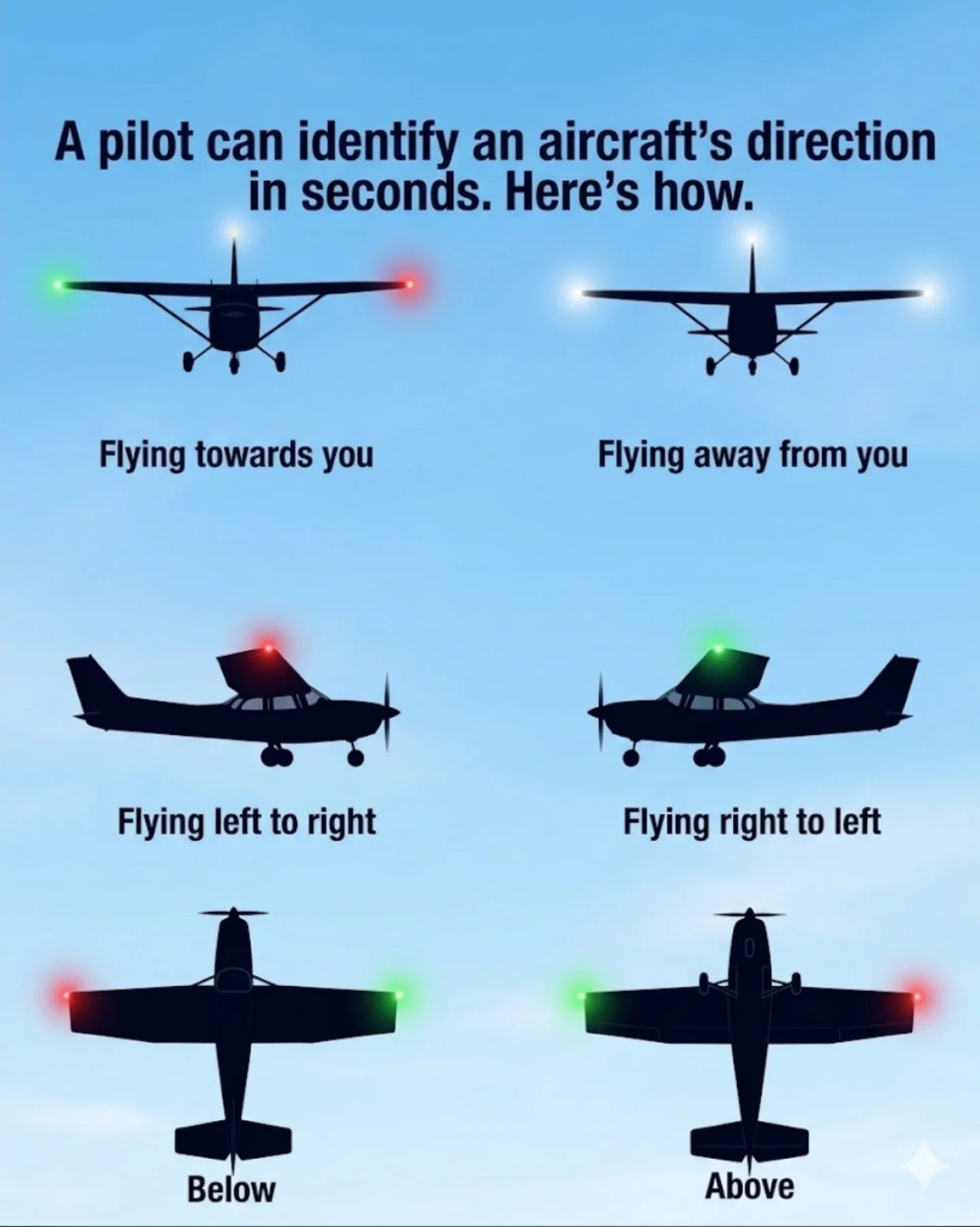
Aircraft Direction Identification Using Navigation Lights
For pilots, accurately determining the direction and flight path of an aircraft is crucial, especially in low visibility or nighttime conditions. The key to this skill lies in understanding and interpreting an aircraft's navigation lights. This article delves into how pilots use these lights to maintain situational awareness and avoid mid-air collisions.
Why This Matters
Aircraft navigation lights are not just for aesthetics; they are vital for safety. By quickly identifying the direction of another aircraft, pilots can make informed decisions to avoid potential collisions. This is particularly important in situations with low visibility, where visual cues are limited.
Standard Aviation Regulations
Aircraft navigation lights follow strict regulations to ensure universal understanding among pilots. These regulations specify:
- Red Light: Always on the left (port) wingtip.
- Green Light: Always on the right (starboard) wingtip.
- White Light: Located on the tail.
These lights are designed to provide clear directional information, helping pilots assess the relative position and movement of other aircraft.
Understanding Navigation Lights
Navigation lights are composed of two main types: position lights and anticollision lights. Position lights include the red, green, and white lights, while anticollision lights are typically red flashing lights on the top and bottom of the aircraft. These lights work together to give a comprehensive view of an aircraft's direction and movement.
Interpreting the Lights
Pilots use the orientation and color combination of these lights to determine the direction of an aircraft. Here are the key scenarios:
Flying Towards
When an aircraft is flying towards you, you will see the green light on the right wingtip and the red light on the left wingtip. The white light at the tail will be directly in the center.
Flying Away
If an aircraft is flying away from you, the red and green lights will be visible on the wingtips, but the white light at the tail will be obscured, showing a diminishing light pattern as it moves away.
Flying Left to Right
When an aircraft is flying from left to right across your path, you will see the green light first, followed by the red light. The white light will be visible at the tail.
Flying Right to Left
When an aircraft is flying from right to left across your path, you will see the red light first, followed by the green light. The white light will be visible at the tail.
Flying Below
If an aircraft is flying below your position, you will see the red and green lights on the wingtips, but the white light will be partially obscured, indicating a lower altitude.
Flying Above
When an aircraft is flying above your position, you will see the red and green lights on the wingtips, but the white light will be fully visible, indicating a higher altitude.
Practical Tips
-
Focus on the Anticollision Lights: In low visibility, the flashing red anticollision lights can help you quickly spot an aircraft. These lights are designed to be easily visible from any direction.
-
Use the Position Lights for Direction: Once you spot the anticollision lights, use the position lights to determine the direction of the aircraft.
-
Maintain Situational Awareness: Always be aware of your surroundings and the positions of other aircraft. Regularly scan the sky for navigation lights to avoid any potential collisions.
-
Communicate with Air Traffic Control: If you are unsure about the direction of an aircraft, communicate with air traffic control for guidance.
-
Practice in Different Conditions: Practice identifying aircraft directions in various lighting and visibility conditions to improve your skills.
Important Takeaways
- Navigation Lights Are Crucial: Understanding and interpreting navigation lights is essential for safe flying.
- Quick Identification: Pilots can identify an aircraft's direction in seconds by observing the position and color of the lights.
- Standard Regulations: Follow the standard aviation regulations for navigation lights to ensure clarity and safety.
- Practice Makes Perfect: Regular practice and situational awareness are key to mastering aircraft direction identification.
Conclusion
Aircraft direction identification through navigation lights is a fundamental skill for pilots. By following standard aviation regulations and understanding the orientation and color combination of the lights, pilots can quickly determine the direction of an aircraft. This skill is critical for maintaining situational awareness and ensuring mid-air collision avoidance, especially in low visibility conditions. Whether you are a seasoned pilot or just starting, mastering this skill will enhance your flight safety and efficiency.
Watch the Reel
Questions readers ask
What are the primary colors of aircraft navigation lights and what do they indicate?
Aircraft navigation lights typically include red, green, and white lights. The red light is positioned on the left wingtip, the green light on the right wingtip, and the white light is found on the tail or belly of the aircraft. These colors help pilots quickly determine the direction and orientation of other aircraft, even in poor visibility.
How do pilots use navigation lights to avoid collisions?
Pilots use navigation lights to maintain situational awareness and avoid collisions by understanding the position and movement of other aircraft. For example, seeing a red light indicates that the aircraft is flying to the pilot's left. Conversely, a green light means the aircraft is flying to the right. This information allows pilots to adjust their flight path accordingly and maintain a safe distance.
What are the standard aviation regulations regarding navigation lights?
Aviation regulations, such as those set by the FAA, mandate the use of navigation lights on aircraft to ensure safety. These regulations specify the colors, positions, and visibility requirements of the lights. For instance, the lights must be visible from a minimum distance to ensure that pilots can identify other aircraft from a safe range, typically 3 statute miles for small aircraft and 5 statute miles for larger ones.
Why are navigation lights crucial for nighttime and low visibility flying?
Navigation lights are essential for nighttime and low visibility flying because they provide visual cues that help pilots determine the direction and position of other aircraft. During these conditions, visibility is often limited, and relying on navigation lights allows pilots to maintain situational awareness and avoid potential mid-air collisions.
How do wingtip navigation lights help in identifying an aircraft's direction?
Wingtip navigation lights play a crucial role in identifying an aircraft's direction. The red light on the left wingtip and the green light on the right wingtip create a clear visual signal. By observing these lights, pilots can quickly determine the relative position and direction of another aircraft. For example, if a pilot sees a red light, they know the aircraft is flying to their left, while seeing a green light indicates the aircraft is moving to the right.
What are the specific meanings of the different aircraft light signals?
Different light signals on an aircraft convey specific information to pilots. The red and green wingtip lights indicate the aircraft's direction, while the white light on the tail or belly signifies the aircraft's presence and movement. Additionally, flashing lights or strobe lights can indicate various statuses, such as an aircraft in distress or one following specific flight procedures.
Recent articles
Fresh deep dives from the latest Reels we unpacked.




Comments
Be the first to comment.