AI Usage in Businesses Across the U.S. in 2026
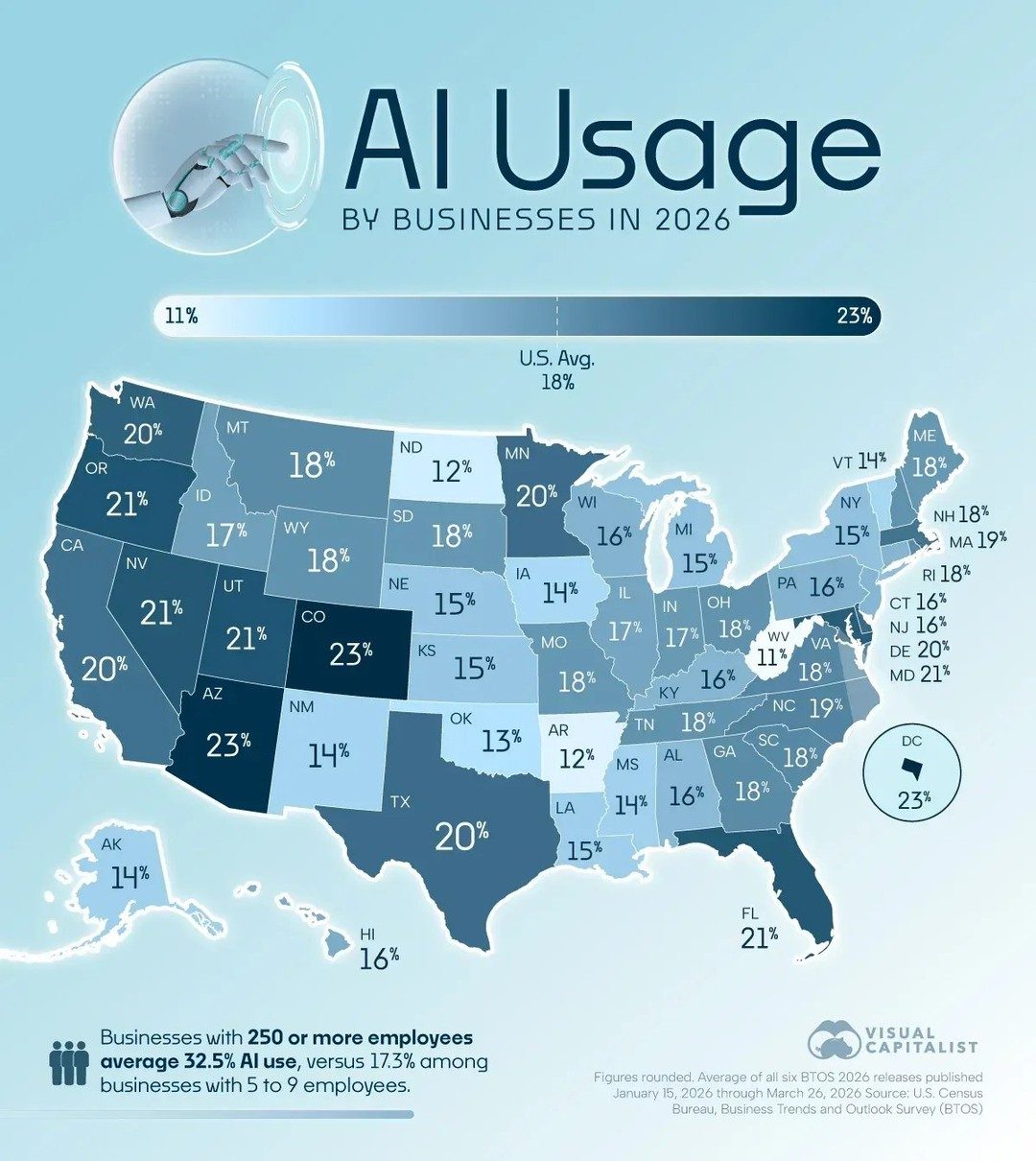
AI usage in businesses across the United States is poised for significant growth by 2026, with notable variations across different states. This shift marks a departure from the coastal tech-centric narrative, as states like Colorado and Arizona emerge as leaders in AI adoption.
Why This Matters
Understanding the landscape of AI adoption in businesses is crucial for several reasons. It provides insights into regional economic trends, highlights areas of technological innovation, and identifies potential opportunities for investment and collaboration. Additionally, it sheds light on how AI is being integrated into various industries, from manufacturing to healthcare, and how it is reshaping business strategies and operational efficiencies.
Main Discussion
Regional Trends
The infographic illustrates a diverse adoption rate of AI across the U.S. For instance, Colorado and Arizona are at the forefront with higher percentages of AI usage, indicating a robust ecosystem for technological innovation. On the other hand, states like Wyoming and Idaho show relatively lower AI adoption rates, suggesting potential areas for future growth and investment.
The data reveals that businesses with 250 or more employees have an average AI usage rate of 32.5%, compared to 17.3% for businesses with 5 to 9 employees. This discrepancy highlights the correlation between company size and AI integration, with larger enterprises more likely to adopt AI technologies to streamline operations and enhance productivity.
Industry Applications
AI is being employed across a wide array of industries, each leveraging its capabilities to drive efficiency and innovation. For example, in manufacturing, AI is used for predictive maintenance and quality control. In healthcare, AI enhances diagnostic accuracy and patient care management. Retailers utilize AI for personalized marketing and inventory management, while financial services benefit from AI-driven fraud detection and risk assessment.
Economic and Technological Evolution
The varying rates of AI adoption across different states reflect broader economic and technological trends. States with higher adoption rates often have strong tech ecosystems, supported by universities, research institutions, and venture capital. These ecosystems foster innovation and attract talent, creating a virtuous cycle that drives further AI adoption.
Additionally, the differences in AI usage rates between large and small businesses underscore the importance of scalable AI solutions. Larger enterprises have the resources to invest in comprehensive AI systems, whereas smaller businesses may require more accessible and affordable AI tools to compete in the market.
Business Trends and Outlook
The data presented is based on six BTOS (Business Trends and Outlook Survey) releases, published between January 15, 2022, and March 26, 2023, by the U.S. Census Bureau. This source provides a reliable snapshot of current AI adoption trends and highlights the dynamic nature of AI integration in U.S. businesses. The figures are rounded and represent an average of all data collected during the specified period.
Practical Tips
For businesses looking to enhance their AI capabilities, consider the following practical tips:
Assess Business Needs
Before implementing AI, evaluate your business needs and identify areas where AI can provide the most significant benefits. This could be in automation, data analysis, customer service, or strategic planning.
Start Small
Begin with pilot projects that allow you to test AI solutions on a smaller scale. This approach helps in understanding the technology's impact and fine-tuning your strategies without significant investment.
Invest in Training
Ensure your employees are well-versed in AI technologies. Training programs can help your team understand how to effectively use AI tools, integrate them into existing systems, and leverage their full potential.
Stay Updated
AI is a rapidly evolving field. Stay informed about the latest advancements and trends. Attend industry conferences, subscribe to relevant publications, and network with other professionals to keep your knowledge current.
Collaborate
Partner with tech companies, startups, and research institutions. Collaboration can provide access to cutting-edge AI technologies and expertise, helping your business stay ahead of the curve.
Important Takeaways
- AI adoption in U.S. businesses is expected to see significant growth by 2026, with Colorado and Arizona leading the way.
- Larger enterprises are more likely to integrate AI technologies, highlighting the need for scalable solutions.
- AI is being applied across various industries, driving innovation and efficiency.
- States with strong tech ecosystems are more likely to have higher AI adoption rates.
- Continuous evaluation, training, and collaboration are key to successful AI integration.
Conclusion
The AI landscape in U.S. businesses is evolving rapidly, with different regions and industries showcasing varied adoption rates. Understanding these trends can help businesses make informed decisions about AI integration, driving innovation, and maintaining competitiveness. By leveraging AI effectively, businesses can enhance operational efficiencies, improve customer experiences, and stay ahead in an increasingly tech-driven world.
Watch the Reel
Questions readers ask
Which states are expected to lead in AI adoption among businesses by 2026?
By 2026, Colorado and Arizona are projected to lead the U.S. in AI adoption among businesses, marking a shift from traditional tech hubs. This trend highlights the growing importance of AI across various industries in these regions.
How is AI adoption expected to vary across different states in the U.S. by 2026?
AI adoption in businesses is expected to vary significantly across different states. While traditional tech hubs may still be important, states like Colorado and Arizona are emerging as leaders, signaling a broader geographic distribution of AI integration.
What industries are expected to benefit most from AI adoption in Colorado and Arizona by 2026?
AI adoption in Colorado and Arizona is expected to impact various industries significantly. Key sectors include manufacturing, healthcare, and other industries where AI can enhance operational efficiency and innovation.
Why is understanding AI adoption in businesses important for economic trends?
Understanding AI adoption in businesses is crucial for identifying regional economic trends. It helps highlight areas of technological innovation, potential investment opportunities, and how AI is reshaping business strategies across different regions.
How does AI adoption in Colorado and Arizona compare to other states in 2026?
Colorado and Arizona are anticipated to rank highest in AI adoption among businesses by 2026. This ranking underscores their leadership in technological innovation compared to other states, which may still be in the early stages of AI integration.
What role does AI play in reshaping business strategies in 2026?
In 2026, AI is expected to play a pivotal role in reshaping business strategies. It offers insights into operational efficiencies, new opportunities for investment, and collaboration, particularly in regions like Colorado and Arizona that are leading in AI adoption.
Related deep dives
Similar reads based on topic and creator.


Recent articles
Fresh deep dives from the latest Reels we unpacked.




Comments
Be the first to comment.