Data Center Growth Projection
Artificial intelligence (AI) is revolutionizing industries, but this transformation comes with a significant drawback: a massive increase in electricity consumption, particularly in data centers. The demand for data centers is expected to surge, driven largely by AI workloads. This growth is projected to strain both data centers and the electricity supply.
Why This Matters
As AI continues to integrate into various sectors, the demand for data centers is escalating. These facilities are crucial for storing, processing, and distributing data, making them indispensable for modern digital infrastructure. However, the energy consumption of these centers is a growing concern.
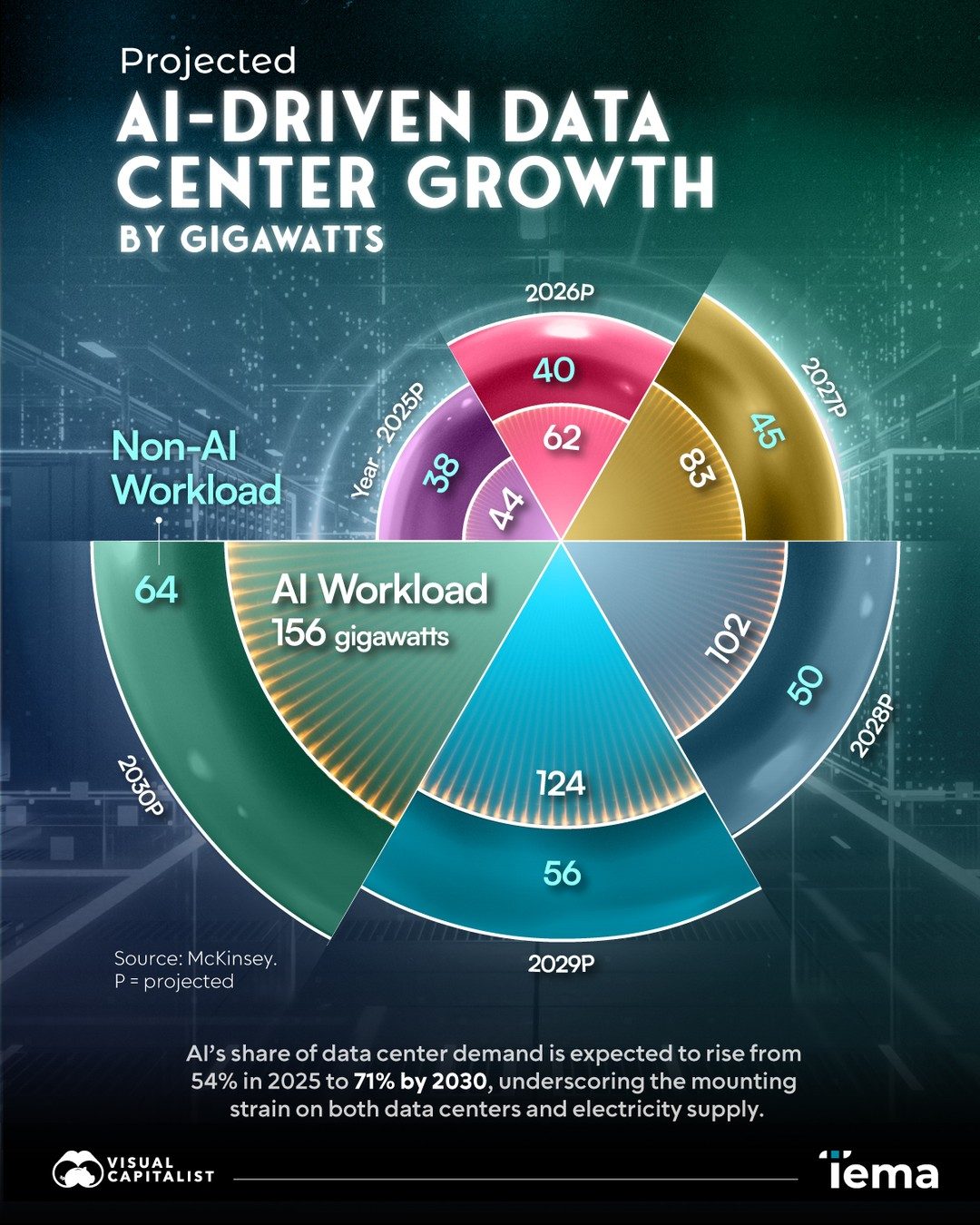
The infographic, sourced from McKinsey, highlights the projected growth of data center demand from 2025 to 2030. It reveals that AI workloads will account for an increasing share of data center demand, measured in gigawatts. Understanding this trend is vital for planning future infrastructure needs and mitigating the environmental impact.
Main Discussion
Projected Growth of Data Center Demand
The data provided by McKinsey shows a clear trend: AI workloads are expected to dominate data center demand. In 2025, the non-AI workload is projected to be 64 gigawatts, while the AI workload is expected to be 156 gigawatts. By 2030, AI's share of data center demand is projected to rise to 71%, up from 54% in 2025.
This shift underscores the mounting strain on both data centers and the electricity supply. The increasing demand for AI-driven data centers will require significant investments in infrastructure and renewable energy sources to meet the growing power needs.
The Role of AI in Data Center Demand
AI workloads are more computationally intensive than traditional workloads. This is because AI algorithms, particularly those used in machine learning and deep learning, require extensive processing power and memory. As a result, data centers need to upgrade their hardware and infrastructure to support these demands, leading to higher energy consumption.
Moreover, the growing adoption of AI in various sectors, such as healthcare, finance, and autonomous vehicles, will further drive the demand for data centers. These sectors rely on AI for tasks like data analysis, predictive modeling, and automation, all of which require substantial computational resources.
The Environmental Impact
The rising demand for data centers also raises concerns about their environmental impact. Data centers consume a significant amount of electricity, contributing to greenhouse gas emissions. The increasing energy demand from AI workloads will exacerbate this issue, making it essential to focus on sustainable solutions.
Data centers can mitigate their environmental impact by adopting renewable energy sources, such as solar and wind power. Additionally, improving energy efficiency through advances in hardware and software can help reduce energy consumption. However, these measures will require significant investment and innovation.
Practical Tips
For organizations looking to manage the growing demand for data center resources, here are some practical tips:
1. Invest in Energy-Efficient Data Centers
Energy-efficient data centers can significantly reduce electricity consumption. This involves using energy-efficient hardware, optimizing cooling systems, and implementing virtualization technologies to maximize resource utilization.
2. Adopt Renewable Energy Sources
Switching to renewable energy sources, such as solar and wind power, can help mitigate the environmental impact of data centers. Many data center providers offer renewable energy options, and investing in these can help organizations achieve their sustainability goals.
3. Optimize Workload Management
Efficient workload management can help optimize resource utilization and reduce energy consumption. This involves using advanced analytics and AI to predict and manage workloads, ensuring that resources are used efficiently.
4. Implement Data Center Infrastructure Management (DCIM)
DCIM solutions provide real-time monitoring and management of data center infrastructure, helping to identify inefficiencies and optimize resource utilization. This can help organizations reduce energy consumption and improve overall performance.
Important Takeaways
The projected growth in data center demand, driven by AI workloads, presents significant challenges and opportunities. Key takeaways include:
- AI workloads are expected to dominate data center demand, reaching 71% by 2030.
- The increasing demand for data centers will strain both infrastructure and the electricity supply.
- Organizations must invest in energy-efficient solutions, renewable energy sources, and advanced workload management to mitigate the environmental impact.
- Data center infrastructure management (DCIM) solutions can help optimize resource utilization and improve performance.
Conclusion
AI-driven growth in data center demand is an inevitable trend, but it comes with significant challenges, particularly in terms of energy consumption and environmental impact. Organizations must be proactive in adopting sustainable solutions and optimizing resource utilization to meet these demands. By investing in energy-efficient data centers, renewable energy sources, and advanced workload management, they can mitigate the environmental impact and ensure sustainable growth.
Watch the Reel
Questions readers ask
How much will AI workloads boost data center electricity demand by 2030?
According to projections, AI workloads are expected to significantly increase data center electricity demand. By 2030, AI's share of data center demand is anticipated to rise substantially, placing considerable strain on both data centers and the overall electricity supply.
What are the main challenges posed by the increased electricity demand from AI data centers?
The primary challenges include the need to expand and upgrade infrastructure to accommodate higher power demands, ensuring a stable electricity supply, and implementing efficient cooling systems to manage the increased heat generation from AI workloads.
How is AI impacting the electricity grid and what measures are needed to mitigate this impact?
AI's high electricity consumption in data centers is exerting significant pressure on the electricity grid. To mitigate this, power providers and data center operators must collaborate on enhancing grid resilience, investing in renewable energy sources, and promoting energy-efficient technologies.
What trends in data center power consumption should stakeholders expect in the coming years?
Stakeholders should anticipate a marked increase in power consumption as AI continues to proliferate. This trend will likely be characterized by rising electricity demand in data centers, necessitating advanced power management strategies and potential infrastructure overhauls to support the growing load.
How can data centers improve their energy efficiency to manage the increased electricity demand from AI workloads?
Data centers can enhance energy efficiency through several measures, such as adopting advanced cooling techniques, optimizing server utilization, using energy-efficient hardware, and integrating renewable energy sources. Additionally, leveraging AI to monitor and predict energy usage can help in optimizing power consumption.
What role do renewable energy sources play in addressing the electricity demand surge from AI data centers?
Renewable energy sources are crucial in mitigating the environmental impact of the increased electricity demand. By incorporating solar, wind, and other renewable sources, data centers can reduce their reliance on traditional power grids, lower carbon emissions, and ensure a more sustainable operation.
Why is it important to forecast power usage in data centers, especially with the rise of AI workloads?
Accurate forecasting is essential for planning infrastructure upgrades, ensuring a stable power supply, and implementing cost-effective energy management strategies. By anticipating future power demands, data centers can proactively address potential challenges and maintain operational efficiency in the face of escalating AI-driven electricity consumption.
Related deep dives
Similar reads based on topic and creator.


Recent articles
Fresh deep dives from the latest Reels we unpacked.




Comments
Be the first to comment.