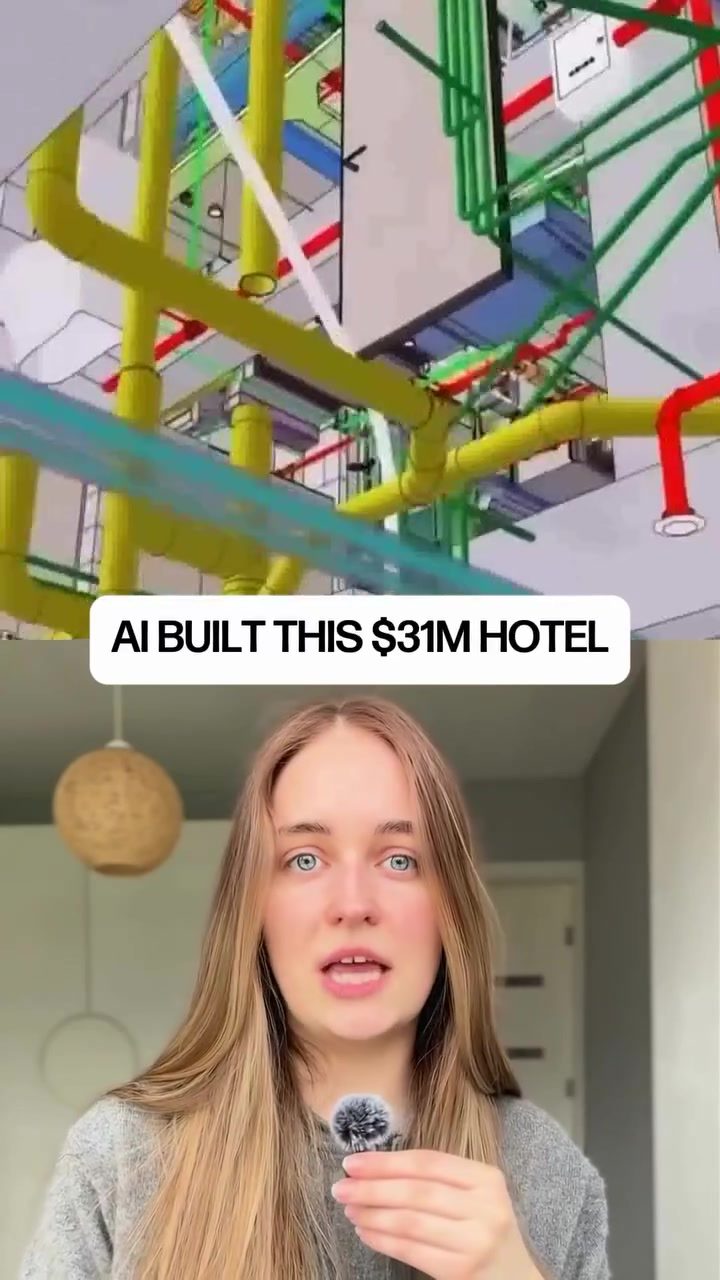
AI in Hotel Construction
In the construction of a $31 million dollar hotel, a comprehensive 3D map of every pipe and wire was created using Artificial Intelligence (AI). This feat was achieved by connecting Kimi K3 to design software through MCP, with engineers inputting their requirements in plain English. The AI modeled and coordinated every duct, electrical line, water pipe, and fire suppression system—crucial steps that typically precede construction. This innovative method significantly accelerated the process, reducing the time and cost from three engineers working for six weeks at $47,000 to just one engineer reviewing the AI’s work in nine days for roughly $10,500.
Why This Matters
Construction projects, especially those involving large-scale buildings like hotels, are notorious for costly change orders. These orders arise due to unforeseen issues or modifications that occur during the construction phase. By modeling every pipe and wire in a 3D environment before actual construction begins, change orders on-site can be dramatically reduced by 60 to 80 percent. This reduction is pivotal because change orders are where many projects incur substantial financial losses. The role of the engineer also evolves; instead of spending time on tedious design tasks, their focus shifts to verifying the AI-generated models and ensuring everything is accurately coordinated.
Main Discussion
The Transition to AI-Driven Construction
The integration of AI in construction marks a significant shift in how projects are approached and managed. Traditionally, the design and modeling phase required extensive manual labor involving multiple engineers. This process was not only time-consuming but also prone to human error, leading to costly revisions and delays. The advent of AI tools like Kimi K3 and MCP has revolutionized this aspect by automating the tedious tasks, allowing engineers to focus on higher-value work.
Reduction in Cost and Time
One of the most compelling aspects of AI-driven construction is the reduction in both time and cost. Traditionally, the design and modeling phase for a $31 million hotel would take three engineers six weeks, amounting to approximately $47,000. However, with the use of AI, this process can be completed in just nine days at a cost of around $10,500. This represents a nearly 80% reduction in both time and cost, making the construction process far more efficient.
Quality Assurance and Change Order Reduction
The AI’s ability to model and coordinate every aspect of the construction before the physical build begins ensures a high level of accuracy. This is particularly crucial in complex projects where the coordination of various systems (ducts, electrical lines, water pipes, and fire suppression systems) is vital. By identifying and resolving potential issues in the virtual model, the likelihood of encountering problems on-site is significantly reduced. This, in turn, leads to a dramatic reduction in change orders, which are a significant cost driver in traditional construction projects.
The Evolving Role of Engineers
The shift to AI-driven construction does not render engineers obsolete; rather, it transforms their roles. Engineers are no longer required to spend countless hours on manual design tasks. Instead, their expertise is leveraged in verifying the AI-generated models, ensuring that all components are accurately represented and coordinated. This not only saves time but also allows engineers to focus on more strategic and creative aspects of the project, ultimately leading to better outcomes.
Practical Tips
For construction professionals looking to integrate AI into their workflow, here are some practical tips:
Choose the Right Tools
Selecting the right AI tools is crucial. Kimi K3, connected through MCP, is a prime example of how AI can be integrated into design software to streamline processes. Research and choose tools that align with your specific needs and project requirements.
Invest in Training
While AI handles the tedious tasks, engineers still need to be trained on how to interact with these tools effectively. Invest in training programs to ensure that your team can leverage AI to its fullest potential.
Start Small
Begin by integrating AI into smaller, less critical components of your projects. This allows you to assess the effectiveness of the AI tools and make necessary adjustments before scaling up.
Embrace a Collaborative Approach
AI is not a replacement for human expertise but a complement. Encourage a collaborative approach where AI tools and human engineers work together to achieve the best results.
Continuous Improvement
Construction projects often have unique challenges. Continuously refine your AI models and processes based on feedback and results to enhance efficiency and accuracy.
Important Takeaways
AI-driven construction is more than just a trend; it is a transformative approach that can significantly reduce costs, time, and errors in complex projects. Here are the key takeaways:
- Efficiency: AI can complete tasks in a fraction of the time and cost compared to traditional methods.
- Accuracy: Virtual modeling ensures that every component is accurately coordinated, reducing the likelihood of issues on-site.
- Cost Savings: The reduction in change orders and manual labor translates to substantial cost savings, particularly in large-scale projects.
- Role Evolution: Engineers' roles shift towards quality control and strategic planning, allowing for more efficient and effective project management.
Conclusion
Incorporating AI into the construction of a $31 million hotel not only demonstrates the feasibility and benefits of this technology but also sets a precedent for future projects. By leveraging AI tools like Kimi K3 and MCP, construction professionals can achieve unprecedented levels of efficiency, accuracy, and cost savings. This shift allows engineers to focus on higher-value tasks, ensuring that projects are completed faster, cheaper, and with fewer errors. The future of construction is undeniably tied to AI, and embracing this technology is essential for staying competitive in an ever-evolving industry.
Watch the Reel
Questions readers ask
How does AI expedite the 3D modeling process in hotel construction?
AI automates the creation of detailed 3D models, such as those for pipes and wires, by understanding plain English inputs from engineers. This automation reduces the time taken to generate these models from weeks to days, allowing engineers to focus more on reviewing and verifying the AI’s work.
What specific tasks are automated when using AI in hotel construction design?
AI can model and coordinate various components such as ducts, electrical lines, water pipes, and fire suppression systems. These elements are crucial for hotel construction and are typically designed before the actual construction begins.
How much time and cost savings can AI bring to a $31M hotel construction project?
For a $31M hotel, AI significantly reduced design work from six weeks by three engineers to just nine days by one. The costs associated with this task dropped from $47,000 to roughly $10,500, showcasing both time and cost efficiency.
What are the benefits of integrating AI with design software in hotel construction?
Connecting AI with design software allows engineers to input requirements in plain English, which AI then translates into detailed 3D models. This integration ensures that the design process is more efficient and accurate, with engineers spending less time on manual tasks.
How accurate is AI-generated design work in the construction of hotels?
AI-generated designs are highly accurate, provided that the initial inputs from engineers are clear and precise. Engineers spend their time reviewing and verifying the AI’s work, ensuring that any discrepancies are minimized.
What role does an engineer play in AI-driven hotel construction design?
In AI-driven construction, engineers primarily oversee the AI's work by inputting requirements and reviewing the generated 3D models. This reduces the need for extensive manual design work, allowing engineers to focus on higher-level tasks.
What software tools are utilized to integrate AI in hotel construction design?
Software tools like Kimi K3 and MCP are used to connect AI with design software. Engineers input their requirements, and the AI generates comprehensive 3D models, making the design process more efficient and accurate.
Related deep dives
Similar reads based on topic and creator.


Recent articles
Fresh deep dives from the latest Reels we unpacked.

Comments
Be the first to comment.