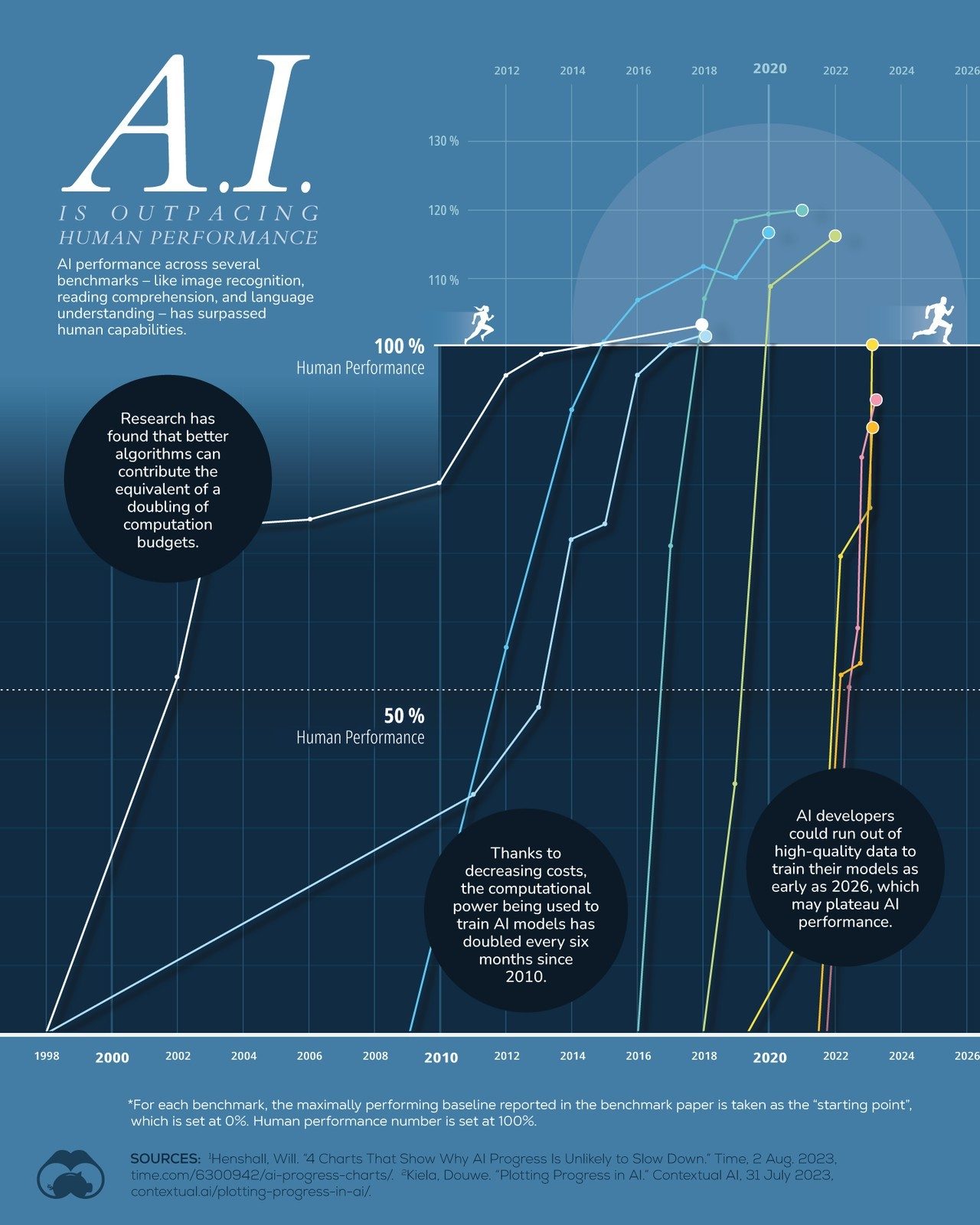
AI Progress Chart
AI has been making significant strides, particularly in areas traditionally dominated by human capabilities such as reading comprehension, speech recognition, and image identification. The rapid advancements in AI are evident in a chart that illustrates how AI has surpassed and is expected to continue outpacing human performance in various domains. This trend underscores the exponential growth in AI's computational power and its increasing integration into daily life.
Why this matters
Understanding the progression of AI is crucial for several reasons. First, it highlights the accelerating pace of technological change. Second, it emphasizes the need for continued innovation and adaptation in various industries. Finally, it prompts discussions about the ethical considerations and potential implications of AI surpassing human capabilities in critical areas.
Main discussion
Historical Context
The chart spans from 1998 to 2026, providing a comprehensive view of AI's performance over nearly three decades. This timeframe is significant because it encompasses the rise of the internet, the proliferation of smartphones, and the advent of modern AI technologies. The early 2000s saw the beginning of significant strides in AI, with notable milestones such as the development of more sophisticated algorithms and the increasing availability of computational resources.
Key Milestones
Several key milestones are highlighted in the chart, each marking a significant advancement in AI capabilities. For instance, the chart indicates that AI has surpassed human performance in areas such as handwriting recognition, image recognition, and speech recognition. These milestones are not isolated events but part of a broader trend of rapid progress.
Computational Budgets
Research has found that the computational budgets used to train AI models have doubled every six months since 2010. This exponential growth in computational power has been a driving force behind the rapid advancements in AI. The chart underscores the importance of continuous investment in computational resources, which is essential for training more complex and accurate AI models.
Benchmarks and Performance Metrics
The chart uses human performance as a baseline, setting it at 100%. Each benchmark's maximally performing baseline reported in the benchmark paper is taken as the 'starting point,' set at 0%. This approach provides a clear and comparative framework for evaluating AI's progress. For each benchmark, AI's performance is then measured against this human baseline, showing how AI has not only matched but often surpassed human capabilities.
Future Projections
The chart extends to 2026, offering a glimpse into the future of AI. It suggests that AI will continue to outpace human performance in various areas, potentially leading to further disruptions and innovations. Key areas where AI is expected to make significant strides include language understanding, common sense reasoning, and code generation. These projections are based on current trends and the increasing computational power available for training AI models.
Color-Coded Representation
The chart employs a color-coded system to differentiate between various AI capabilities. For instance, handwriting recognition is represented by white, image recognition by dark blue, and speech recognition by light blue. This visual representation makes it easier to understand the progress in different areas at a glance. Additional colors represent other capabilities such as reading comprehension, language understanding, common sense completion, grade school math, and code generation.
Contextual AI Progress
The chart is sourced from Will Henshall's article "4 Charts That Show Why AI Progress Is Unlikely to Slow Down," published in Time on August 2, 2023. This article provides deeper insights into the factors driving AI's progress and the potential implications for society. For a more detailed analysis, you can visit the Contextual AI website at contextual.ai/progress-charts/.
Practical tips
Stay Informed
To stay informed about the latest developments in AI, consider following reputable sources and experts in the field. This will help you keep up with the rapid advancements and understand their implications for various industries.
Invest in Computational Resources
For those involved in AI research or development, investing in computational resources is crucial. The exponential growth in computational power is a key driver of AI progress, and having access to advanced computational resources can give you a competitive edge.
Ethical Considerations
As AI continues to outpace human performance, it is essential to consider the ethical implications. This includes issues such as job displacement, privacy concerns, and the potential for AI to be used for malicious purposes. Engaging in discussions and efforts to address these ethical considerations can help mitigate potential risks.
Important takeaways
The chart illustrates the rapid progress of AI, highlighting several key takeaways. First, AI has already surpassed human performance in various areas, and this trend is expected to continue. Second, the exponential growth in computational power is a significant driver of AI progress. Finally, staying informed, investing in computational resources, and considering ethical implications are essential for navigating the future of AI.
Conclusion
AI's progress is a testament to the rapid advancements in technology and its increasing integration into daily life. As AI continues to outpace human performance in various domains, it is crucial to stay informed, invest in computational resources, and consider the ethical implications. By doing so, we can harness the full potential of AI while mitigating potential risks and ensuring its beneficial use for society.
Watch the Reel
Questions readers ask
How has AI's performance in reading comprehension improved over time?
AI's reading comprehension capabilities have significantly improved, surpassing human performance in understanding and interpreting text. This progress is evident in AI's ability to answer questions, summarize information, and even generate coherent text. Major milestones include the development of advanced language models and transformers, which have revolutionized natural language processing.
What are some key areas where AI has outperformed humans?
AI has notably surpassed human performance in areas such as reading comprehension, speech recognition, and image identification. For instance, AI models can now transcribe speech to text more accurately than humans and identify objects in images with remarkable precision. These advancements are transforming fields like healthcare, autonomous vehicles, and customer service.
How does the AI performance progress chart illustrate AI's advancements?
The AI performance progress chart provides a visual representation of AI's exponential growth in capabilities from 1998 to 2026. It shows how AI has not only caught up to but also surpassed human performance in various domains, highlighting key milestones and the rapid pace of technological change. The chart is a useful tool for understanding the trajectory of AI development and its impact on different industries.
What ethical implications arise from AI outperforming humans?
As AI continues to outpace human performance, several ethical considerations come to the forefront. These include job displacement due to automation, privacy concerns with data-driven AI systems, and the potential for AI to perpetuate or amplify existing biases. Additionally, there are questions about accountability and the potential misuse of AI technologies, all of which require careful consideration and regulation.
How is AI's integration into daily life expected to evolve?
AI's integration into daily life is expected to become even more pervasive. With advancements in AI capabilities, we can anticipate more sophisticated virtual assistants, improved healthcare diagnostics, and enhanced personalization in various services. However, this integration also necessitates a balanced approach to ensure that the benefits of AI are widely shared and that potential risks are mitigated.
What are some industries most affected by AI advancements in speech recognition?
Industries such as customer service, healthcare, and entertainment are among those most affected by AI advancements in speech recognition. These industries are leveraging AI to provide more efficient and accurate services, such as automated customer support, voice-activated medical devices, and interactive entertainment experiences. The integration of AI in these sectors is not only improving efficiency but also enhancing user experiences.
What are some of the AI capabilities from 1998 to 2026?
From 1998 to 2026, AI capabilities have evolved dramatically. Early advancements included basic pattern recognition and simple natural language processing. By the 2010s, AI began to excel in areas like image and speech recognition. Looking ahead, AI is expected to achieve even greater proficiency in complex decision-making, creative problem-solving, and real-time data analysis, further integrating into various aspects of society and industry.
Related deep dives
Similar reads based on topic and creator.



Recent articles
Fresh deep dives from the latest Reels we unpacked.




Comments
Be the first to comment.