Understanding AI Model Costs: A Comparative Analysis
When delving into the world of artificial intelligence (AI), one of the most critical factors to consider is the cost per task for various AI models. This cost can significantly impact the feasibility and scalability of AI implementations in different projects. Here, we will explore a comparative analysis of the costs of different AI models to give you a clearer understanding of the financial implications involved.
Why This Matters
Understanding the cost per task for AI models is essential for budgeting, resource allocation, and making informed decisions about which models to use for specific applications. The cost can vary widely based on the model's complexity, reasoning capabilities, and other factors. By comparing these costs, businesses and developers can optimize their spending and maximize the efficiency of their AI solutions.
The Cost Breakdown
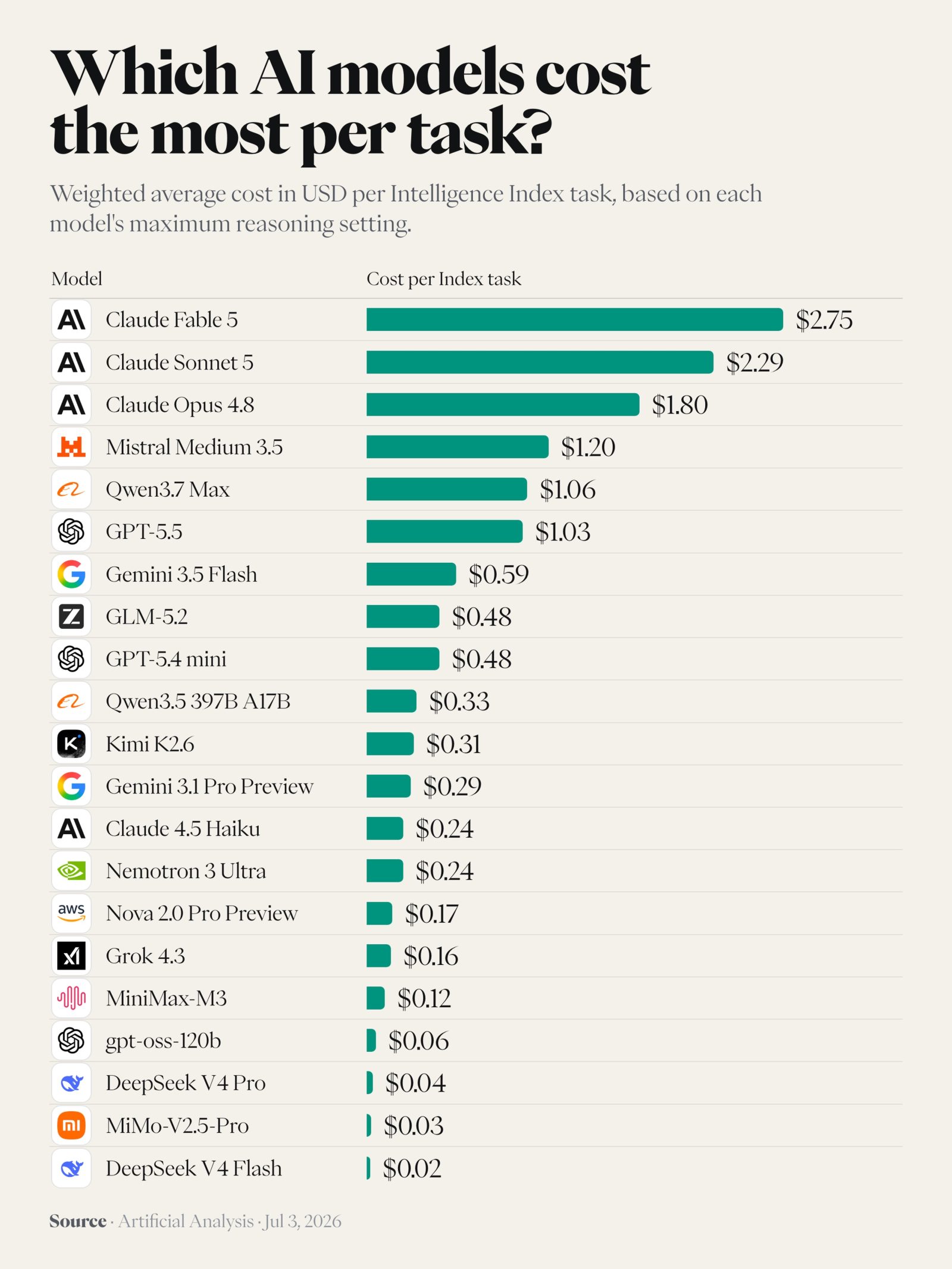
The chart provides a clear comparison of various AI models, listed with their corresponding costs in USD. The models are ranked based on their weighted average cost per task, considering each model’s maximum reasoning setting. Here are some key points to note:
High-Cost Models
At the higher end of the cost spectrum, you have models like Claude Fable 5 and Claude Sonnet 5, which cost $2.75 and $2.29 per task, respectively. These models are likely equipped with advanced reasoning capabilities and offer a high level of accuracy and performance. Claude Opus 4.8 follows closely at $1.80, making it a slightly more affordable option with presumably similar capabilities.
Mid-Range Models
Models like Mistral Medium 3.5 at $1.20, Qwen3.7 Max at $1.06, and GPT-5.5 at $1.03 fall into the mid-range category. These models offer a balance between cost and performance, making them suitable for a wide range of applications. Gemini 3.5 Flash at $0.59 and GLM-5.2 at $0.48 are also noteworthy, providing robust performance at a relatively lower cost.
Budget-Friendly Models
For those looking to optimize costs without compromising too much on performance, models like Qwen3.5 397B A17B at $0.33, Kimi K2.6 at $0.31, and Gemini 3.1 Pro Preview at $0.29 are viable options. These models are designed to be more cost-effective, making them ideal for large-scale or budget-conscious projects.
Economy Models
If cost is the primary consideration, models like Nemotron 3 Ultra at $0.24, Nova 2.0 Preview at $0.17, Grok 4.3 at $0.16, and MiniMax-M3 at $0.12 offer the lowest costs. These models are suitable for tasks where the AI's reasoning capabilities are less critical or for projects with very tight budgets.
Best Value
At the very bottom, we have gpt-oss-120b at $0.06, DeepSeek V4 Pro at $0.04, MiMo-V2.5-Pro at $0.03, and DeepSeek V4 Flash at $0.02. These models provide the most economical options, making them ideal for bulk tasks or low-stakes applications where cost efficiency is paramount.
Practical Tips for Choosing the Right AI Model
When selecting an AI model for your project, consider the following tips to ensure you make the best decision:
Assess Your Budget
Determine your budget constraints and align them with the cost per task of the AI models. Higher-cost models may offer superior performance, but they may not be necessary for all applications. If cost is a significant factor, opt for more economical models that still meet your performance needs.
Evaluate Task Requirements
Consider the specific requirements of your tasks. Some models may be overkill for simple tasks, while others may not offer the necessary capabilities for complex tasks. Choose a model that balances cost and performance for your specific use case.
Check for Scalability
If your project involves large-scale operations, ensure that the chosen model can handle the volume of tasks efficiently. Lower-cost models may be more scalable and suitable for bulk processing.
Performance vs. Accuracy
Consider the trade-off between performance and accuracy. High-cost models generally offer better accuracy and performance, but they come at a higher price. Evaluate whether the improved performance justifies the additional cost for your specific application.
Trial and Error
Don’t hesitate to experiment with different models to see which one best fits your needs. Many AI service providers offer trial periods or demo versions, allowing you to test the models before committing to a purchase.
Important Takeaways
The cost per task for AI models varies significantly, and understanding these differences is crucial for making informed decisions. Here are the key takeaways:
- High-Cost Models: Offer top-tier performance and accuracy but come at a premium price.
- Mid-Range Models: Provide a good balance between cost and performance, suitable for a wide range of applications.
- Budget-Friendly and Economy Models: Ideal for cost-conscious or large-scale projects where performance requirements are less critical.
- Best Value: Offer the most economical options, perfect for bulk tasks or low-stakes applications.
Choosing the right AI model involves considering your budget, task requirements, scalability, and the trade-off between performance and accuracy. By understanding the cost per task and evaluating these factors, you can make a well-informed decision that optimizes both cost and performance for your specific needs.
Conclusion
The cost per task for various AI models is a critical factor in determining the feasibility and scalability of AI implementations. By understanding the cost breakdown and considering practical tips, you can make informed decisions that align with your budget and project requirements. Whether you opt for high-cost models for top-tier performance or economical models for cost efficiency, the right choice will depend on your specific needs and priorities.
Watch the Reel
Questions readers ask
How do AI model costs differ between high-end and budget-friendly options?
High-end AI models, such as Claude Fable 5, typically have higher costs per task, like $2.75, due to their advanced capabilities. In contrast, budget-friendly options like GLM-5.2 cost around $0.48 per task, making them more affordable for projects with tighter budgets.
Why is it important to compare AI model costs for specific tasks?
Comparing AI model costs for specific tasks helps developers and businesses determine the most cost-effective solution. This ensures that they can scale their projects efficiently without overspending, especially when dealing with large datasets or complex operations.
What factors influence the cost per task for AI models?
Several factors influence the cost per task for AI models, including the model's complexity, reasoning capabilities, and the underlying infrastructure required to run it. High-end models with superior performance generally cost more per task than their medium or budget-friendly counterparts.
How can understanding AI model costs help with budgeting and resource allocation?
By understanding the costs associated with different AI models, businesses can create more accurate budgets and allocate resources more effectively. This knowledge allows for better planning and ensures that the chosen model fits within the project's financial constraints while meeting performance requirements.
What is the significance of comparing AI model costs for project scalability?
Comparing AI model costs is crucial for project scalability because it helps in choosing models that can handle increasing workloads without disproportionately increasing costs. This ensures that as the project grows, the financial implications remain manageable, supporting long-term sustainability.
Are there any medium-tier AI models that offer a balance between cost and performance?
Yes, there are medium-tier AI models that provide a good balance between cost and performance. While they may not have the advanced capabilities of high-end models, they offer reasonable performance at a more affordable price point, making them suitable for a wide range of applications.
How can an AI model comparison chart assist in choosing the right model for a project?
An AI model comparison chart provides a visual and concise way to evaluate different models based on their costs and performance metrics. By comparing factors such as cost per task, speed, and accuracy, businesses can make informed decisions about which model best fits their project's needs and budget.
Related deep dives
Similar reads based on topic and creator.



Recent articles
Fresh deep dives from the latest Reels we unpacked.




Comments
Be the first to comment.