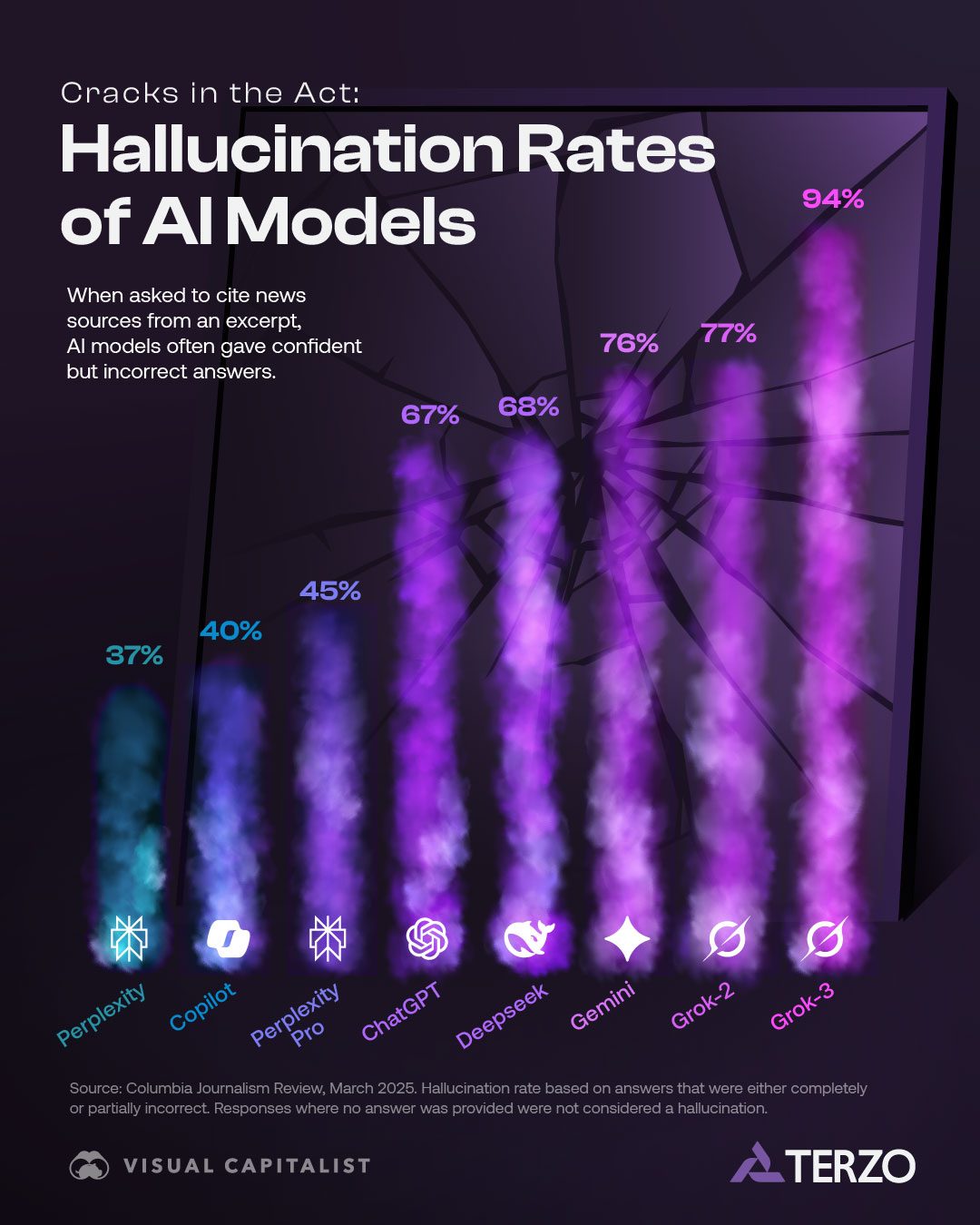
AI Hallucination Rates
AI models have become ubiquitous in our daily lives, assisting with everything from drafting emails to generating code. However, the accuracy of these models is a topic of growing interest. Recent data reveals that AI hallucination rates—the instances where AI models produce incorrect or misleading information—can be surprisingly high, sometimes reaching up to 94%. This article delves into the hallucination rates of various AI models, providing a clear picture of where these technologies stand today.
Context / Why This Matters
Understanding AI hallucination rates is crucial for several reasons. First, it helps users gauge the reliability of the information they receive from AI systems. Second, it guides developers in identifying areas for improvement in AI model training and deployment. Lastly, it aids organizations in making informed decisions about which AI models to integrate into their operations. The insights provided here are grounded in a data visualization comparing hallucination rates across different AI models, as presented in a recent executive guide by TERZO AI and Visual Capitalist.
Main Discussion
What Are AI Hallucinations?
AI hallucinations occur when an AI model generates outputs that are factually incorrect or misleading. These errors can range from minor inaccuracies to completely fabricated information. Hallucinations can be triggered by a variety of factors, including ambiguous input, insufficient training data, or inherent limitations in the model's architecture.
Hallucination Rates by Model
The hallucination rates for various AI models can vary significantly. Here's a breakdown of the hallucination rates for some popular models as per the TERZO AI and Visual Capitalist data visualization:
- Perplexity: 45%
- Copilot: 76%
- Perplexity Pro: 77%
- ChatGPT: 67%
- Deepseek: 68%
- Gemini: 68%
- Grok-2: 77%
- Grok-3: 94%
These rates highlight the varying levels of accuracy among different AI models. For instance, Perplexity has a relatively lower hallucination rate compared to Grok-3, which has the highest rate at 94%.
Factors Influencing Hallucination Rates
Several factors contribute to the high hallucination rates observed in AI models:
- Data Quality: The quality and quantity of training data significantly impact the model's performance. Insufficient or biased data can lead to higher hallucination rates.
- Model Architecture: The design and complexity of the model architecture play a crucial role. Some architectures are better suited for handling ambiguous inputs and generating accurate outputs.
- Prompt Engineering: The way prompts are crafted can influence the model's responses. Effective prompt engineering can help mitigate hallucinations by providing clear and unambiguous instructions.
- Contextual Understanding: AI models with better contextual understanding are less likely to hallucinate. Models that can comprehend the broader context of a conversation or task tend to produce more accurate results.
Practical Tips
To minimize the impact of AI hallucinations, consider the following practical tips:
Verify AI-Generated Information
Always verify AI-generated information with reliable sources before making decisions based on it. Cross-referencing with multiple sources can help identify and correct any inaccuracies.
Use Multiple AI Models
Leverage multiple AI models to generate responses and compare the outputs. This approach can help identify inconsistencies and improve the overall reliability of the information.
Provide Clear Prompts
Craft clear and unambiguous prompts to help the AI model generate accurate responses. Avoid vague or open-ended questions that can lead to higher hallucination rates.
Stay Informed About Model Limitations
Understand the limitations of the AI models you are using. Knowing their strengths and weaknesses can help you make more informed decisions and manage expectations accordingly.
Important Takeaways
As AI continues to evolve, so do its capabilities and limitations. The hallucination rates highlight the need for continuous improvement and vigilance in AI development and deployment. Users and developers alike must be aware of these limitations and take steps to mitigate their impact.
Conclusion
AI hallucination rates are a critical aspect of AI model performance that cannot be overlooked. By understanding the factors contributing to these errors and taking practical steps to mitigate them, we can enhance the reliability and usefulness of AI systems. Whether you're a developer, a user, or an organization integrating AI into your operations, staying informed about AI hallucination rates is essential for making informed decisions and ensuring the accuracy of AI-generated information.
Watch the Reel
Questions readers ask
What are AI hallucination rates and why are they significant?
AI hallucination rates refer to the frequency at which AI models generate incorrect or misleading information. These rates are significant because they indicate how often users might receive unreliable information, impacting the trustworthiness of AI outputs.
Which AI models have the highest hallucination rates?
While specific rates can vary, models like Deepseek and Terzo have been noted for high hallucination rates, sometimes exceeding 90%. Even widely-used models like ChatGPT and Gemini can produce incorrect answers in a significant portion of their responses.
How can users detect AI hallucinations in the information provided by AI models?
Users can detect AI hallucinations by cross-verifying the information with reliable sources, using tools for AI hallucination detection, and staying informed about common types of errors associated with specific AI models.
What are some common examples of AI hallucinations?
AI hallucinations can manifest in various ways, such as generating factual inaccuracies, producing non-existent references, or providing logically inconsistent explanations. For instance, an AI might invent a non-existent historical event or provide a solution to a problem that doesn't align with known scientific facts.
How can developers improve AI models to reduce hallucination rates?
Developers can reduce AI hallucination rates by implementing stricter data validation processes, enhancing training data quality, incorporating robust error-checking mechanisms, and continuously updating models with the latest, most accurate information.
Are there tools available for visualizing AI hallucination rates?
Yes, there are tools and techniques for visualizing AI hallucination rates, such as confusion matrices, error rate charts, and specific AI hallucination visualization tools that help in understanding and mitigating the frequency and types of errors produced by AI models.
What precautions should users take when relying on AI-generated information?
Users should approach AI-generated information with caution, verify critical information through multiple sources, and be aware of the limitations and potential inaccuracies of the AI model being used. Regularly updating knowledge about the AI model's performance can also help in making more informed decisions.
Related deep dives
Similar reads based on topic and creator.


Recent articles
Fresh deep dives from the latest Reels we unpacked.




Comments
Be the first to comment.