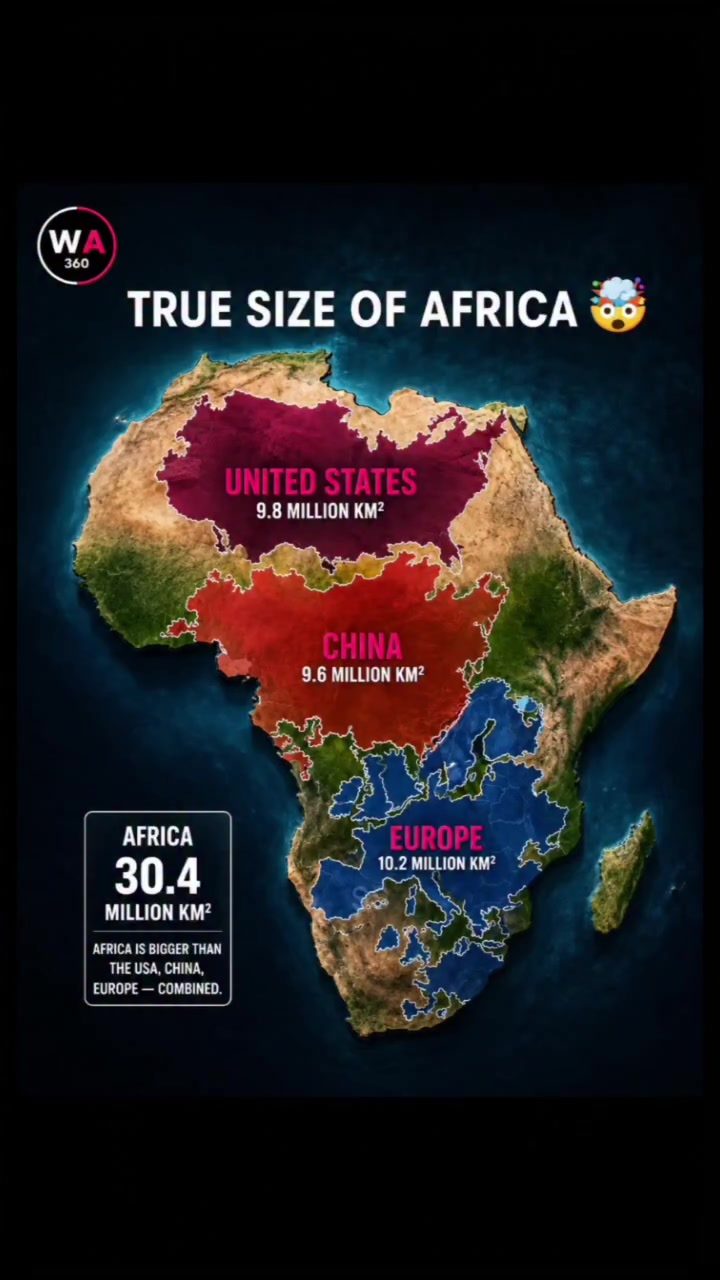
Africa's Size Comparison
Africa stretches across an astonishing 30.4 million square kilometers, making it significantly larger than many people realize. This vast continent could comfortably encompass the United States, China, and most of Europe within its borders, with room to spare. Understanding the true size of Africa challenges conventional map projections that often distort the sizes of countries and continents, offering a fresh perspective on global geography.
Why This Matters
The misconception about Africa's size isn't just a geography trivia factoid; it has profound implications for how we perceive the world. The standard Mercator map projection, commonly found in classrooms and atlases, disproportionately shrinks Africa and other regions near the equator while exaggerating the sizes of countries in the Northern Hemisphere. This distortion shapes our global understanding, influencing everything from international relations to cultural perceptions.
The true scale of Africa is more than just a matter of landmass. It's home to 54 nations, each with its own rich history, culture, and diverse landscapes. From the Sahara Desert to the lush rainforests of the Congo Basin, the continent's biodiversity is unmatched. Africa is also a hub of human diversity, with over 1.4 billion people speaking thousands of different languages and representing a myriad of cultures. This vast human landscape reflects Africa's global importance in history, resources, innovation, and future developments.
Africa's Size in Context
Misleading Map Projections
Most world maps we encounter are based on the Mercator projection, created in the 16th century. While this projection is useful for navigation, it distorts the size of landmasses disproportionately. Africa, for instance, appears much smaller than it actually is. In reality, Africa is about 3.4 times the size of the United States, and it could contain China, India, and most of Europe combined with plenty of space left over.
Comparing Landmasses
Let's break down the landmasses to understand the scale more clearly:
- Africa: 30.4 million square kilometers
- United States: 9.8 million square kilometers
- China: 9.6 million square kilometers
- Europe: 10.2 million square kilometers
When you overlay these countries onto a map of Africa, it becomes evident how vast the continent is. The United States, China, and Europe combined would still fit within Africa's borders, leaving significant space unoccupied.
Beyond Landmass: Africa's Rich Diversity
54 Nations
Africa is a continent of nations, not a single, homogeneous entity. With 54 recognized countries, each has its own unique history, government, and cultural heritage. From the bustling cities of Nigeria to the serene landscapes of Botswana, the diversity is astounding.
Extraordinary Landscapes
From the towering peaks of Mount Kilimanjaro to the vast expanses of the Serengeti, Africa's landscapes are as varied as they are breathtaking. The continent is home to some of the world's most iconic natural wonders, including the Nile River, the world's longest, and the Victoria Falls, one of the largest waterfalls by volume.
Unmatched Biodiversity
Africa's biodiversity is unparalleled. The continent is home to a vast array of flora and fauna, including the "Big Five" game animals: the lion, leopard, rhinoceros, elephant, and Cape buffalo. The Great Rift Valley is a hotspot for biodiversity, hosting a multitude of endemic species.
Practical Tips for Understanding Africa's Size
Explore Interactive Maps
Interactive maps and digital globes offer a more accurate representation of Africa's size. Tools like the "True Size" map by James Talmage and Damon Manahan allow users to compare the sizes of countries and continents more accurately. These tools can help correct the misconceptions propagated by traditional map projections.
Read Books and Articles
Dive into books and articles that discuss Africa's geography, history, and culture. Publications like "Africa: A Biography of the Continent" by John Reader and "The Scramble for Africa" by Thomas Pakenham provide deep insights into the continent's rich past and present.
Engage with African Media
Explore African media, including films, documentaries, and literature, to gain a more nuanced understanding of the continent. Works like "Beasts of No Nation" by Uzodinma Iweala and documentaries like "Black Gold" offer insights into the diverse experiences and challenges faced by African people.
Important Takeaways
Understanding the true size of Africa is crucial for several reasons. It corrects a fundamental misconception propagated by traditional map projections, highlights the continent's immense biodiversity and cultural richness, and underscores its global importance. Recognizing Africa's true scale can foster a more accurate and respectful global perspective, fostering better understanding and cooperation.
Conclusion
The true size of Africa is a revelation that challenges our conventional understanding of the world. By appreciating the continent's vast landmass, rich diversity, and global importance, we can foster a more accurate and respectful global perspective. Whether through interactive maps, insightful literature, or engaging media, exploring Africa's true size offers a fascinating journey into a world that is both familiar and surprising.
Watch the Reel
Questions readers ask
How large is Africa compared to other continents?
Africa spans approximately 30.4 million square kilometers, making it the second-largest continent. It is larger than Europe, Asia, and the United States combined. Only Asia is larger than Africa. North America is also smaller than Africa, with a total area of 24.7 million square kilometers. This makes Africa significantly larger than most people perceive it to be.
Why does Africa appear smaller on most maps?
Most maps use the Mercator projection, which distorts the size of objects near the equator. This projection shrinks Africa and enlarges countries near the poles. For instance, Africa appears to be roughly the same size as Greenland or the United Kingdom on these maps, which is a gross underestimation of its true size.
How does Africa's size compare to the United States?
Africa is about 3.6 times the size of the United States. The US has a total area of 9.8 million square kilometers, while Africa spans 30.4 million square kilometers. This means that the continent of Africa could comfortably contain the United States, China, and most of Europe, with room to spare.
What are the implications of understanding Africa's true size?
Comprehending Africa's true size helps to correct misconceptions about the continent and the world. By understanding the true size of Africa, it is easier to appreciate the vastness of its biodiversity, vast natural resources, and its diverse cultures. This understanding can also help with better global policy decisions, international relations, and planning.
Why should we challenge conventional map projections?
Conventional map projections, such as the Mercator map, often distort the sizes of countries and continents, leading to inaccurate geographical perceptions. By challenging these projections, we can achieve a more accurate understanding of the world, fostering a better appreciation of global geography and the true size of continents like Africa. This can also help to correct the misconception that Africa is a small continent.
Related deep dives
Similar reads based on topic and creator.

Recent articles
Fresh deep dives from the latest Reels we unpacked.




Comments
Be the first to comment.