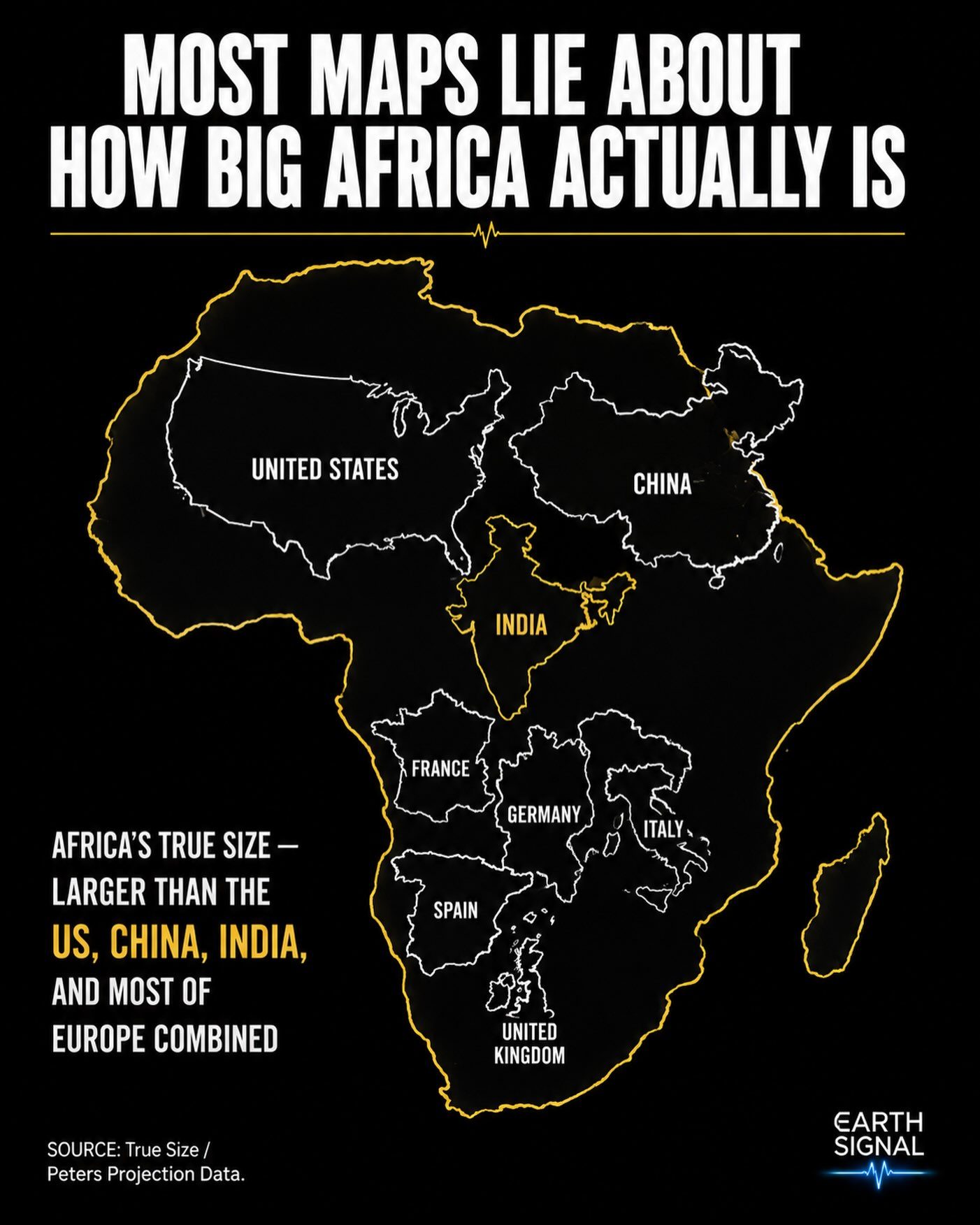
The Mercator Map's Distortion of Africa
Africa is approximately 14 times larger than Greenland. It is large enough to hold the United States, China, India, and most of Western Europe combined. Yet, most maps omit this important fact. Gerardus Mercator—a Flemish geographer—developed the Mercator projection in 1569, a map designed for navigation purposes. It is a cylindrical map projection that represents the surface of a sphere or an ellipsoid on a cylinder. The projection preserves direction and shape but significantly distorts size, particularly near the poles. During the Age of Exploration, it was incredibly important for sailors to keep a consistent compass bearing during long voyages. Mercator maps were the tools that facilitated this. However, despite its navigational advantages, the Mercator map has a serious drawback: it distorts the size of landmasses, making regions closer to the poles appear larger than they are, just as the equator makes Greenland look similar to Africa. When it was released in 1569, the Mercator map may have been useful for sea navigation, but it wasn't intended for educational use. Africa is roughly 14 times the size of Greenland, according to the caption.
The Peters Projection: Africa's True Scale
So how can we correct this size distortion? One popular map that puts Africa back to its true scale is the Peters Projection. Unlike the Mercator map, the Peters Projection captures a better representation of landmass sizes. The projection shows the world on a rectangular map, which accurately portrays the size of many regions like Africa and Central and South America. But the Peters Projection has some downfalls as well. The Peters Projection doesn't show the curvature of the Earth well. Since it’s a global map, the distance between lines of latitude is the same everywhere, distorting the size of areas near the poles. Gall-Peters map projection represents areas accurately, but it distorts distances, shapes, and directions. There are even more map projections that offer compromises between the various ways of minimizing distortion.
The UN Takes a Stand
Just this month, the General Assembly of the United Nations took a position on this long-held map projection debate. Africa will now be represented by its true size in all UN maps. This decision comes after centuries of using the Mercator map, whose design does more harm than good when representing a region like Africa. The UN will now adopt the Peters Projection as a standard for mapping. Peters Projection maps are known for accurately representing the size of landmasses. This change will help to correct the misconceptions about the sizes of continents and countries. This month, the UN General Assembly endorsed a new UN map showing "Africa's true size." This decision is significant as it is a step towards creating a concise, geopolitically-neutral map.
Africa's True True Size: Why It Matters
Depriving Africa of its true size has consequences for how we perceive the continent and its role in the world. To understand why this matters, consider this: Africa's size is not a trivial detail, but a fundamental factor in understanding the continent's diversity, resources, and potential. This change in mapping convention will likely prompt additional interest in Africa's unique history and possibilities. The Mercator map's distortion of Africa's size has long perpetuated a misconception of Africa's landmass. Representing Africa's true size is not just a matter of correcting a historical record, but also a step toward accurate representations of Africa's reality. By adopting a more accurate map, developers build a better understanding of the environment, population density, and land use, which can drive critical policy decisions.
Watch the Reel
Related deep dives
Similar reads based on topic and creator.
Recent articles
Fresh deep dives from the latest Reels we unpacked.


Comments
Be the first to comment.