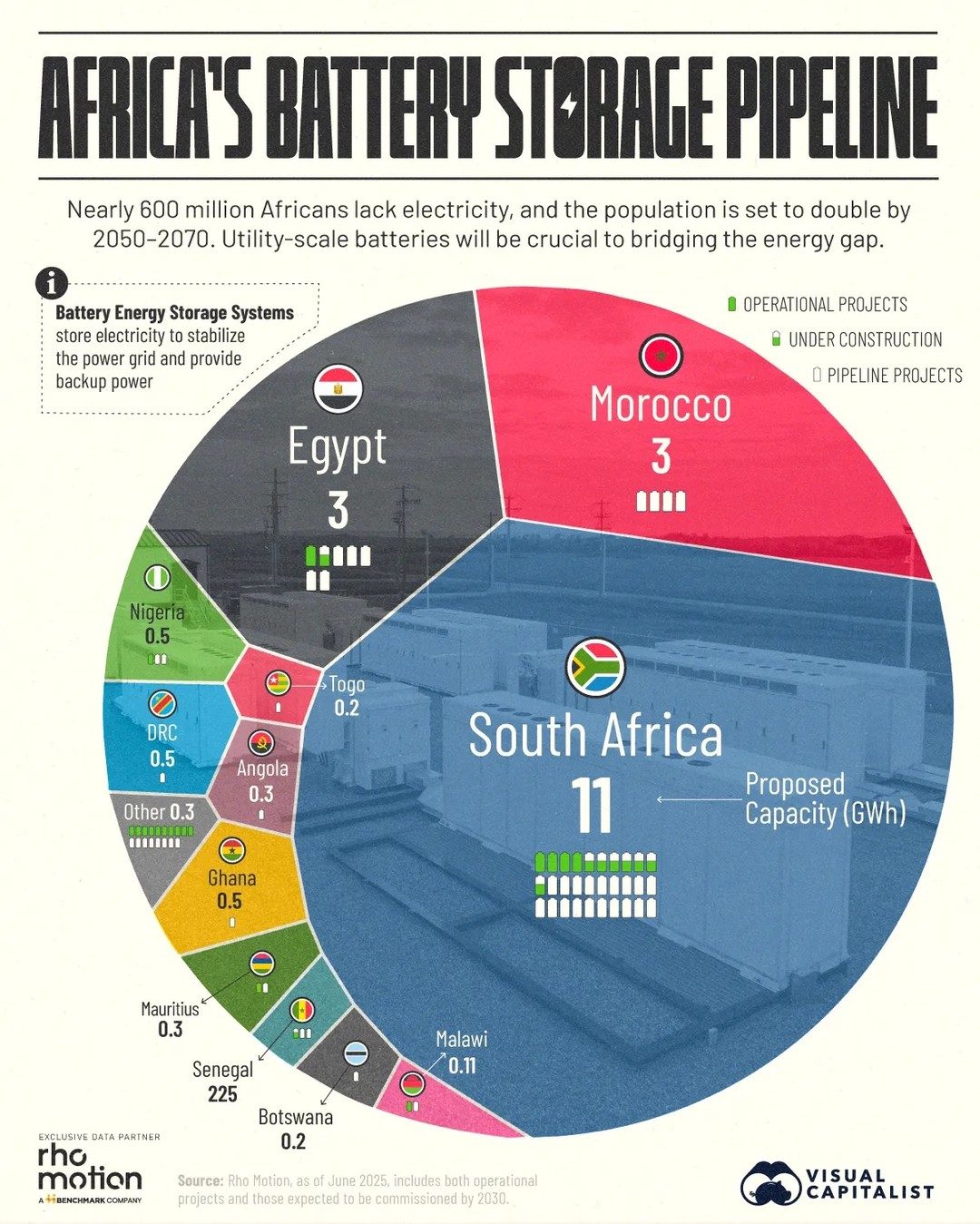
Africa's Battery Storage Pipeline
African countries face a daunting challenge: nearly 600 million people lack electricity. With the continent’s population projected to double by 2070, the demand for reliable power is set to skyrocket. Utility-scale batteries, particularly Battery Energy Storage Systems (BESS), are emerging as crucial tools in bridging this energy gap. By storing electricity, these systems stabilize the power grid and provide backup power, making them indispensable in the evolving power infrastructure.
Why This Matters
Africa’s rapid population growth and industrialization require robust and reliable energy solutions. Traditional power infrastructure, often reliant on fossil fuels, struggles to meet the increasing demand efficiently and sustainably. Utility-scale batteries offer a flexible and scalable solution. They can store excess energy generated from renewable sources like solar and wind, ensuring a steady supply during peak demand times. This capability is vital for ensuring energy security, supporting economic growth, and promoting sustainable development.
Main Discussion
The Current State of Battery Storage in Africa
Benchmark, a leading data provider, has been instrumental in mapping out Africa’s battery storage pipeline. The data reveals a diverse landscape of projects, from operational to those under construction or in the planning stages.
Operational Projects
Several countries have already implemented battery storage projects, showcasing the viability and benefits of this technology. For instance, Egypt and Morocco each have operational projects with a capacity of 3 GW and 3 GW respectively. These projects highlight the region's commitment to integrating battery storage into their power infrastructure.
Projects Under Construction
Many African countries are actively constructing new battery storage facilities. Nigeria, for example, has a 0.5 GW project underway. Angola and Togo are also in the construction phase with 0.5 GW and 0.2 GW projects, respectively. These initiatives indicate a growing momentum towards adopting battery storage solutions across the continent.
Proposed Projects
The pipeline includes several proposed projects that are in the planning stages. South Africa leads with a proposed capacity of 11 GW, followed by Senegal with 225 MW. Other countries with significant proposed capacities include Ghana and Mauritius with 0.3 GW and Botswana with 0.2 GW.
Key Players and Collaborations
The successful implementation of battery storage projects in Africa relies on collaborations between various stakeholders. Benchmark, with its extensive data on the energy sector, has been a valuable partner in providing insights into the current and future landscape of battery storage. Additionally, various governments, international organizations, and private companies are working together to drive these projects forward.
Practical Tips
Policy and Regulatory Framework
For battery storage initiatives to thrive, a supportive policy and regulatory framework is essential. Governments should:
- Incentivize Investment: Provide tax incentives, subsidies, and other financial incentives to attract private investments in battery storage projects.
- Streamline Permitting: Simplify the permitting process to reduce the bureaucratic hurdles and accelerate project implementation.
- Grid Integration Policies: Develop policies that facilitate the integration of battery storage systems with the existing power grid, ensuring seamless energy management.
Technology and Innovation
African countries should focus on leveraging cutting-edge technology and innovation to enhance the efficiency and reliability of battery storage systems. Key areas to explore include:
- Renewable Energy Integration: Enhance the integration of renewable energy sources with battery storage systems to create a sustainable and resilient energy mix.
- Battery Technology: Invest in research and development to improve battery technology, focusing on longevity, safety, and cost-effectiveness.
- Smart Grid Solutions: Implement smart grid solutions that can optimize energy distribution and management, leveraging data analytics and artificial intelligence.
Important Takeaways
The transformation of Africa’s power infrastructure through the adoption of utility-scale batteries is a significant step towards ensuring energy security and sustainability. Key takeaways from this overview include:
- Growing Demand: The population growth and industrialization in Africa will drive the demand for reliable and sustainable energy solutions.
- Versatility of Batteries: Utility-scale batteries offer a versatile solution for stabilizing the power grid and providing backup power, making them indispensable in the evolving energy landscape.
- Critical Projects: Operational, under-construction, and proposed projects across various African countries highlight the continent's commitment to battery storage solutions.
- Collaboration: Successful implementation of battery storage projects requires collaboration between governments, international organizations, and private companies.
Conclusion
As Africa continues to transform its power infrastructure, utility-scale batteries will play a pivotal role in bridging the energy gap and ensuring sustainable development. By leveraging data from sources like Benchmark, stakeholders can gain valuable insights into the current and future landscape of battery storage projects. Policymakers, technology innovators, and investors must work collaboratively to harness the full potential of battery technology, ensuring a reliable and sustainable energy future for the continent.
Watch the Reel
Questions readers ask
What is the current state of electricity access in Africa?
Currently, nearly 600 million people in Africa are without electricity. This underscores the significant energy gap that needs to be addressed to support the continent's development and economic growth.
How do utility-scale batteries help stabilize power grids in Africa?
Utility-scale batteries, such as Battery Energy Storage Systems (BESS), store excess electricity and release it during peak demand periods. This helps to stabilize the power grid, reduce power fluctuations, and ensure a reliable supply of electricity.
What are the benefits of battery storage for African energy systems?
Battery storage systems provide backup power, enhance grid stability, and support the integration of renewable energy sources. They enable African countries to meet the growing demand for electricity more efficiently and sustainably.
What role do battery storage solutions play in African power grid modernization?
Battery storage solutions are critical in modernizing African power grids. They help integrate renewable energy sources, improve grid reliability, and provide backup power, making the energy infrastructure more robust and resilient.
What are some of the key African battery storage projects currently in the pipeline?
Several African countries are developing battery storage projects to enhance their energy infrastructure. For example, South Africa is investing in large-scale battery storage systems to support its renewable energy initiatives, while countries like Nigeria and Kenya are exploring similar projects to stabilize their power grids.
Why is it important to address Africa's energy gap by 2070?
Addressing Africa's energy gap by 2070 is crucial due to the continent's projected population growth and increasing demand for electricity. By investing in reliable energy solutions, African countries can support industrialization, economic growth, and improve the quality of life for their citizens.
Related deep dives
Similar reads based on topic and creator.


Recent articles
Fresh deep dives from the latest Reels we unpacked.




Comments
Be the first to comment.