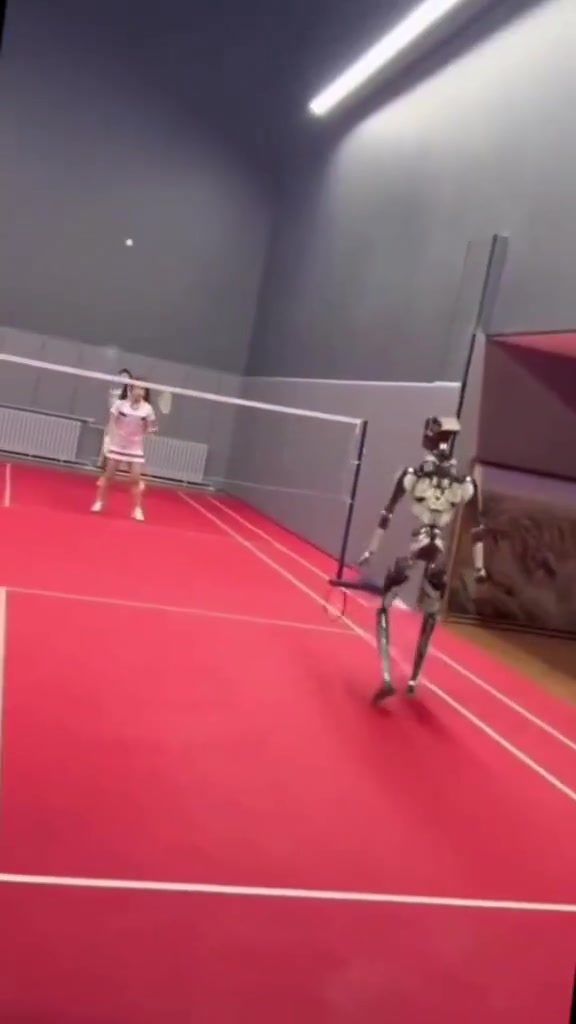
Robot Badminton
Badminton is a thrilling sport that demands agility, precision, and strategic thinking. But what if a robot could master this complex game, competing against human players on a real court? This is exactly what was showcased in a remarkable demonstration of advanced robotics technology.
Context / Why this matters
The use of robots in sports is not just about entertainment; it's a testament to the incredible advancements in artificial intelligence, computer vision, and motor control. Robots in sports can push the boundaries of what machines can achieve, inspiring innovations that could have real-world applications. Whether it's in manufacturing, healthcare, or even in developing assistive technologies for people with disabilities, the lessons learned from robots in sports can pave the way for groundbreaking developments.
Main discussion
Advanced Robotics in Action
The humanoid robot, standing on a vibrant red badminton court, showcased remarkable agility and precision. Mimicking the movements of human players, the robot held a racket and executed forehand and backhand swings with astonishing fluidity. This feat is a testament to the sophistication of its computer vision, real-time motion planning, and high-precision motor control systems.
Real-Time Agility and Precision
One of the most striking aspects of the robot's performance was its real-time tracking of the shuttlecock. As the shuttlecock flew over the net, the robot seamlessly adjusted its footwork and executed precise returns. This level of responsiveness is a result of advanced computer vision algorithms that allow the robot to track the shuttlecock's trajectory with pinpoint accuracy. The robot's balance and spatial awareness also played a crucial role, enabling it to react dynamically to unpredictable human returns.
The Role of Technology
The robot's ability to play badminton with such skill is a result of several advanced technologies working in harmony. Computer vision allows the robot to perceive and understand its environment, including the position and movement of the shuttlecock. Real-time motion planning enables the robot to decide on the best course of action in response to the shuttlecock's trajectory. Finally, high-precision motor control ensures that the robot's movements are smooth and accurate.
Human vs. Machine
The robot's performance raises interesting questions about the future of sports and the potential for robots to compete at a high level. While the robot's movements and precision are impressive, human players still have an edge when it comes to intuition and creative thinking. However, as robotics technology continues to advance, it's possible that we could see even more impressive feats.
Potential Applications
The advancements showcased in this demonstration have potential applications beyond the sports arena. The technologies involved, such as computer vision and real-time motion planning, could be applied to various fields, including:
- Manufacturing: Robots with advanced motion planning capabilities could improve efficiency and accuracy in production lines.
- Healthcare: Robots with high-precision motor control could be used to assist in surgeries or provide physical therapy.
- Assistive Technologies: Robots with advanced computer vision and motion planning could help individuals with disabilities perform daily tasks more easily.
Practical Tips
For those interested in exploring the potential of robotics or even trying out badminton with a robot, here are a few practical tips:
- Understand the Basics: Start by learning the basic principles of computer vision, real-time motion planning, and motor control. There are many resources available online, including tutorials and courses.
- Experiment with Simulations: Before building a physical robot, experiment with simulations. This will allow you to test and refine your algorithms without the need for expensive hardware.
- Use Open-Source Tools: Utilize open-source tools and libraries, such as ROS (Robot Operating System), to build and program your robot.
Important Takeaways
The demonstration of a robot playing badminton highlights the incredible advancements in robotics technology. The robot's ability to mimic human movements, track the shuttlecock, and execute precise returns showcases the potential for robots to compete in complex sports. This technology has practical applications beyond sports, offering new possibilities in manufacturing, healthcare, and assistive technologies. As robotics continues to advance, we can expect to see even more impressive feats, potentially reshaping the way we think about human-machine interaction.
Conclusion
Badminton is a sport that requires a combination of agility, speed, and precision. The robot's ability to compete against human players on a real court showcases the incredible advancements in robotics technology. The integration of computer vision, real-time motion planning, and high-precision motor control has made this achievement possible. As we continue to push the boundaries of what robots can achieve, we open up new possibilities for technology to enhance our lives in meaningful ways.
Watch the Reel
Questions readers ask
How does a robot achieve precise shots in a badminton match?
A robot achieves precise shots in badminton through a combination of advanced robotics, AI, and computer vision. These technologies allow the robot to analyze the shuttlecock's trajectory, predict its landing spot, and execute the necessary movements to return it accurately.
What are the key technologies behind a humanoid robot playing badminton?
The key technologies include AI for decision-making and strategy, computer vision for tracking the shuttlecock and court layout, and motor control for precise and agile movements. These technologies work together to enable the robot to compete effectively in a badminton match.
Can a robot compete in a real-time badminton rally against a human?
Yes, advanced humanoid robots can compete in real-time badminton rallies against humans. These robots are equipped with sensors and algorithms that allow them to react quickly to the shuttlecock's movement, making them formidable opponents in a dynamic game like badminton.
What are the potential real-world applications of robotics and AI in sports?
The advancements in robotics and AI demonstrated in sports like badminton can have wide-ranging applications. These include improvements in manufacturing processes, enhancing healthcare technologies, and developing assistive devices for individuals with disabilities. The precision and real-time adjustments required in sports can inspire innovations in these fields.
How does a robot make real-time adjustments during a badminton match?
Robots make real-time adjustments during a badminton match by continuously processing data from their sensors and vision systems. This allows them to assess the shuttlecock's speed, spin, and trajectory, and to adjust their movements accordingly to ensure a successful return. AI algorithms play a crucial role in making these rapid, accurate decisions.
What makes badminton a challenging sport for robots?
Badminton is challenging for robots due to its fast-paced nature, requiring quick reflexes and precise movements. The unpredictable nature of the shuttlecock’s flight, including its speed, spin, and trajectory, demands advanced motor control and real-time processing capabilities from the robot. Additionally, the need for strategic thinking and adaptability makes it a complex task for robots.
Related deep dives
Similar reads based on topic and creator.


Recent articles
Fresh deep dives from the latest Reels we unpacked.




Comments
Be the first to comment.