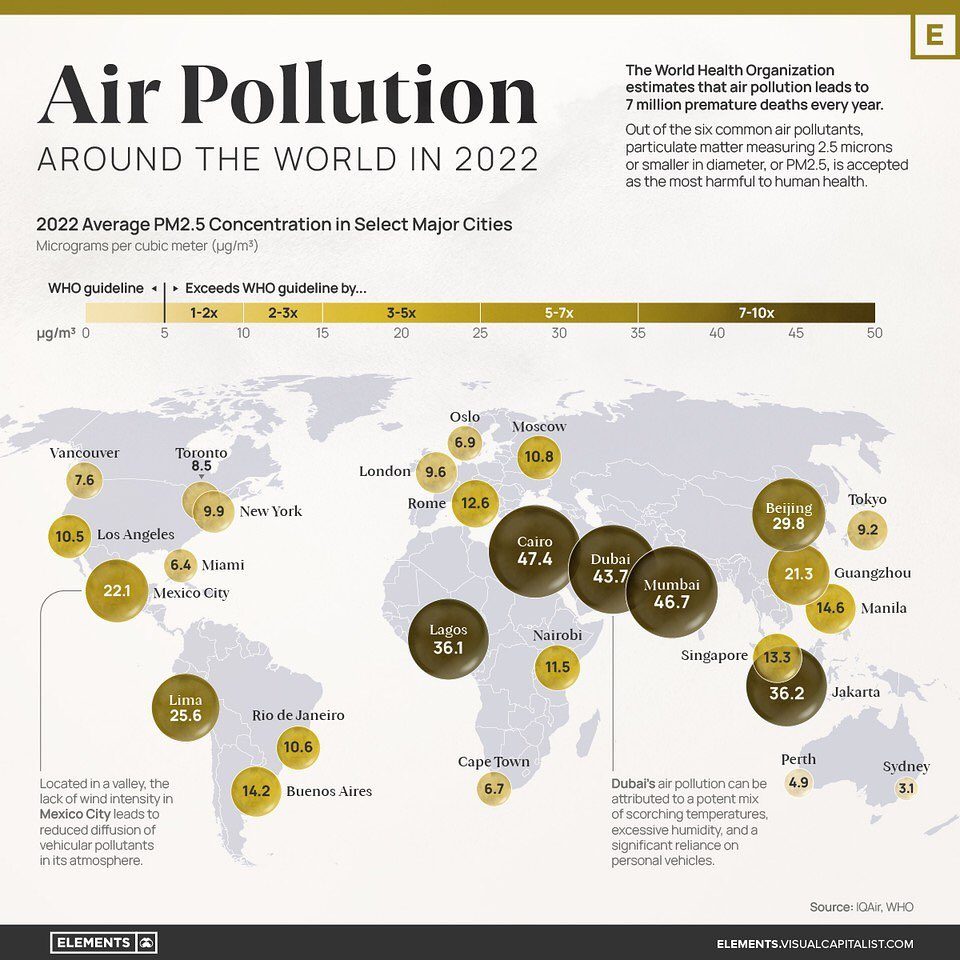
Air Pollution Levels Around the World in 2022
Air pollution is a pressing global issue, with stark disparities in air quality across different regions. In 2019, a mere 1% of the global population lived in areas that met the World Health Organization’s (WHO) air quality guidelines, which are designed to safeguard public health from harmful effects of air pollution. These guidelines cover a range of pollutants, including particulate matter, ozone, nitrogen dioxide, sulfur dioxide, and carbon monoxide.
Why This Matters
Air pollution poses significant risks to human health, with particulate matter (PM2.5) being especially harmful. PM2.5, which measures particles 2.5 microns or smaller in diameter, can penetrate deep into the lungs and even enter the bloodstream, leading to serious health issues such as respiratory and cardiovascular diseases. The World Health Organization estimates that 7 million premature deaths were attributed to air pollution in 2022, underscoring the urgent need for improved air quality.
Main Discussion
PM2.5 Concentrations in Major Cities
PM2.5 levels vary widely across major cities worldwide. In 2022, cities like Delhi, Lagos, and Cairo recorded significantly higher PM2.5 concentrations compared to cities like Vancouver, London, and Sydney. This stark contrast highlights the disparities in air quality and the need for targeted interventions in highly polluted areas.
Cities with Higher PM2.5 Levels
- Delhi: Known for its severe air pollution, Delhi often exceeds the WHO guideline for PM2.5 by several times. The city's air quality is heavily influenced by industrial activities, vehicle emissions, and crop burning in nearby regions.
- Lagos: Similar to Delhi, Lagos faces high levels of air pollution due to industrial activities, traffic congestion, and inadequate waste management.
- Cairo: Cairo's air quality is compromised by vehicle emissions, industrial activities, and desert dust storms, leading to high PM2.5 concentrations.
Cities with Lower PM2.5 Levels
- Vancouver: Benefiting from stricter air quality regulations and a lower reliance on fossil fuels, Vancouver maintains relatively lower PM2.5 levels.
- London: Despite urbanization, London has implemented measures to reduce air pollution, including the Ultra Low Emission Zone (ULEZ), which has helped lower PM2.5 concentrations.
- Sydney: Sydney’s air quality is generally good, thanks to effective environmental policies and regulations aimed at reducing pollution from various sources.
Global Air Quality Trends
The disparities in air quality across different cities can be attributed to various factors, including economic development, industrial activities, vehicle emissions, and environmental regulations. Cities with higher economic development and stricter environmental regulations tend to have better air quality. For example, cities in North America and Europe generally have lower PM2.5 concentrations compared to cities in South Asia and Africa. However, this is not a hard and fast rule, as city-specific factors also play a significant role.
Practical Tips
Improving air quality requires a multi-faceted approach. Here are some practical steps that can be taken at various levels:
For Individuals
- Monitor Air Quality: Use air quality monitoring apps and devices to stay informed about local air pollution levels.
- Use Public Transportation: Reduce personal vehicle use by opting for public transportation, carpooling, or biking.
- Indoor Air Quality: Ensure good ventilation and use air purifiers to maintain clean indoor air.
For Governments and Policymakers
- Enforce Emission Standards: Implement and enforce stringent emission standards for vehicles and industries.
- Promote Green Spaces: Increase green spaces and urban forests to help filter out pollutants and improve air quality.
- Public Awareness: Launch awareness campaigns to educate the public about the dangers of air pollution and encourage behavior changes.
For Industries
- Emission Controls: Invest in technologies that reduce emissions from industrial processes.
- Renewable Energy: Transition to renewable energy sources to reduce reliance on fossil fuels.
- Waste Management: Implement effective waste management practices to minimize air pollution from waste disposal.
Important Takeaways
- PM2.5 levels vary significantly across major cities, with some cities facing extremely high concentrations while others maintain relatively lower levels.
- Air pollution is a global health concern, with PM2.5 being particularly harmful to human health.
- Effective air quality management requires a collaborative effort from individuals, governments, and industries.
- Increasing awareness and implementing practical steps can help improve air quality and protect public health.
Conclusion
Air pollution remains a critical global issue, with varying levels of severity across different cities. Understanding the disparities in air quality and taking proactive steps to improve it is essential for safeguarding public health. By adopting practical measures and promoting awareness, we can work towards a cleaner and healthier environment for all.
Watch the Reel
Questions readers ask
Which cities had the highest PM2.5 levels in 2022?
Cities like Delhi, Lagos, and Cairo were among those with the highest PM2.5 levels in 2022. These high concentrations of particulate matter pose serious health risks to residents and require targeted interventions to improve air quality.
What are the WHO air quality guidelines?
The WHO air quality guidelines are designed to protect public health from the harmful effects of air pollution. They specify safe limits for various pollutants, including particulate matter, ozone, nitrogen dioxide, sulfur dioxide, and carbon monoxide.
Which cities had lower PM2.5 levels in 2022?
In 2022, cities such as Vancouver, London, and Sydney had relatively lower PM2.5 levels. These cities have implemented various measures to mitigate air pollution, resulting in better air quality for their residents.
Why is PM2.5 particularly concerning?
PM2.5 is particularly concerning because these tiny particles, measuring 2.5 microns or smaller, can penetrate deep into the lungs and even enter the bloodstream. This makes PM2.5 especially harmful to human health, leading to serious health issues.
What can be done to improve air quality in highly polluted cities?
To improve air quality in highly polluted cities, targeted interventions are necessary. These can include implementing stricter emission standards, promoting public transportation, encouraging renewable energy use, and enhancing green spaces within urban areas.
How many people live in areas that meet the WHO air quality guidelines?
In 2019, only 1% of the global population lived in areas that met the WHO air quality guidelines. This highlights the vast extent of the air pollution problem and the need for widespread, effective interventions to improve global air quality.
What is the significance of air pollution levels in major cities?
Air pollution levels in major cities are significant because they directly impact the health of urban populations. High levels of air pollution can lead to various health issues, including respiratory and cardiovascular diseases, making it crucial to monitor and address air quality issues in these densely populated areas.
Related deep dives
Similar reads based on topic and creator.


Recent articles
Fresh deep dives from the latest Reels we unpacked.




Comments
Be the first to comment.