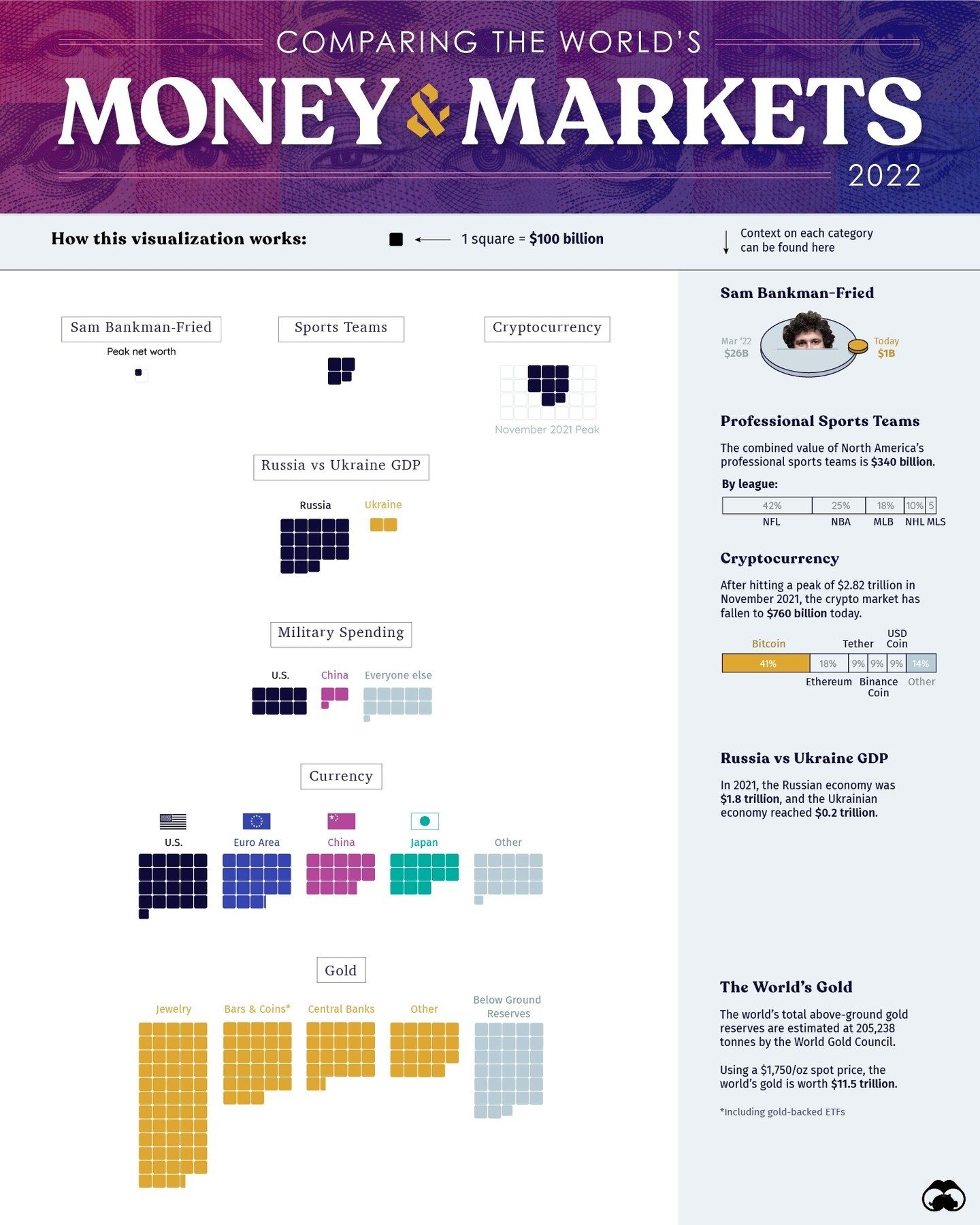
World Money and Markets Comparison
The era of easy money has officially come to an end, with inflation prompting a sudden reversal of many financial policies. This shift has had widespread implications, from the wealth of billionaires to the overall global debt within the financial system. Understanding the current state of world money and markets in 2022 provides valuable insights into the economic landscape.
Context / Why this matters
In 2022, the global financial landscape underwent significant changes due to inflation, which led to a reversal of many previously established monetary policies. These changes have wide-ranging impacts on various sectors, including GDP, military spending, cryptocurrency markets, currency reserves, gold holdings, and global debt. By examining these key areas, we can gain a comprehensive understanding of the current economic climate and its potential future directions.
Main discussion
GDP and Economic Power
One of the critical metrics for comparing economic strength is GDP. The comparison between Russia and Ukraine's GDP highlights the stark differences in economic power and stability. This economic disparity plays a crucial role in determining a country's influence on the global stage and its ability to withstand economic shocks.
Military Spending
Military spending is another important indicator of a nation's economic priorities and power. High military expenditures can indicate a focus on defense and security, but they can also divert resources from other critical sectors such as healthcare and education. Understanding military spending trends can provide insights into a country's strategic goals and economic resilience.
Cryptocurrency Markets
The cryptocurrency market has seen significant growth and volatility in recent years. Cryptocurrencies offer an alternative to traditional financial systems, providing decentralized and secure transactions. However, the value of cryptocurrency markets can be highly volatile, making it both an opportunity and a risk for investors. By examining the current state of cryptocurrency markets, we can better understand the potential impact of this emerging asset class on the global financial landscape.
Currency Reserves and Gold Holdings
Currency reserves and gold holdings are essential components of a country's financial stability. These assets provide a buffer against economic shocks and can be used to stabilize the national currency. The distribution of currency reserves and gold holdings globally can reveal which countries are best prepared to weather economic storms and maintain financial sovereignty.
Global Debt and Financial Stability
Global debt levels have reached unprecedented heights, posing significant risks to financial stability. Debt can be a useful tool for economic growth, but excessive borrowing can lead to financial instability and economic crises. Different sectors, including non-financial corporates, governments, the financial sector, and households, play crucial roles in the overall debt landscape. By examining global debt levels and their distribution, we can better understand the potential risks and opportunities in the global financial system.
Regional Insights
Different regions of the world have unique economic landscapes and challenges. Europe, China, and the Asia-Pacific region each have their specific economic characteristics and financial strategies. By comparing these regions, we can gain a deeper understanding of the global economic landscape and identify potential areas of collaboration and competition.
Europe
Europe has a diverse economic landscape, with countries ranging from highly industrialized economies to those with significant agricultural sectors. The region's economic stability is influenced by various factors, including the European Union's policies, trade agreements, and financial regulations. Understanding Europe's economic dynamics provides insights into its role in the global financial system and its potential for future growth.
China
China has emerged as a global economic powerhouse, with a significant impact on the world economy. The country's rapid economic growth has been driven by a combination of industrialization, urbanization, and technological innovation. China's economic policies and financial strategies have significant implications for the global economy, making it a critical player in the world financial landscape.
Asia-Pacific
The Asia-Pacific region is home to some of the world's fastest-growing economies, with countries like India, Japan, and South Korea playing significant roles. The region's economic dynamics are shaped by a mix of traditional and emerging economic sectors, with technology, manufacturing, and finance being particularly important. The Asia-Pacific region's economic performance and financial stability have a significant impact on the global economy.
Practical tips
When analyzing the global financial landscape, it's essential to consider multiple factors and data points. Here are some practical tips for gaining a comprehensive understanding of world money and markets:
-
Diversify Your Data Sources: Rely on a variety of data sources, including GDP reports, military spending data, cryptocurrency market trends, currency reserve statistics, and global debt information, to get a holistic view of the economic landscape.
-
Region-Specific Analysis: Analyze different regions separately to understand their unique economic characteristics and financial strategies. This approach can help identify regional trends and potential areas of collaboration and competition.
-
Stay Updated on Policy Changes: Monitor changes in monetary policies, trade agreements, and financial regulations, as these can have significant impacts on the global economy.
-
Risk Management: Assess the risks associated with different asset classes, such as cryptocurrency markets, and develop strategies to mitigate potential financial risks.
-
Economic Indicators: Pay attention to key economic indicators, such as inflation rates, GDP growth, and unemployment levels, to gauge the health of the global economy.
Important takeaways
Understanding the current state of world money and markets is crucial for navigating the global financial landscape. By examining key areas such as GDP, military spending, cryptocurrency markets, currency reserves, global debt, and regional economic dynamics, we can gain valuable insights into the economic landscape and its potential future directions. It is essential to stay informed about policy changes, diversify data sources, and assess risks to make informed decisions in the ever-changing global economy. The reversal of easy money policies and the rise of inflation have underscored the importance of being proactive and well-informed in the financial world.
Conclusion
The end of the easy money era and the rise of inflation have significantly impacted the global financial landscape. By examining key economic metrics and regional insights, we can better understand the current state of world money and markets. Staying informed and proactive in analyzing these trends will be crucial for navigating the complex and ever-changing global economy.
Watch the Reel
Questions readers ask
How did inflation influence monetary policies in 2022?
Inflation in 2022 led to a significant reversal of many monetary policies that were previously put in place. Central banks around the world took measures to combat rising prices, including increasing interest rates and tightening monetary policy, marking the end of the 'era of easy money.'
What are the impacts on global debt due to the 2022 financial shifts?
The reversal of monetary policies in 2022 has had notable effects on global debt. As interest rates rise, the cost of servicing debt increases, putting pressure on governments and corporations with significant debt levels. This can lead to slower economic growth and potential defaults in some cases.
How did the 2022 financial trends affect global military spending?
The 2022 financial trends saw a lot of volatility, which can sometimes lead to increased military spending. This trend can be driven by economic uncertainty, geopolitical tensions, and the need to maintain national security, even if it means taking on more debt.
What were the key trends in the cryptocurrency market in 2022?
The cryptocurrency market experienced significant volatility in 2022, largely influenced by the reversal of easy money policies and inflation. This led to a decline and recovery in prices and shifts in the market’s sentiment and trading volumes. Additionally, there was a growing interest from institutional investors and regulatory bodies.
Which countries saw the most significant shifts in their currency reserves in 2022?
Several countries saw notable shifts in their currency reserves in 2022. For example, China maintained large reserves to stabilize its economy amidst global volatility and increased military spending. The US also showed changes in its reserves as it navigated inflation and geopolitical dynamics.
How did 2022's financial trends impact global wealth distribution?
The 2022 financial trends had a profound impact on global wealth distribution. The reversal of easy money policies led to a decline in the wealth of billionaires, while the overall global debt increased. This shift highlighted the disparities in wealth and the vulnerability of certain sectors to economic changes.
What were the key trends in gold prices in 2022?
Gold prices in 2022 experienced notable fluctuations due to inflation and monetary policy changes. As investors sought safe havens, gold prices saw a surge, especially during periods of high market volatility. This trend underscored gold's role as a hedge against economic uncertainty.
Recent articles
Fresh deep dives from the latest Reels we unpacked.




Comments
Be the first to comment.