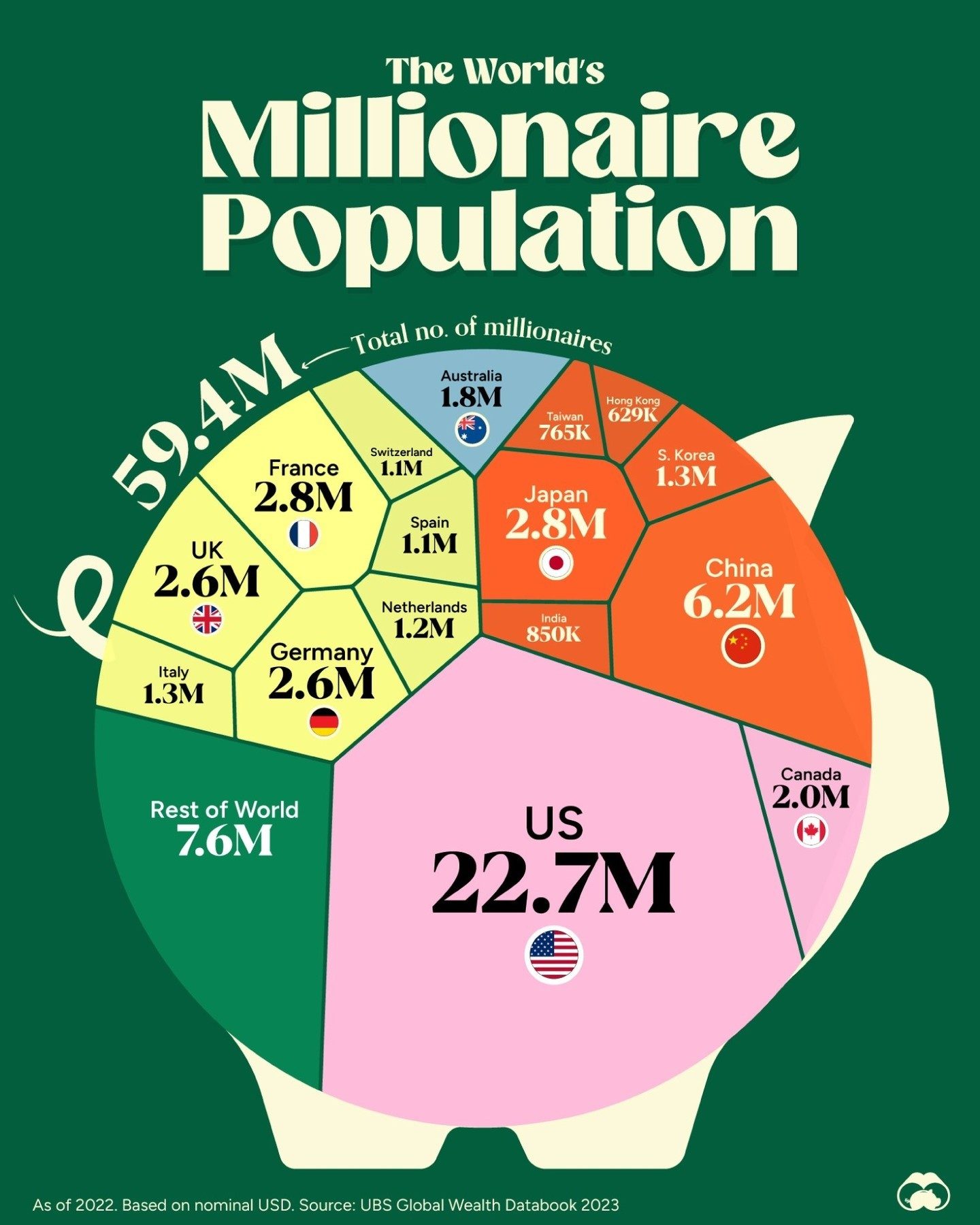
The Global Distribution of Millionaires
In 2022, the world's household wealth reached an astonishing $454 trillion, with millionaires holding half of that wealth. Understanding where the world's wealthiest individuals reside provides valuable insights into global economic trends and disparities. The United States leads the way with nearly 23 million millionaires, constituting 40% of the total global millionaire population. China follows closely with 6.2 million millionaires, accounting for about 10% of the total.
Why This Matters
The distribution of millionaires globally is more than just a curiosity; it reflects broader economic trends, investment patterns, and societal structures. For policymakers and economists, this data is crucial for understanding economic health, inequality, and the effectiveness of fiscal policies. For individuals, it offers a glimpse into the economic landscape and potential opportunities for wealth creation and investment.
Key Areas With Significant Millionaire Populations
The United States
The United States is the undisputed leader in the number of millionaires. With 22.7 million millionaires, the U.S. holds a commanding 40% of the global millionaire population. This dominance can be attributed to several factors, including robust economic policies, a strong stock market, and a vibrant entrepreneurial ecosystem. The concentration of wealth in the U.S. underscores the country's role as a global economic powerhouse.
China
China ranks second with 6.2 million millionaires, making up about 10% of the global total. The country's rapid economic growth, fueled by industrialization and technological advancements, has led to a significant increase in high-net-worth individuals. China's millionaire population is projected to continue growing as the country's economy expands and its middle class becomes more affluent.
Europe
Europe is home to a significant number of millionaires, with several countries contributing to the continent's wealth. Germany has 2.6 million millionaires, making it one of the wealthiest countries in Europe. The UK follows with 2.6 million millionaires, reflecting its historical economic strength and financial sector. Other European countries with substantial millionaire populations include France (2.8 million), Italy (1.3 million), and the Netherlands (1.2 million).
Asia-Pacific
The Asia-Pacific region, excluding China, is also a hub for millionaires. Japan leads with 1.3 million millionaires, followed by South Korea with 1.3 million, and Taiwan with 1.3 million. These countries have seen significant economic growth and industrial development, contributing to their millionaire populations. Hong Kong, with 629,000 millionaires, is another key player in the region, known for its financial hub status.
Australia and Canada
Australia and Canada are notable for their millionaire populations, with 1.8 million and 2.0 million millionaires, respectively. Both countries benefit from strong economies, stable political environments, and vibrant financial sectors. Their millionaire populations reflect their economic stability and growth potential.
Rest of the World
The rest of the world accounts for 7.6 million millionaires, including regions such as South America, Africa, and other parts of Asia. While these areas have smaller millionaire populations compared to the U.S. and Europe, their economic growth and development are areas of interest for investors and policymakers.
Practical Tips for Understanding Global Wealth Distribution
Invest in Diversified Markets
For investors, diversifying their portfolios across different regions with significant millionaire populations can be a strategic move. This approach allows for exposure to various economic landscapes and potential growth opportunities. Investing in markets like the U.S., Europe, and Asia-Pacific can provide a balanced and resilient investment strategy.
Monitor Economic Indicators
Staying informed about economic indicators in regions with high millionaire populations is essential. Key indicators such as GDP growth, interest rates, and employment rates can provide insights into the economic health and future trends of these regions. Paying attention to these indicators can help in making informed investment decisions.
Leverage Financial Technology
Financial technology (fintech) has revolutionized the way wealth is managed and invested. Leveraging fintech platforms for investment, wealth management, and financial planning can offer enhanced tools and resources for managing and growing wealth. Fintech solutions can provide access to global markets, investment opportunities, and financial advice tailored to individual needs.
Important Takeaways
- The U.S. and China are the leading countries in terms of the number of millionaires, reflecting their economic dominance and growth.
- European countries, particularly Germany, the UK, and France, have significant millionaire populations, highlighting their economic strength and stability.
- The Asia-Pacific region, including Japan, South Korea, and Hong Kong, is a crucial hub for millionaires, driven by industrial development and economic growth.
- Australia and Canada offer stable economic environments with notable millionaire populations.
- The rest of the world, while having a smaller millionaire population, presents opportunities for economic diversification and growth.
Conclusion
Understanding the global distribution of millionaires offers valuable insights into the world's economic landscape. The concentration of wealth in regions like the U.S., China, and Europe reflects their economic policies, financial sectors, and entrepreneurial ecosystems. For investors, policymakers, and individuals, this information can guide strategic decisions, investment strategies, and economic policies. By staying informed about the global distribution of millionaires, we can better navigate the complexities of the global economy and identify opportunities for growth and prosperity.
Watch the Reel
Questions readers ask
Which country has the highest number of millionaires in 2022?
The United States has the highest number of millionaires in 2022, with approximately 23 million individuals. This represents about 40% of the global millionaire population.
How many millionaires does China have, and what percentage of the global millionaire population does this represent?
China has 6.2 million millionaires, which accounts for around 10% of the total global millionaire population. This significant figure highlights China's rapid economic growth and increasing wealth concentration.
What is the total global wealth, and how much of it is controlled by millionaires?
The total global wealth in 2022 reaches $454 trillion, with millionaires holding half of that wealth, or approximately $227 trillion.
What insights can be gained from understanding the distribution of millionaires worldwide?
Understanding the distribution of millionaires provides insights into global economic power, investment trends, and societal structures. It helps in identifying economic hotspots and areas of rapid wealth accumulation.
Which regions are considered millionaire hotspots in 2022?
The United States and China are major millionaire hotspots in 2022. Other regions with significant millionaire populations include Europe and parts of Asia, reflecting their economic stability and growth.
How does the millionaire population in the US compare to other countries?
The US has nearly 23 million millionaires, which is significantly higher than any other country. This number is more than three times the number of millionaires in China, the country with the second-largest millionaire population.
What trends can be observed in the growth of millionaire households worldwide?
The growth of millionaire households worldwide is driven by economic expansion, investment opportunities, and technological advancements, particularly in regions like the United States and China, where policies and economic structures support wealth accumulation.
Recent articles
Fresh deep dives from the latest Reels we unpacked.




Comments
Be the first to comment.