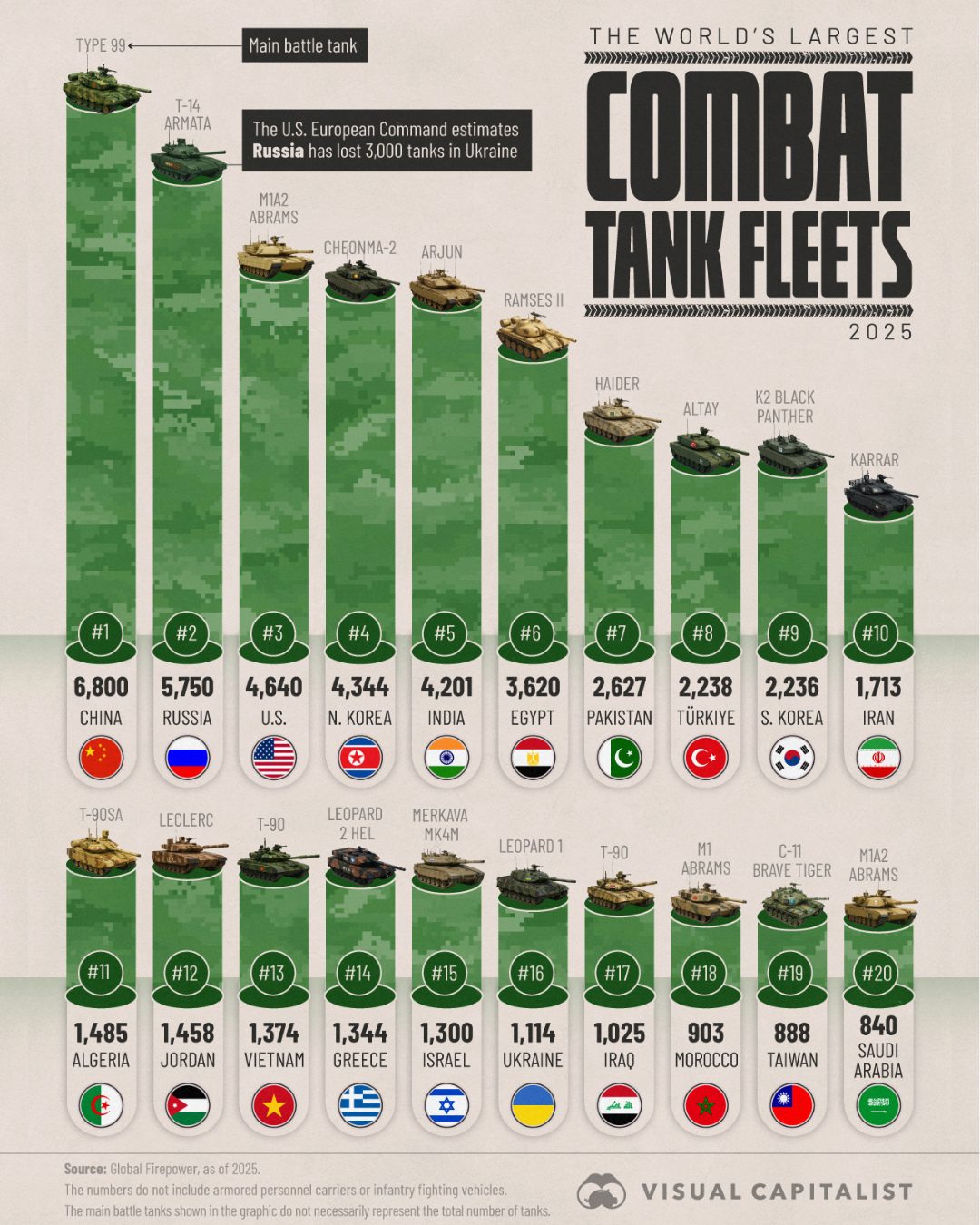
Tank Fleets Comparison in 2025
Tank fleets around the world vary significantly in size and composition. As of 2025, China leads with the largest number of tanks, while other nations like Russia, the United States, and North Korea follow closely. This comparison provides insights into the military capabilities and strategic focus of these countries.
Context: Why Tank Fleets Matter
Tanks are essential components of modern military arsenals. They provide both offensive and defensive capabilities, making them crucial for ground warfare. The size and composition of a country's tank fleet can indicate its military preparedness and strategic priorities. Understanding the distribution of tanks globally offers valuable context for geopolitical analysis and defense planning.
Main Discussion
China
China currently leads the world with the largest tank fleet, boasting an impressive 6,800 tanks. This substantial number underscores China's focus on maintaining a robust ground force capable of handling various threats. The fleet includes a mix of modern and legacy tanks, reflecting China's efforts to balance cutting-edge technology with tried-and-true military hardware.
Russia
Russia ranks second with 5,750 tanks. However, it's important to note that Russia has lost 3,000 tanks in the conflict in Ukraine. This significant loss highlights the impact of ongoing conflicts on military capabilities. Despite these losses, Russia retains a formidable tank fleet, which includes advanced models like the T-14 Armata and legacy systems still effective in combat.
United States
The United States, with 4,640 tanks, comes in third. The U.S. fleet is characterized by advanced technology and high operational readiness. The M1 Abrams remains a cornerstone of the U.S. tank arsenal, known for its durability, firepower, and tactical flexibility.
North Korea and India
North Korea and India round out the top five with substantial tank fleets. North Korea's fleet is estimated to be around 4,300 tanks, making it a significant military force in the region. India, with approximately 4,200 tanks, also maintains a robust ground force, with a focus on modernizing its inventory to enhance combat effectiveness.
Other Notable Fleets
Beyond the top five, several other countries possess notable tank fleets. Egypt, Pakistan, and Türkiye each have over 2,000 tanks, reflecting their investment in ground combat capabilities. South Korea, Iran, and Algeria also feature prominently, each with fleets exceeding 1,000 tanks. These countries, along with others like Vietnam, Jordan, Greece, Israel, Ukraine, Iraq, Morocco, and Saudi Arabia, contribute to a diverse and complex global landscape of tank fleets.
Practical Tips
When analyzing tank fleets, it's essential to consider several factors:
- Quantity vs. Quality: While the number of tanks is crucial, the quality and modernization of the fleet are equally important. Advanced technology and maintenance can significantly impact a tank's effectiveness on the battlefield.
- Geopolitical Context: The geopolitical context in which a country operates can influence its tank fleet. For example, Russia's losses in Ukraine highlight the real-world impact of conflicts on military capabilities.
- Diverse Inventory: A diverse inventory can provide tactical flexibility, allowing a country to adapt to various battlefield scenarios. This includes a mix of modern and legacy tanks, as well as specialized vehicles like armored personnel carriers and infantry fighting vehicles.
Important Takeaways
- China's Dominance: China's large tank fleet underscores its military strength and strategic focus on ground warfare.
- Conflict Impact: Ongoing conflicts, such as in Ukraine, can significantly impact a country's tank fleet and overall military capabilities.
- Technological Advancements: Modernization and technological advancements play a crucial role in enhancing the effectiveness of tank fleets.
- Geopolitical Influence: The size and composition of a country's tank fleet can influence its geopolitical standing and military strategies.
Conclusion
The comparison of global tank fleets in 2025 provides a snapshot of military capabilities and strategic priorities around the world. China's lead, Russia's significant losses, and the U.S.'s advanced technology highlight the diverse approaches to tank warfare. Understanding these dynamics is essential for geopolitical analysis and defense planning, offering a comprehensive view of the global military landscape.
Watch the Reel
Questions readers ask
Why does China have the largest tank fleet in 2025?
China's significant investment in military technology advancements and its focus on enhancing ground force capabilities have led to the country having the world's largest tank fleet. This reflects China's strategic priorities and military preparedness, making it a formidable player in global military power in 2025.
How does Russia's tank fleet compare to China's in 2025?
While Russia has a substantial tank fleet, it is smaller than China's. Russia's military technology and strategic focus differ from China's, with each country prioritizing different aspects of their ground forces. Russia's fleet size and composition are key indicators of its military preparedness and strategic priorities.
What insights can be gained from the US vs China tank comparison in 2025?
The comparison of US and China's tank fleets in 2025 reveals differences in military strategy. While China leads in the number of tanks, the United States focuses on advanced military technologies and battle capabilities. This comparison helps in understanding each country's strengths and strategic priorities in ground warfare.
Why are tank fleets important for understanding global military power in 2025?
Tank fleets are important for understanding global military power as they provide insights into a country's military preparedness and strategic focus. The size and composition of a country's tank fleet can indicate its ground force capabilities and readiness for potential conflicts, offering valuable context for geopolitical analysis and defense planning.
How does North Korea's tank fleet rank in 2025?
North Korea has a significant tank fleet, ranking among the world's top tank fleet rankings in 2025. While not as large as China's, North Korea's fleet is still a crucial component of its military strategy. The size and composition of North Korea's tank fleet reflect its military priorities and capabilities in ground warfare.
What can the tank fleet comparison in 2025 tell us about military technology advancements?
The tank fleet comparison in 2025 highlights the varying stages of military technology advancements among different countries. It showcases how countries like the United States focus on cutting-edge technologies, while others prioritize quantity and specific strategic capabilities, offering a snapshot of global military technology trends.
What is the significance of a country's tank fleet size in 2025?
A country's tank fleet size in 2025 is significant as it indicates its military preparedness and strategic priorities in ground warfare. A larger fleet can suggest a greater focus on traditional military power, while a smaller fleet may indicate a focus on advanced technologies and specialized capabilities, providing key insights into a nation's military strategies.
Recent articles
Fresh deep dives from the latest Reels we unpacked.




Comments
Be the first to comment.