Incarceration Rates by Country
Introduction
Countries around the world have vastly different approaches to criminal justice, leading to significant variations in incarceration rates. Understanding these differences is critical for gaining insights into global criminal justice systems and the factors that influence them.
Context / Why This Matters
The incarceration rate is a key indicator of a country's criminal justice system, reflecting policies, crime rates, and societal attitudes toward punishment and rehabilitation. High incarceration rates can indicate stringent law enforcement, harsh sentencing, or overcrowded prison systems, while low rates may signal effective crime prevention, rehabilitation initiatives, or alternative sentencing.
Countries with high incarceration rates often face challenges such as overcrowding, high costs, and the social and economic impacts on families and communities. Conversely, countries with lower rates might prioritize community-based corrections, restorative justice, or other alternative approaches. By examining these rates, we can better understand the global landscape of criminal justice and the factors that drive incarceration trends.
Main Discussion
The Global Picture
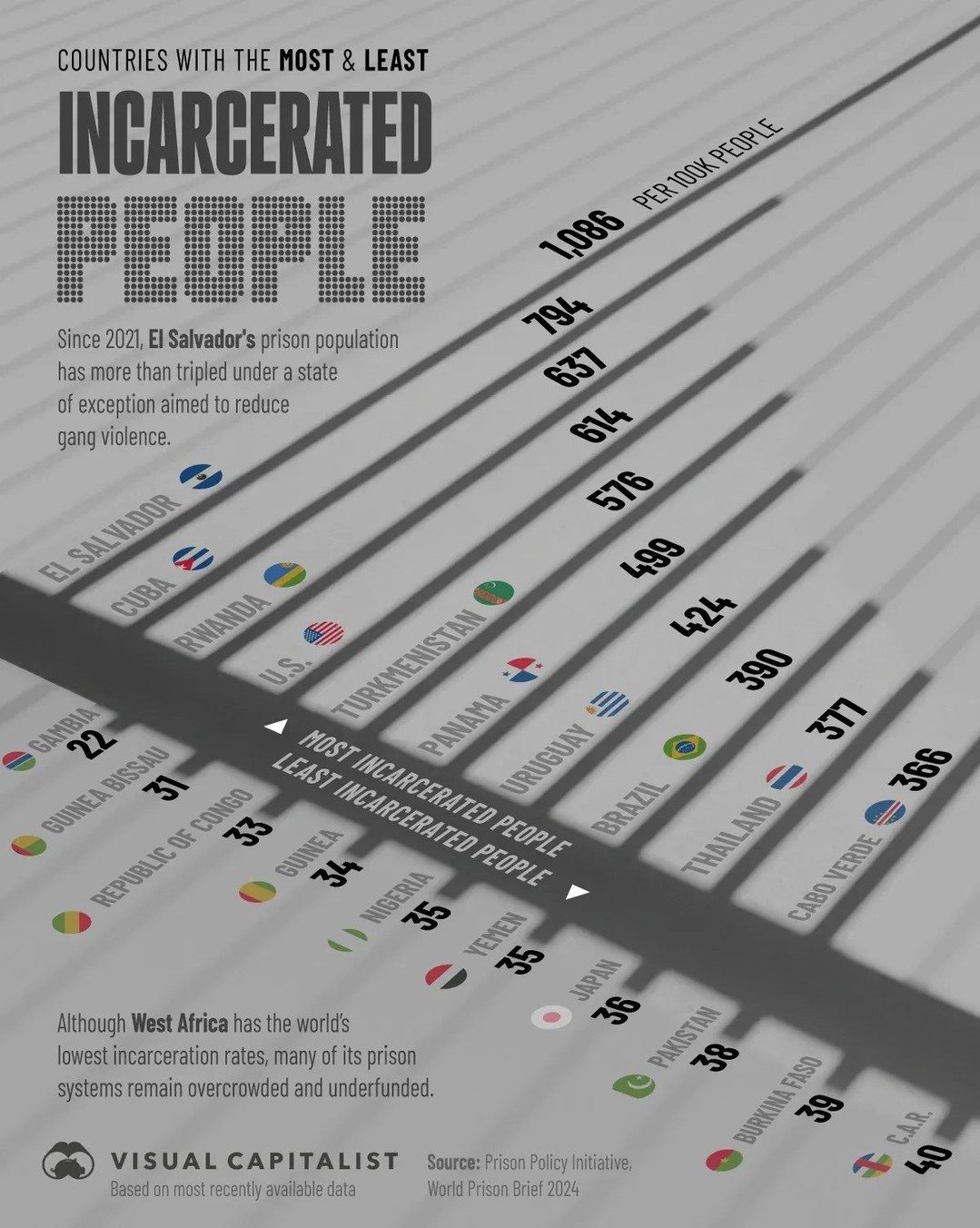
El Salvador has the highest incarceration rate in the world, with 1,086 prisoners per 100,000 people. This rate is nearly three times that of the United States, which ranks fourth globally at 614 per 100,000. These numbers highlight the stark differences in criminal justice policies and practices across the globe.
Leading the Ratings
At the top of the list, El Salvador's high incarceration rate is largely driven by severe penalties for drug-related crimes and gang violence. The country's approach to criminal justice is characterized by strict law enforcement and lengthy prison sentences, contributing to its infamous "prison capital of the world" status. Other countries with high rates, such as Cuba, Rwanda, and Turkmenistan, also have punitive criminal justice systems that prioritize incarceration.
The Middle Ground
Countries like the United States, Panama, and Uruguay fall into the mid-range of incarceration rates. The U.S., for instance, has a complex criminal justice system with varying approaches to sentencing and rehabilitation, reflecting a mix of punitive and reformative policies. This range reflects a blend of different strategies, from strict penalties to community-based corrections.
The Lowest Rates
At the other end of the spectrum, countries like Cabo Verde and Japan have significantly lower incarceration rates. Cabo Verde, for example, has the lowest rate at 38 per 100,000. These countries often prioritize rehabilitation, community service, and alternative sentencing such as fines and community service. Japan, with just 36 per 100,000, emphasizes community policing, low reoffending rates, and diversionary programs, contributing to its low incarceration rate.
Key Factors Influencing Incarceration Rates
Understanding the factors that contribute to high or low incarceration rates is essential for grasping the broader picture. These factors include:
Crime Rates and Policing
Crime rates and policing strategies significantly impact incarceration rates. Countries with high crime rates often have higher incarceration rates due to increased arrests and convictions. Policing strategies, such as proactive policing and harsh penalties, can lead to more arrests and longer sentences.
Legal and Judicial Systems
The legal and judicial systems play a crucial role in determining incarceration rates. Countries with severe sentencing laws and a focus on punishment are more likely to have high incarceration rates. In contrast, countries that prioritize rehabilitation and alternative sentencing may have lower rates.
Socioeconomic Factors
Socioeconomic conditions, including poverty, unemployment, and inequality, can also influence incarceration rates. Countries with high levels of these issues may see higher crime and incarceration rates, as socio-economic factors can contribute to criminal behavior and reduce access to rehabilitation programs.
Practical Tips
For policymakers and advocates aiming to understand or influence incarceration rates, several practical steps can be taken:
Data Analysis
Regularly analyze and compare incarceration rates and criminal justice policies across countries to identify best practices and areas for improvement. Utilize data from sources like the Prison Policy Initiative and World Prison Brief to gain a comprehensive understanding of global trends.
Policy Reform
Advocate for policy reforms that focus on rehabilitation and alternative sentencing. Encourage the implementation of community policing, diversionary programs, and initiatives that address the root causes of crime.
Public Awareness
Raise public awareness about the impact of incarceration on individuals, families, and communities. Foster a broader understanding of the complexities of criminal justice systems and the importance of humane and effective policies.
Important Takeaways
Examining incarceration rates globally provides valuable insights into the effectiveness and challenges of different criminal justice systems. Key takeaways include:
- El Salvador's high rate reflects stringent law enforcement and severe penalties for drug and gang-related crimes.
- Countries like Japan and Cabo Verde show that low incarceration rates are possible with a focus on rehabilitation and alternative sentencing.
- Crime rates, policing strategies, legal systems, and socioeconomic factors all play crucial roles in shaping incarceration rates.
Conclusion
Incarceration rates vary widely across the globe, reflecting different approaches to criminal justice. El Salvador's high rate, the U.S.'s mid-range position, and Japan's and Cabo Verde's low rates illustrate diverse policies, emphasizing either punishment or rehabilitation. By understanding these differences, policymakers, advocates, and the public can work towards more effective and humane criminal justice systems. This comparison not only sheds light on global variations but also highlights the importance of data-driven policies and public awareness in promoting meaningful change.
Watch the Reel
Questions readers ask
What is the current highest incarceration rate in the world?
As of recent data, the highest incarceration rate in the world belongs to El Salvador. This small Central American country has one of the highest prison population rates per 100,000 residents. This high rate is often attributed to strict policies on gang-related crimes and drug trafficking.
Which countries have the lowest incarceration rates?
The countries with the lowest incarceration rates are typically found in Europe and Asia. For instance, Iceland and Liechtenstein have some of the lowest prison population rates per 100,000 residents. These low rates can be attributed to effective crime prevention measures, alternative sentencing methods like community service and fines, and a strong emphasis on rehabilitation.
How do incarceration rates vary between different regions?
Incarceration rates can vary significantly between regions due to differences in criminal justice policies, crime rates, and societal attitudes. For example, the Americas tend to have higher incarceration rates compared to Europe and Asia. This variation reflects different approaches to law enforcement, sentencing, and crime prevention.
What factors contribute to a country's high incarceration rate?
Several factors can contribute to a high incarceration rate in a country, including stringent law enforcement practices, harsh sentencing laws, and high crime rates. Additionally, a lack of resources for rehabilitation and alternative sentencing can lead to overcrowded prisons and higher incarceration rates.
How do global incarceration trends affect policy-making?
Global incarceration trends provide valuable insights into the effectiveness of different criminal justice policies. By examining the prison population rates per 100,000 residents, policy-makers can learn from countries with low incarceration rates and adapt successful strategies to their own systems. This includes implementing alternative sentencing, improving rehabilitation efforts, and focusing on prevention.
How does the incarceration rate in the U.S. compare to other countries?
The United States has one of the highest incarceration rates in the world, with a significantly higher prison population per 100,000 residents compared to many other developed nations. This high rate is often attributed to stricter sentencing laws, mandatory minimums, and a focus on incarceration as the primary means of addressing crime.
What are some alternative approaches to incarceration that countries with low incarceration rates use?
Countries with low incarceration rates often employ a mix of alternative approaches to address crime. These can include community service, fines, probation, and a strong emphasis on rehabilitation within the community. By focusing on prevention and reintegration, these countries aim to reduce the reliance on incarceration as a primary solution to crime.
Recent articles
Fresh deep dives from the latest Reels we unpacked.




Comments
Be the first to comment.