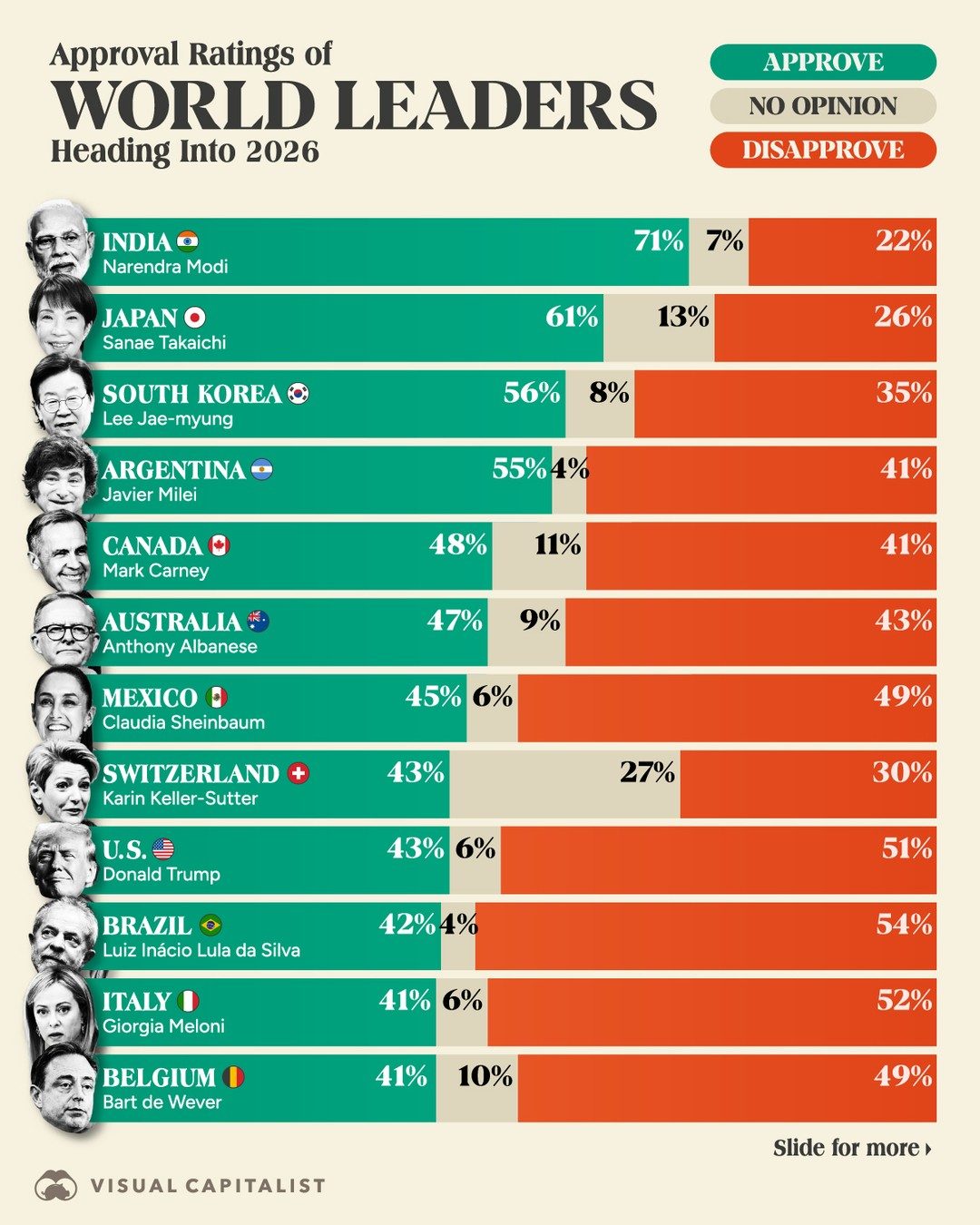
World Leader Approval Ratings
The approval ratings of world leaders are an essential indicator of public sentiment and political stability. As we head into 2026, these ratings reflect the global trends and economic conditions that shape public opinion. Here, we dive into the approval ratings of major world leaders, analyzing the factors that influence these numbers and highlighting key trends.
Context / Why this matters
Understanding the approval ratings of world leaders is crucial for several reasons. Firstly, it provides insight into the effectiveness of leadership and governance. High approval ratings often indicate that a leader's policies are resonating well with the public, while low ratings may suggest dissatisfaction with governance. Secondly, these ratings can influence global politics and international relations. Leaders with high approval ratings may have more bargaining power and credibility on the international stage. Thirdly, economic conditions, policy decisions, and major events can significantly impact these ratings, making them a useful barometer for a country's overall health and stability.
Main discussion
Economic Conditions and Policy Decisions
Economic conditions and policy decisions play a pivotal role in shaping public opinion and, consequently, a leader's approval ratings. For instance, Narendra Modi, the Prime Minister of India, enjoys a 71% approval rating, the highest among the leaders surveyed. This high approval rating can be attributed to economic reforms and policies that have had a positive impact on the country's growth and development. Conversely, leaders facing economic downturns or policy backlashes may see their approval ratings plummet. For example, Anthony Albanese of Australia has a 47% approval rating, reflecting the economic challenges and policy decisions that have shaped public sentiment in the country.
Leadership Changes
Leadership changes often result in significant shifts in approval ratings. For instance, new leaders may enjoy a "honeymoon period" where they are given the benefit of the doubt by the public. This period can be crucial for gaining initial approval, but sustaining it requires effective governance and policy decisions. In Argentina, Javier Milei’s approval rating stands at 56%, indicating a mix of optimism and skepticism as the country navigates political and economic transitions. Similarly, in Japan, Sanae Takaichi, a new leader, has a 61% approval rating, suggesting a positive reception from the public. These ratings reflect the public's response to leadership changes and their expectations from new leadership.
Public Opinion and Governance
Public opinion plays a critical role in shaping governance and policy decisions. Leaders with high approval ratings are likely to have more support for implementing their policies, which can lead to better governance and economic outcomes. For example, Giorgia Meloni of Italy has a 41% approval rating, reflecting the challenges of governing in a diverse country with varying public opinions. In contrast, Donald Trump of the U.S. has a 42% approval rating, indicating a polarized public opinion where a significant portion of the population either strongly approves or disapproves of his governance.
Regional Trends
Regional differences in approval ratings highlight the unique challenges and opportunities leaders face in their respective regions. In Europe, leaders such as Emmanuel Macron of France and Olaf Scholz of Germany have lower approval ratings, with 67% and 60% disapproval, respectively, reflecting the complex political and economic landscape. In contrast, leaders in Asia, such as Narendra Modi and Sanae Takaichi, enjoy higher approval ratings, suggesting stronger public support for their governance.
Gender and Governance
The gender of a leader can also influence public opinion and approval ratings. For example, Claudia Sheinbaum of Mexico has a 48% approval rating, which provides insight into how gender dynamics play a role in public perception. In Switzerland, Karin Keller-Sutter has a 45% approval rating, indicating a mix of approval and disapproval that reflects the public's views on her governance. These ratings highlight the importance of gender dynamics in leadership and how they can influence public sentiment and governance effectiveness.
Practical tips
For those interested in understanding and analyzing leader approval ratings, here are a few practical tips:
Stay Informed
Regularly follow updates from reliable sources such as Morning Consult, which provides comprehensive data on approval ratings. Staying informed can help you understand the latest trends and factors influencing public opinion.
Analyze Economic Indicators
Economic conditions significantly impact approval ratings. Keep an eye on economic indicators such as GDP growth, unemployment rates, and inflation to understand how they influence public sentiment.
Assess Policy Outcomes
Evaluate the outcomes of policy decisions and their impact on the public. Policies that address key issues and positively impact the economy and society are more likely to garner public approval.
Consider Regional Differences
Regional contexts play a crucial role in shaping public opinion. Understand the unique challenges and opportunities leaders face in their respective regions to better interpret their approval ratings.
Examine Gender Dynamics
Recognize the role of gender dynamics in public perception and approval ratings. Gender can influence how leaders are perceived and the level of support they receive.
Important takeaways
-
Economic Conditions and Policy Decisions: These are critical factors that shape public opinion and, consequently, a leader's approval ratings. Economic reforms and policies that positively impact a country's growth and development are likely to boost a leader's approval ratings.
-
Leadership Changes: New leaders often enjoy a "honeymoon period" where they are given the benefit of the doubt by the public. Sustaining high approval ratings requires effective governance and policy decisions.
-
Public Opinion and Governance: Public opinion is crucial in shaping governance and policy decisions. Leaders with high approval ratings are likely to have more support for implementing their policies, which can lead to better governance and economic outcomes.
-
Regional Differences: Regional differences in approval ratings reflect the unique challenges and opportunities leaders face in their respective regions. Understanding these differences can provide insight into the factors influencing public sentiment.
-
Gender and Governance: Gender dynamics play a role in public perception and approval ratings. Recognizing these dynamics can help understand how leaders are perceived and the level of support they receive.
Conclusion
The approval ratings of world leaders offer a valuable glimpse into public sentiment and the factors shaping governance. As we head into 2026, understanding these ratings can provide insight into the effectiveness of leadership, the impact of policy decisions, and the unique challenges faced by leaders in different regions. By staying informed, analyzing economic indicators, and considering regional differences, we can gain a better understanding of the dynamics at play and how they influence global politics.
Watch the Reel
Questions readers ask
How do economic conditions impact world leader approval ratings in 2026?
Economic conditions significantly influence approval ratings. In 2026, leaders in countries with strong economic growth and low unemployment are likely to see higher approval ratings. Conversely, leaders in countries facing economic downturns or high inflation may experience lower ratings due to public dissatisfaction with economic policies.
Which major world leaders are expected to have the highest approval ratings in 2026?
Based on current trends and data from sources like Morning Consult, leaders known for effective crisis management, economic stability, and popular policies are expected to be highly rated. As of recent data, leaders such as Narendra Modi and others with strong public support and effective leadership are likely contenders for the highest approval ratings.
What are the key trends in world leader approval ratings for 2026?
Key trends include a focus on leadership effectiveness in handling global crises, economic management, and public health. Leaders addressing these issues effectively are likely to see higher ratings. Additionally, there is a noticeable impact of social media and public opinion polls on shaping these ratings, with leaders who are more engaged with the public likely to have higher approval.
How do approval ratings in 2026 compare to those in 2025?
The trends suggest a shift in public opinion towards leaders who prioritize economic recovery and public health. Leaders who successfully navigated the challenges of 2025, such as economic crises and health concerns, may see a boost in their 2026 ratings. Conversely, leaders who struggled with these issues may face a decline in approval.
Why are world leader approval ratings important for international relations?
Approval ratings can impact international relations through influencing policy decisions and public sentiment in other countries. High approval ratings may signal stability and strength, potentially enhancing a leader's global influence. Conversely, low ratings could lead to diplomatic challenges and strained international relations.
Recent articles
Fresh deep dives from the latest Reels we unpacked.




Comments
Be the first to comment.