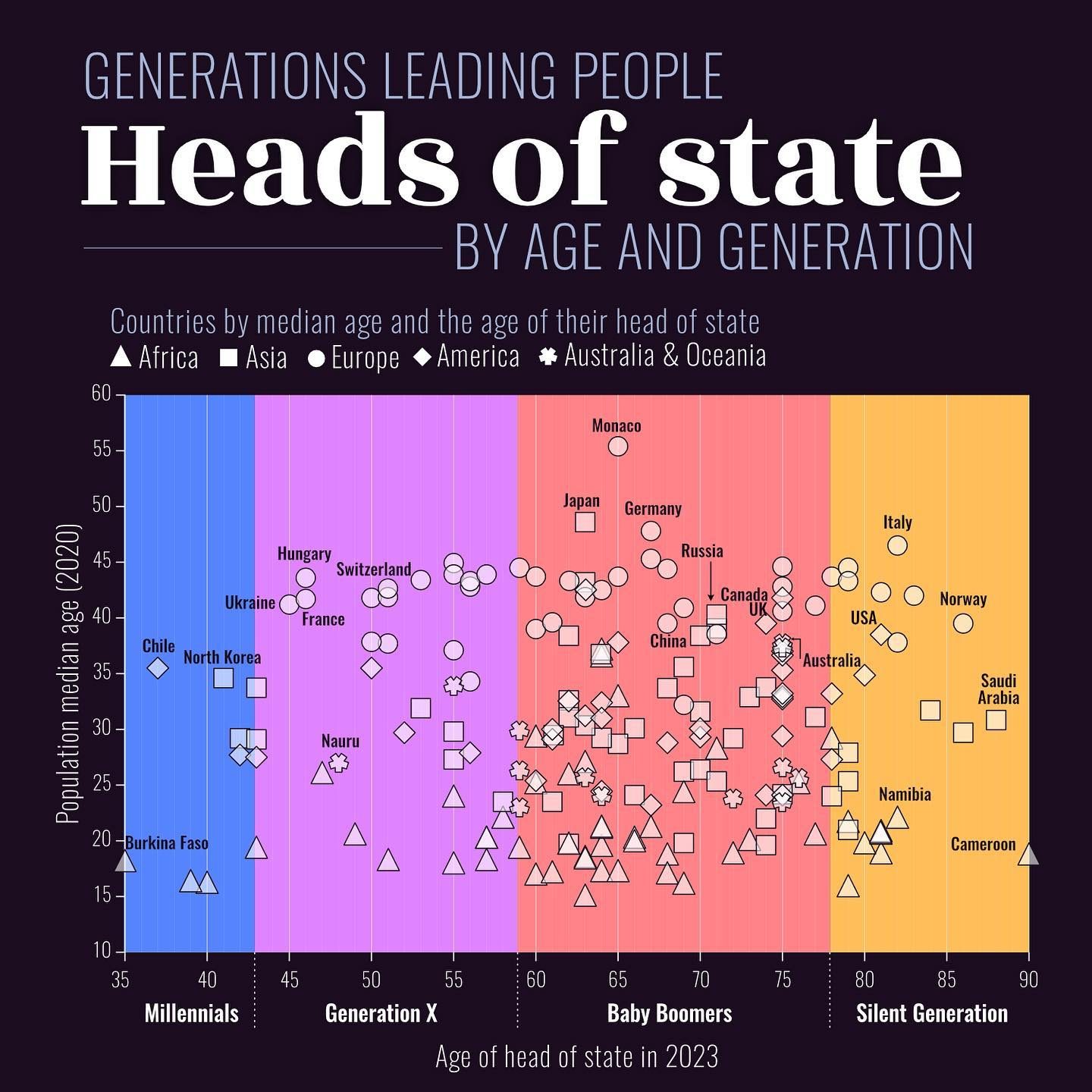
Heads of State by Age and Generation
Understanding the age and generational distribution of world leaders provides insight into the diverse demographics shaping global governance. As of March 2023, heads of state span various generations, reflecting the demographic composition of their respective countries. This comparison reveals intriguing patterns and highlights the generational trends influencing world leadership.
Why This Matters
The age and generational makeup of world leaders can significantly impact policy decisions, governance styles, and international relations. By examining the median age of countries and the ages of their heads of state, we gain a clearer understanding of how different generations are represented in leadership roles. This analysis also underscores the importance of considering generational perspectives in global politics.
Main Discussion
Generational Distribution of World Leaders
Heads of state are categorized into four primary generations: Millennials, Generation X, Baby Boomers, and the Silent Generation. Each generation brings unique experiences, values, and perspectives to leadership roles. For instance, Millennial leaders may prioritize digital innovation and sustainability, while Baby Boomers might focus on economic stability and traditional governance structures.
Regional Analysis
The infographic categorizes countries by continent, providing a regional perspective on leadership demographics. Here are some key observations:
Africa
Countries in Africa showcase a mix of generations in leadership roles. For example, Cameroon and Namibia have heads of state from different generations, reflecting the country's generational diversity.
Asia
Asia presents a varied landscape. Japan, for instance, has a head of state from the Silent Generation, while countries like Russia and Saudi Arabia have leaders from Generation X.
Europe
European countries exhibit a range of generational leadership. For example, Switzerland and Germany have heads of state from the Baby Boomer generation, while Italy and Norway represent Generation X and Millennials, respectively.
America
In the Americas, the USA and Canada have heads of state from different generations. The USA's leader, for example, is from Generation X, while Canada’s leader is a Baby Boomer.
Generational Trends
The data highlights several generational trends. For example, the Silent Generation and Baby Boomers are well-represented among world leaders, reflecting their extensive experience in politics. Generation X and Millennials are also present, indicating a shift towards younger leaders who may bring fresh perspectives and innovative approaches to governance.
Data Sources
The infographic sources its data from the CIA World Factbook (2020) and Wikipedia, ensuring a reliable and comprehensive analysis. These sources provide accurate demographic data and leadership information, making the visualization a valuable resource for understanding global governance.
Practical Tips
If you are interested in analyzing leadership demographics or conducting similar research, consider the following tips:
Utilize Reliable Data Sources
Ensure your research is grounded in credible data sources. For demographic and leadership information, resources like the CIA World Factbook and Wikipedia are invaluable.
Categorize by Generation and Region
Categorizing countries by continent and generation can help identify regional and generational trends. This approach provides a comprehensive view of leadership demographics.
Visualize Data for Clarity
Using infographics and scatter plots can make complex data more accessible. Visual representations help in identifying patterns and trends that might be difficult to discern from raw data.
Important Takeaways
Understanding the age and generational distribution of world leaders offers valuable insights into global governance. Key takeaways include:
- The Silent Generation and Baby Boomers remain well-represented among world leaders.
- Generation X and Millennial leaders are increasingly taking on prominent roles.
- Regional differences in leadership demographics highlight diverse generational perspectives.
- Reliable data sources and visualizations enhance the analysis of leadership demographics.
Conclusion
The age and generational diversity of world leaders significantly impact global governance. By comparing the median age of countries with the age of their heads of state, we gain a clearer understanding of how different generations influence leadership roles. This analysis highlights the importance of considering generational perspectives in global politics and provides valuable insights for those interested in understanding the demographics of world leadership. Whether you are a researcher, policymaker, or simply curious about global governance, this comparison offers a comprehensive view of the generational trends shaping our world.
Watch the Reel
Questions readers ask
How does the age of a world leader influence their governance style?
The age of a world leader can significantly influence their governance style, as it often correlates with their generation and the experiences they've had. For instance, younger leaders from the Millennial generation may prioritize technological innovation and sustainability, while older leaders from the Baby Boomer generation might focus on economic stability and traditional governance methods.
Which generation has the most representation among current world leaders?
As of March 2023, the Baby Boomer generation holds the most representation among world leaders. This is likely because Baby Boomers have been in the workforce and in positions of power for a significant period, and many have risen to leadership roles through political careers that span several decades.
Who are some of the youngest world leaders and what unique perspectives do they bring?
Some of the youngest world leaders include Prime Minister of Finland, Sanna Marin, and the former Prime Minister of Canada, Justin Trudeau. These leaders, often from the Millennial or Gen Z generations, bring fresh perspectives to leadership by focusing on digital transformation, climate change, and social justice initiatives, appealing to younger constituents and setting new global agendas.
How does the age of a world leader affect policy decisions?
The age of a world leader can affect policy decisions by shaping their priorities and worldview. For example, younger world leaders might prioritize policies related to technology, sustainability, and social issues, while older leaders might focus on economic stability, international relations, and long-term planning. Additionally, generational experiences can influence policy decisions, with older leaders having grown up in different economic and social environments.
Who are the oldest world leaders and how does their age influence their leadership?
Some of the oldest world leaders include the King of Saudi Arabia, Salman bin Abdulaziz Al Saud, and the Queen of the United Kingdom, Elizabeth II, as of March 2023. Their advanced age often brings a wealth of experience, a long-term perspective on global issues, and a deep understanding of history, which can be valuable in navigating complex international relations and maintaining stability in an ever-changing world. They may have a more traditional approach to governance, prioritizing continuity and diplomatic stability.
What is the significance of comparing world leaders by age and generation?
Comparing world leaders by age and generation is significant as it offers insights into the diverse perspectives and experiences influencing global governance. By examining the generational trends in leadership, we can understand how different age groups approach policy decisions, governance styles, and international relations, fostering a more comprehensive understanding of the world's power dynamics and the forces shaping the future.
Recent articles
Fresh deep dives from the latest Reels we unpacked.




Comments
Be the first to comment.