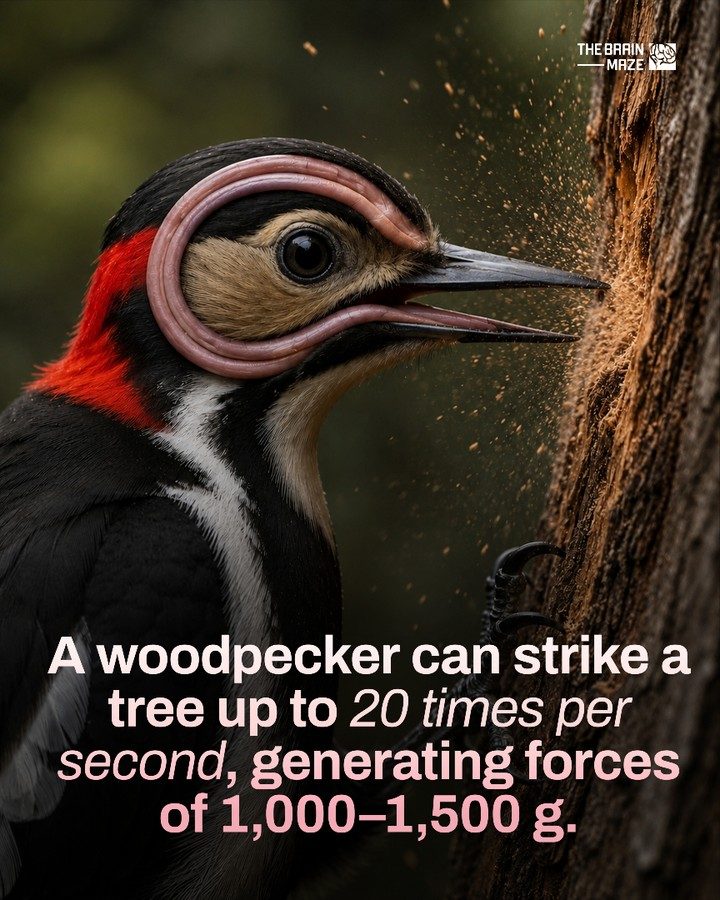
Woodpecker Facts
Woodpeckers are fascinating creatures known for their extraordinary ability to peck at tree trunks with remarkable speed and force. These birds can strike a tree trunk up to 20 times per second, generating forces of 1,000–1,500 g. To put this into perspective, such forces would cause serious injury to most other animals. However, woodpeckers have evolved unique adaptations that allow them to withstand these powerful impacts.
Why This Matters
Understanding the unique adaptations of woodpeckers provides insights into the wonders of nature and the evolutionary processes that have enabled these birds to thrive. Their specialized features are not just fascinating but also serve practical purposes, such as drilling into wood to search for insects or create nesting cavities.
Woodpecker Anatomy and Adaptations
The Skull and Beak
Woodpeckers have a specially adapted skull and beak designed to absorb the shock of repeated impacts. Their skulls are reinforced with spongy bone tissue, which acts as a shock absorber. Additionally, their beaks are designed to be strong and durable, with a chisel-like tip that can easily penetrate tree bark.
Neck Muscles
The neck muscles of a woodpecker are exceptionally strong, allowing them to deliver powerful blows to the tree. These muscles are also connected to a unique system of tendons and ligaments that help distribute the force evenly, reducing the risk of injury.
The Hyoid Apparatus
One of the most intriguing adaptations of the woodpecker is its tongue-supporting hyoid structure. Unlike most birds, the hyoid bone in a woodpecker extends around the back of the skull and connects to the base of the tongue. This unique structure allows the tongue to wrap around the bird's skull for added support, preventing brain damage from the powerful impacts.
Behavioural Adaptations
Woodpeckers' striking behaviour is not just about strength; it's also about precision and efficiency. They use their beaks to tap on trees in a specific rhythm, listening for the sound of insects or hollow spaces. This methodical approach increases their chances of finding food or suitable nesting sites.
Drumming and Communication
Woodpeckers also use their pecking behaviour for communication. Both males and females drum on trees to mark their territory and attract mates. The rhythm and intensity of their drumming can convey different messages, making it an essential part of their social interactions.
Specialised Behaviours
Feeding
Woodpeckers feed on a variety of insects, larvae, and even sap. Their long, sticky tongues help them extract insects from deep within tree crevices. This specialized feeding behaviour is made possible by their powerful pecking ability and unique tongue structure.
Nesting
Woodpeckers create nesting cavities by drilling into tree trunks. These cavities not only serve as homes but also provide shelter for other animals once the woodpeckers have moved on. This behavioural trait highlights the woodpecker's role in creating habitats for other species.
Practical Tips for Observing Woodpeckers
Observing woodpeckers in their natural habitat can be a rewarding experience. Here are some tips to help you get the most out of your woodland adventures:
Find the Right Habitat
Woodpeckers are typically found in forested areas, particularly those with mature trees. Look for environments with a mix of tree species, as this provides a variety of food sources and nesting sites.
Listen for Their Sounds
Woodpeckers are often easier to hear than to see. Listen for their distinctive tapping and drumming sounds. Once you locate the sound, scan the area to spot the bird.
Use Binoculars
Binoculars can greatly enhance your observation experience. They allow you to see the woodpeckers' movements and behaviours up close, without disturbing them.
Be Patient and Quiet
Woodpeckers are sensitive to disturbances. Move quietly and remain still while observing. Patience is key, as it may take some time for the birds to become accustomed to your presence.
Important Takeaways
Woodpeckers are remarkable creatures with a unique set of adaptations that enable them to thrive in their environment. Their powerful pecking ability, reinforced skull, strong neck muscles, and tongue-supporting hyoid structure work together to protect them from the forces generated during pecking. Additionally, their specialized behaviours for feeding and nesting play a crucial role in their survival and in shaping their habitats. Understanding these aspects of woodpecker biology and behaviour provides a deeper appreciation for these fascinating birds.
Conclusion
The world of woodpeckers is one of natural wonders and evolutionary marvels. From their powerful pecking ability to their unique adaptations and behaviours, these birds offer a wealth of insights into the natural world. By observing and understanding woodpeckers, we gain a greater appreciation for the diverse and intricate ecosystems that support them.
Watch the Reel
Questions readers ask
How fast can a woodpecker peck and what forces are involved?
Woodpeckers can peck at an astonishing rate of up to 20 times per second. This rapid pecking generates significant forces, ranging from 1,000 to 1,500 g, which is equivalent to about 98 to 147 times the force of gravity. This force is substantial and would be harmful to most other animals.
What adaptations do woodpeckers have to prevent injury while pecking?
Woodpeckers have several key adaptations that help them avoid injury. Their skulls are designed to absorb and distribute the impact of their pecking, and their beaks are reinforced to withstand the force of their strikes. Additionally, their brains are cushioned by special membranes and fluid, providing extra protection against impact.
How does a woodpecker's beak help in pecking?
A woodpecker’s beak is specially adapted for pecking. It is strong and sharp, allowing the bird to drill into wood efficiently. The beak’s unique shape and structure help to direct the force of the strike into the tree, reducing the amount of shock transferred back to the woodpecker's skull and brain.
What role do woodpecker's skull and brain play in their pecking ability?
The woodpecker's skull is uniquely structured to absorb the shock of each peck. It has a spongy bone composition that helps to dissipate the impact. Additionally, the brain is surrounded by special membranes and fluid that act as a cushion, further protecting it from injury during rapid, forceful pecking.
Why do woodpeckers peck so rapidly?
Woodpeckers peck rapidly to search for insects and to create nesting cavities. Their rapid pecking is not just a display of strength but also a highly efficient way to break through wood and access the resources they need, such as food and nesting materials.
What can we learn from woodpeckers about force absorption?
Woodpeckers' ability to rapidly peck without injury offers insights into natural force absorption techniques. Their specialized skull, beak, and brain structures provide a model for understanding how to distribute and mitigate impact forces, which could inspire advancements in various fields, including materials science and engineering.
Are there other animals that peck trees like woodpeckers?
While woodpeckers are the most well-known for their tree-pecking behavior, there are other animals that also peck or drill into wood. However, woodpeckers are unique in their ability to generate such high forces and peck at such rapid speeds without sustaining injury, thanks to their specialized adaptations.
Recent articles
Fresh deep dives from the latest Reels we unpacked.




Comments
Be the first to comment.