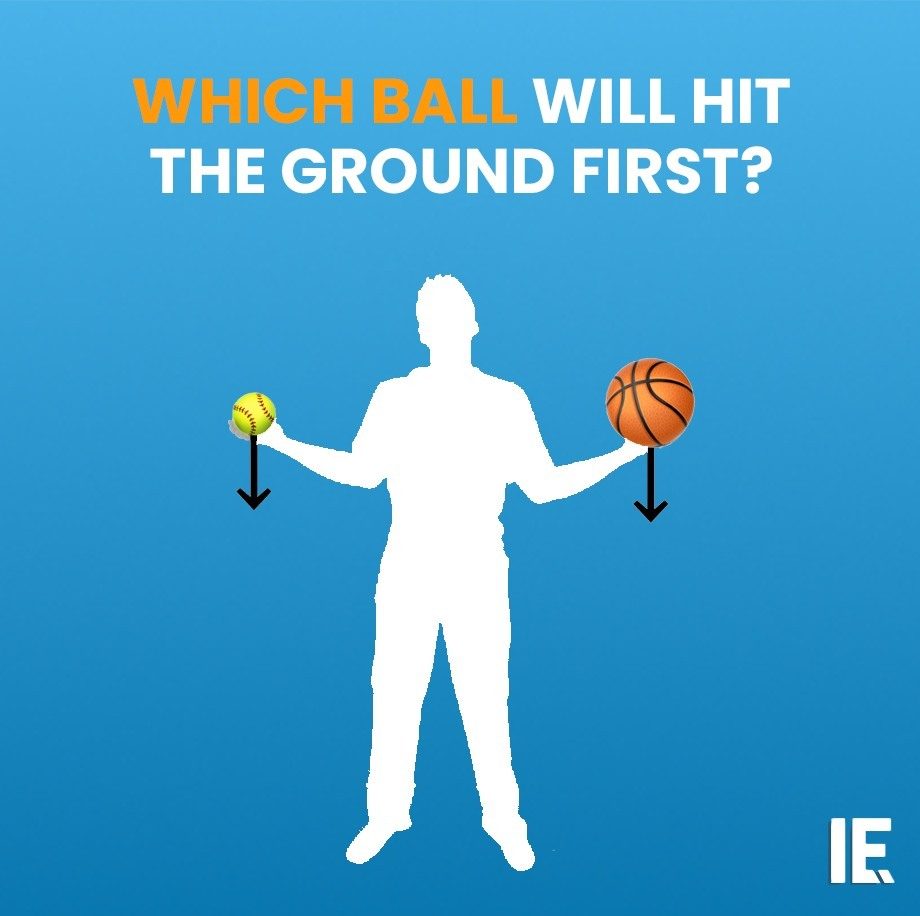
What Happens When You Drop a Tennis Ball and a Basketball from the Same Height?
Dropping two different-sized balls from the same height is a classic question to illustrate the principles of gravity and air resistance. This scenario is not only a fascinating brainteaser but also a practical demonstration of fundamental physics.
Context / Why this matters
Understanding how objects of different sizes and masses fall can help us grasp the role of air resistance in everyday scenarios. This knowledge is crucial in various fields, from engineering to sports, where the behavior of moving objects is critical. For instance, aerodynamics in sports equipment design, or the trajectory of projectiles in military applications, both rely on an understanding of falling objects and air resistance.
Main discussion
The Role of Gravity
Gravity is a fundamental force that pulls objects toward the earth. When an object is dropped, it accelerates downward at a rate of 9.8 meters per second squared (on Earth). Regardless of the object's mass or size, gravity will pull it toward the ground at the same rate.
The Impact of Air Resistance
Air resistance, or drag, is the force that opposes the motion of an object through the air. This force is influenced by several factors, including the object's shape, size, and velocity. For spherical objects like balls, the larger the surface area, the more air resistance they encounter.
Comparing a Tennis Ball and a Basketball
When you drop a tennis ball and a basketball from the same height, you might intuitively think that the heavier basketball will hit the ground first. However, the dynamics of air resistance play a significant role in this scenario.
Surface Area and Air Resistance
The basketball, being larger, has a greater surface area. This increased surface area results in more air resistance as the ball falls. The tennis ball, being smaller, experiences less air resistance.
Terminal Velocity
As the balls fall, they reach a point where the force of air resistance equals the force of gravity, causing them to fall at a constant speed known as terminal velocity. The larger surface area of the basketball means it reaches its terminal velocity more quickly than the smaller tennis ball.
Practical tips
Conducting Your Own Experiment
To observe this phenomenon firsthand, you can conduct a simple experiment. Here’s how:
- Gather Materials: You will need a tennis ball and a basketball.
- Find a Suitable Location: Choose a location with enough height to drop the balls safely, such as a tall building or a multi-story structure.
- Drop the Balls: Hold both balls at the same height and drop them simultaneously.
- Observe: Watch as the balls fall. You will likely see the tennis ball hit the ground slightly after the basketball, due to the difference in air resistance.
Variations to Consider
For a more comprehensive understanding, you can try varying the conditions of the experiment:
- Different Heights: Drop the balls from different heights to see if the results change.
- Different Types of Balls: Use other spherical objects of different sizes and materials to observe how their falling behavior compares.
- Indoor vs. Outdoor: Conduct the experiment indoors and outdoors to see how the presence of wind affects the results.
Important takeaways
- Gravity Affects All Objects Equally: Regardless of size or mass, gravity pulls all objects toward the ground at the same rate.
- Air Resistance Plays a Key Role: The larger the surface area of an object, the more air resistance it encounters, affecting its falling speed.
- Terminal Velocity: Objects reach a constant falling speed when the force of air resistance equals the force of gravity.
- Practical Applications: Understanding these principles can be applied in various fields, from sports to engineering, where the behavior of moving objects is critical.
Conclusion
Dropping a tennis ball and a basketball from the same height is a simple yet enlightening experiment that demonstrates the interplay between gravity and air resistance. By understanding these fundamental principles, you can gain valuable insights into how objects move through the air, with practical applications in various fields. So, the next time you see two balls fall, remember that the first to hit the ground isn't necessarily the heaviest—it's the one that encounters the least air resistance.
Watch the Reel
Questions readers ask
Why do a tennis ball and a basketball fall at different rates?
The primary reason is air resistance. The basketball has a larger surface area, causing it to experience more air resistance than the smaller tennis ball, which encounters less resistance. This difference in air resistance affects their falling rates.
Will the tennis ball or basketball hit the ground first in a vacuum?
In a vacuum, where there is no air resistance, both the tennis ball and the basketball will hit the ground at the same time. This is because gravity pulls all objects down at the same rate in the absence of air resistance.
How can you demonstrate the effect of air resistance on falling objects?
A simple demonstration involves dropping different-sized balls, like a tennis ball and a basketball, from the same height. The tennis ball, with less air resistance, will likely hit the ground first, illustrating the impact of air resistance on falling objects.
Does the mass of the balls affect which one hits the ground first?
The mass of the balls does not significantly affect which one hits the ground first when dropped from the same height. The key factor is air resistance, which is determined more by the surface area of the object than its mass.
Can you predict which ball will hit the ground first without conducting an experiment?
Without conducting an experiment, you can predict that the tennis ball will likely hit the ground first due to its smaller surface area and less air resistance. This prediction is based on the understanding that smaller objects experience less air resistance, leading to a faster fall.
How does air resistance affect the trajectory of falling objects?
Air resistance affects the trajectory of falling objects by slowing them down. The larger the surface area of an object, the more air resistance it encounters, which can alter its falling rate compared to smaller objects with less air resistance.
Recent articles
Fresh deep dives from the latest Reels we unpacked.




Comments
Be the first to comment.