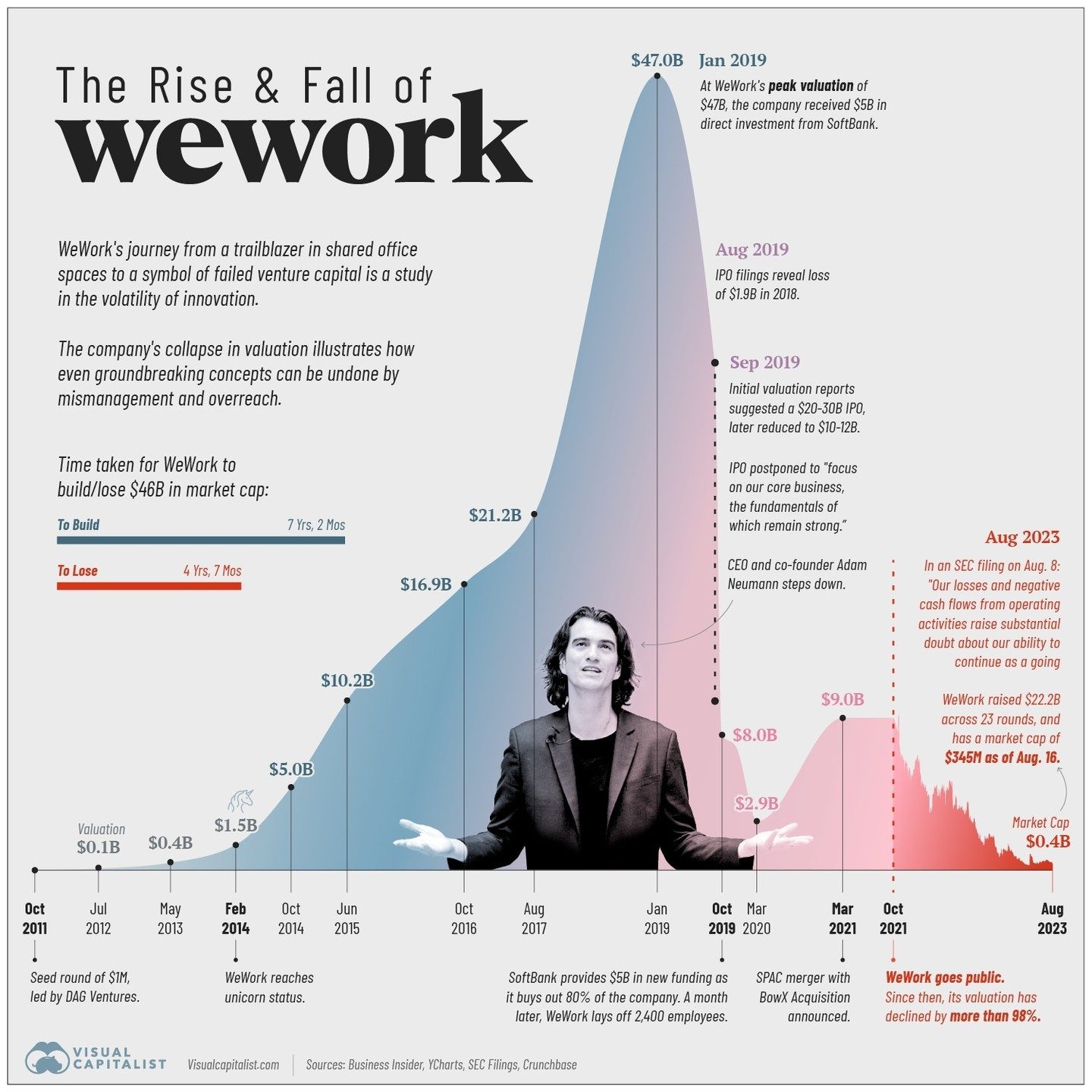
WeWork's Rise and Fall
WeWork, once hailed as the poster child of Silicon Valley's innovative startup culture, has seen a dramatic rise and fall. Founded in 2010, the company quickly became a symbol of the shared workspace revolution, offering flexible office solutions to freelancers, startups, and established businesses. However, its meteoric rise was followed by a precipitous decline, culminating in a 99% drop in valuation from its peak.
Why This Matters
Understanding the trajectory of WeWork is critical for several reasons. It provides valuable insights into the dynamics of the coworking industry, the challenges of rapid scalability, and the importance of sustainable business models. The company's story also serves as a cautionary tale for investors and entrepreneurs, highlighting the risks associated with overvaluation and misaligned corporate governance.
The Early Years and Peak Valuation
WeWork's journey began in 2010 with a vision to create a community of innovators and entrepreneurs. The company's initial offerings included shared workspaces and amenities designed to foster collaboration and creativity. This innovative approach resonated with a growing number of freelancers and small businesses, leading to rapid expansion.
By 2019, WeWork had raised a staggering $22.2 billion in funding and was valued at $47 billion, making it one of the most highly valued private companies in the world. The company's rapid growth was fueled by aggressive marketing, strategic acquisitions, and a charismatic leadership style from its co-founder and CEO, Adam Neumann.
Key Milestones
- Founding and Early Growth (2010-2015): WeWork's initial success was driven by a strong demand for flexible workspace solutions. The company quickly expanded its footprint, opening locations in major cities around the world.
- Rapid Expansion (2015-2018): During this period, WeWork focused on aggressive growth, acquiring competitors and expanding into new markets. The company's valuation soared, peaking at $47 billion in 2019.
- Initial Public Offering (IPO) Filings (2018-2019): In August 2018, WeWork filed for an IPO, revealing financial struggles with a loss of $1.98 billion for the year.
The Decline
Despite its impressive growth, WeWork's financial health was fragile. The company's aggressive expansion strategy, coupled with a lack of clear profitability, raised concerns among investors. The situation came to a head when WeWork filed for an IPO in 2019, revealing significant financial losses and negative cash flows. This disclosures raised substantial doubt about the company's ability to continue as a going concern.
In September 2019, initial valuation reports indicated that WeWork’s value had dropped significantly from its peak. This marked the beginning of a rapid decline, with the company losing approximately $16.9 billion in just 4 years and 7 months.
Factors Contributing to the Decline
- Leadership Issues: Adam Neumann's leadership style, while charismatic, was also highly controversial. His decisions, including the use of company funds for personal expenses and controversial statements, raised concerns among investors and stakeholders.
- Financial Struggles: The company's aggressive expansion strategy led to significant financial losses, exacerbated by a lack of clear profitability. The revelation of a $1.98 billion loss in 2018 further eroded investor confidence.
- Cultural and Strategic Challenges: WeWork's culture, characterized by rapid growth and a lack of clear strategic direction, contributed to its financial woes. The company's emphasis on community and innovation often came at the expense of financial discipline and operational efficiency.
Management Shakeup and Current Status
In May 2023, WeWork experienced another significant shakeup when CEO Sandeep Mathrani departed, further signaling uncertainty about the company's future. The departure of Mathrani, who had been brought in to stabilize the company, raised questions about WeWork's ability to regain its footing.
Current Financial Status
As of August 2023, WeWork's market capitalization had plunged to a mere $0.4 billion, marking a 99% decline from its peak valuation. The company's struggles highlight the challenges faced by rapidly growing startups in the tech and coworking sectors.
Practical Tips for Investors and Entrepreneurs
The story of WeWork offers several valuable lessons for investors and entrepreneurs. Here are some practical tips to consider:
- Emphasize Financial Discipline: While innovation and growth are essential, maintaining financial discipline is crucial. Rapid expansion without a clear path to profitability can lead to significant financial losses.
- Strategic Leadership: Effective leadership is critical for the success of any company. Investors and stakeholders should closely scrutinize the leadership team and their strategic decisions.
- Sustainable Growth: Sustainable growth requires a balanced approach, focusing on both expansion and profitability. Companies should avoid overly aggressive expansion strategies that prioritize growth over financial stability.
Important Takeaways
WeWork's rise and fall serve as a stark reminder of the challenges faced by rapidly growing startups. The company's journey highlights the importance of financial discipline, strategic leadership, and sustainable growth. For investors, the story underscores the need for careful evaluation of a company's financial health and strategic direction.
Conclusion
WeWork's dramatic rise and fall offer valuable insights into the dynamics of the coworking industry and the challenges of rapid scalability. From its early success to its subsequent decline, the company's journey serves as a cautionary tale for investors, entrepreneurs, and stakeholders. By emphasizing financial discipline, strategic leadership, and sustainable growth, companies can navigate the complexities of rapid expansion and achieve long-term success.
Watch the Reel
Questions readers ask
What was WeWork's peak valuation and when was it achieved?
WeWork's peak valuation was $47 billion, achieved in 2019. This valuation was a result of its rapid expansion and dominance in the coworking industry during that time.
What caused the dramatic fall in WeWork's valuation?
The dramatic fall in WeWork's valuation was due to a combination of factors, including rapid, unchecked growth, mismanagement, and issues in its business model, which raised concerns among investors.
How has WeWork's valuation changed since 2019?
Since its peak in 2019, WeWork's valuation has dropped by approximately 99%, significantly impacting its market position and investor confidence. As of 2023, the company continues to navigate these challenges.
What are some key lessons from WeWork's rise and fall?
WeWork's story highlights the importance of sustainable growth, transparency, and good governance. It serves as a reminder of the risks involved in rapid expansion and the need for a solid business model for long-term success.
How has the coworking industry responded to WeWork's fall?
The coworking industry has seen both challenges and opportunities following WeWork's fall. Many competitors have stepped in to fill the void, while the industry as a whole has focused on learning from WeWork's mistakes and implementing more stable and sustainable practices.
Related deep dives
Similar reads based on topic and creator.


Recent articles
Fresh deep dives from the latest Reels we unpacked.




Comments
Be the first to comment.