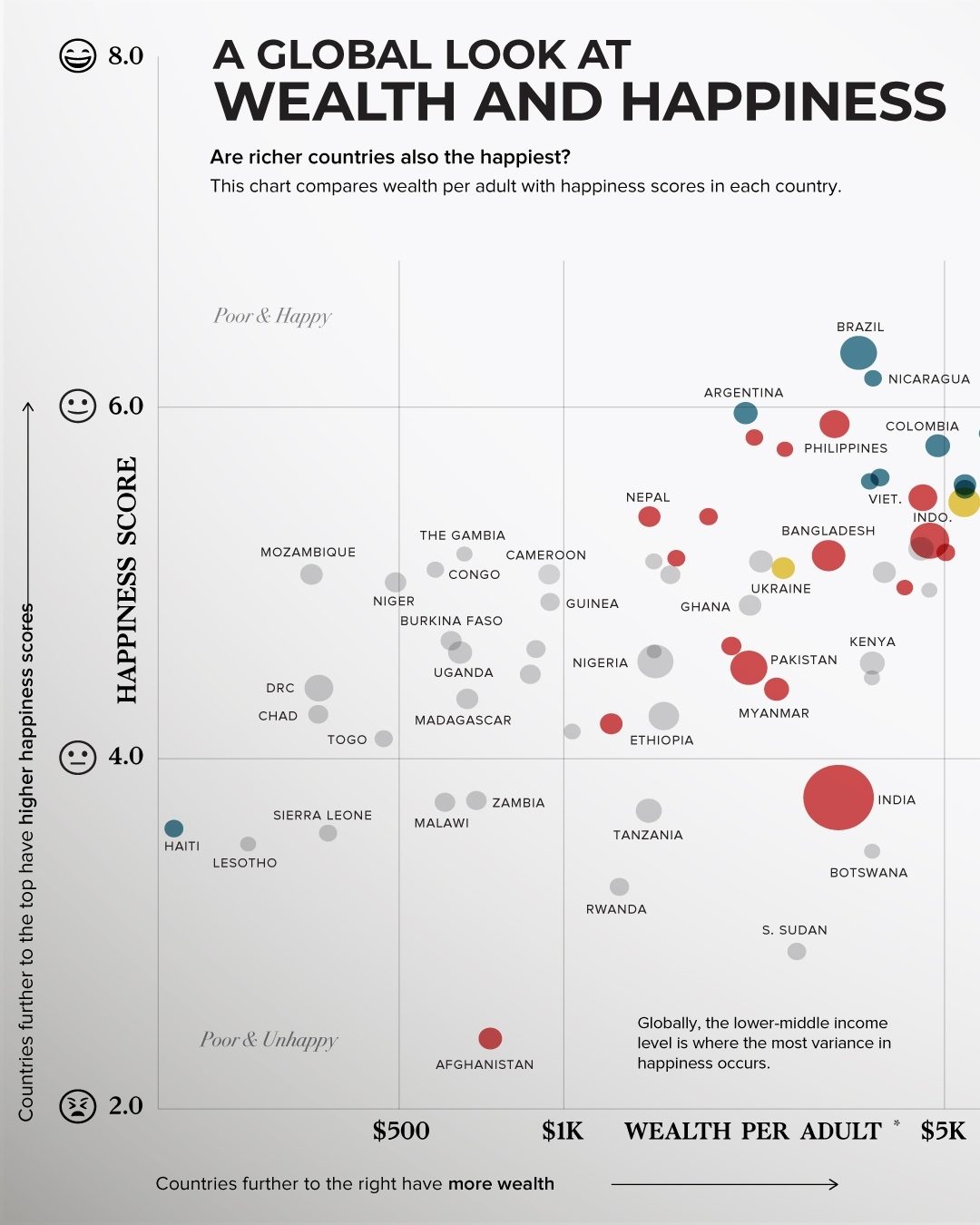
Wealth and Happiness Correlation
The relationship between wealth and happiness is a topic of enduring interest, with many wondering if financial prosperity equates to greater contentment. Recent global data from the Credit Suisse and the World Happiness Report 2022 have shed light on this complex interplay, revealing intriguing patterns and exceptions.
To explore this correlation, visual tools like the scatter plot charting wealth per adult against happiness scores across various countries have proven invaluable. This kind of visual representation not only makes the data more accessible but also allows for a more nuanced understanding of the relationship between wealth and happiness.
Context
The pursuit of happiness has long been a central theme in human history, with philosophers, economists, and sociologists alike attempting to decipher its secrets. The concept of happiness itself is subjective and multifaceted, influenced by a myriad of factors including family, love, purpose, and, notably, wealth. While the first three factors are challenging to quantify in a data-driven manner, wealth offers a more measurable metric.
According to the World Happiness Report, happiness can be evaluated using global survey data from over 150 countries. This report aggregates how people perceive their own lives, offering a comprehensive snapshot of global well-being. By cross-referencing this data with wealth indicators, such as the Credit Suisse's wealth per adult, it becomes possible to examine the relationship between financial affluence and personal satisfaction.
Main Discussion
Global Patterns
When examining the scatter plot, several global patterns emerge. Countries with higher wealth per adult often have higher happiness scores. Finland, Switzerland, and the Netherlands are clear examples of this trend. These nations not only rank high in wealth but also consistently top the World Happiness Report rankings year after year. This suggests that in these countries, wealth may play a significant role in overall life satisfaction.
Regions and Exceptions
While the trend generally holds, there are notable exceptions and regional variations. For instance, the Philippines, despite having a lower wealth per adult, scores relatively high on the happiness index. This indicates that factors beyond wealth are at play, such as strong community support, social connections, and cultural values.
Lebanon: A Unique Case
One of the most striking anomalies on the chart is Lebanon. Despite having a relatively high wealth per adult, it scores much lower on happiness. This discrepancy can be attributed to political turmoil, an economic crisis, and the devastating explosion in Beirut. These external factors have a profound impact on the overall well-being of the population, illustrating that wealth alone does not guarantee happiness.
The Happiness Paradox
The chart also highlights the concept of the "happiness paradox." Countries in the "Poor & Happy" quadrant, such as those in Latin America, often have lower wealth per adult but score significantly higher on happiness. This paradox suggests that while wealth is a contributing factor, it is not the sole determinant of happiness. Cultural, social, and community factors play a crucial role in shaping overall well-being.
Practical Tips
Understanding Happiness
To better understand the nuances of happiness, it is essential to recognize that wealth is just one of many factors. By focusing on multiple dimensions of well-being, including social connections, personal fulfillment, and community support, a more holistic view of happiness can be achieved.
Financial Well-being
While wealth alone does not equate to happiness, financial stability is a critical component. Creating a budget, saving for emergencies, and investing in financial education can help individuals achieve financial well-being, which in turn can contribute to overall happiness.
Cultivating Social Connections
Social connections and community support are vital for emotional well-being. Engaging in community activities, fostering strong relationships, and maintaining a sense of belonging can enhance personal satisfaction, even in the absence of substantial wealth.
Emphasizing Purpose
Purpose and fulfillment play a significant role in overall happiness. Pursuing passions, setting goals, and engaging in meaningful work can provide a sense of purpose, which is essential for long-term well-being.
Important Takeaways
The relationship between wealth and happiness is complex and multifaceted, influenced by a variety of factors. Wealth can contribute to happiness, but it is far from the sole determinant. Regional and cultural differences, social connections, and personal fulfillment are equally important. Understanding these nuances can help individuals and societies better prioritize factors that contribute to overall well-being.
Conclusion
Exploring the correlation between wealth and happiness provides valuable insights into the multifaceted nature of well-being. While wealth is an essential factor, it is not the only determinant. By considering other dimensions such as social connections, personal fulfillment, and community support, a more comprehensive understanding of happiness can be achieved. This understanding can guide individuals and societies in prioritizing well-being and fostering a happier, more fulfilling life.
Watch the Reel
Questions readers ask
How do global wealth and happiness rankings compare across different countries?
The comparison reveals a positive correlation, but it's not a perfect match. Wealthier countries like Switzerland and Finland often rank high in happiness, while some less wealthy countries, like Costa Rica and Panama, also show surprisingly high happiness scores. Conversely, some wealthy countries like Hong Kong and Singapore have relatively lower happiness scores, suggesting that wealth is just one factor influencing happiness.
What insights can be gained from the scatter plot of wealth per adult against happiness scores?
The scatter plot provides a clear visual representation of the relationship between wealth and happiness. Countries that cluster towards the top right of the chart indicate higher levels of both wealth and happiness, while those that fall below the trend line suggest other factors may be more significant. This tool helps to identify outliers and understand the nuances of the wealth-happiness correlation.
Which global reports are most reliable for understanding the relationship between wealth and happiness?
Two key sources for understanding the relationship between wealth and happiness are the Credit Suisse Global Wealth Report and the World Happiness Report. The Credit Suisse report provides updated wealth statistics, while the World Happiness Report includes a comprehensive ranking of global happiness scores, offering a broad perspective on the interplay between wealth and happiness.
Are there any countries that defy the typical wealth and happiness trend?
Yes, countries like Costa Rica and Panama have shown higher happiness scores despite having relatively lower wealth per adult. Conversely, countries like Hong Kong and Singapore, while very wealthy, have lower happiness scores. These outliers indicate that factors beyond wealth, such as social support, freedom, and health, contribute significantly to a population's contentment.
What other factors besides wealth influence global happiness trends?
Beyond wealth, factors such as social support, personal freedom, and a sense of community are essential to happiness. Health and life satisfaction also play significant roles. According to the World Happiness Report, these factors contribute significantly to the overall happiness and well-being of individuals and communities.
How does the concept of life satisfaction relate to financial prosperity and well-being?
Life satisfaction, a key component of happiness, is influenced by financial prosperity. However, it's not the sole determinant. Individuals with a higher income might report greater well-being, but those with strong community ties and a sense of purpose often experience equal or greater contentment. This emphasizes the multifaceted nature of happiness, extending beyond financial prosperity.
Related deep dives
Similar reads based on topic and creator.




Recent articles
Fresh deep dives from the latest Reels we unpacked.




Comments
Be the first to comment.