Wealth Inequality: A Global Comparison
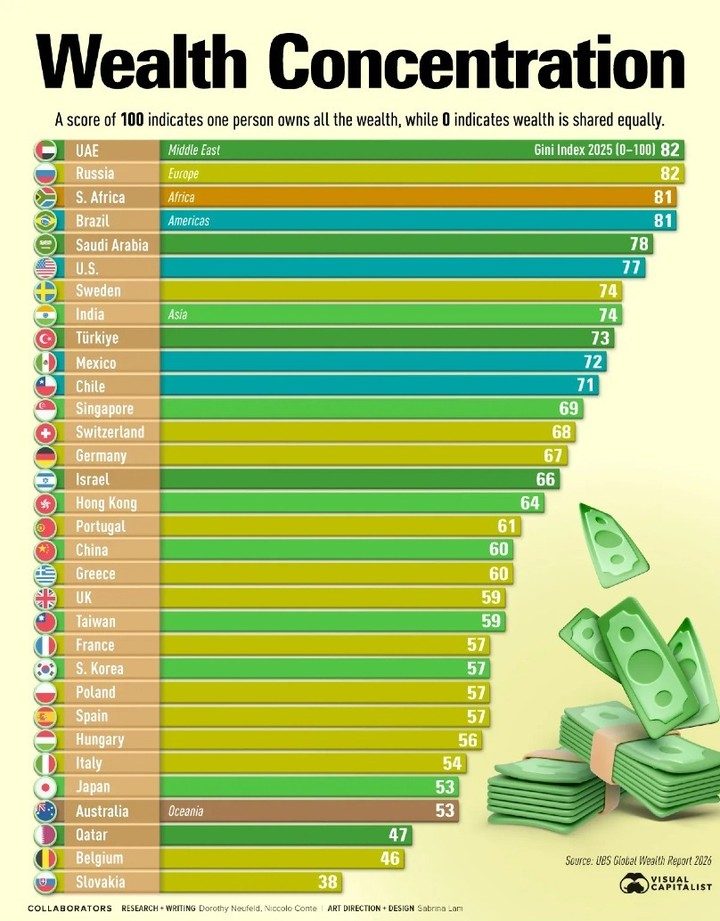
Wealth inequality is a pressing global issue, with significant disparities in wealth distribution across countries. The Wealth Gini Index, a key measure of wealth inequality, provides a clear picture of where wealth is most concentrated. This index, featured in the UBS Global Wealth Report 2026, offers a quantifiable way to compare wealth distribution disparities worldwide. Let's delve into the findings and explore what they mean for different regions.
Why This Matters
Understanding wealth inequality is crucial for economic planning, policy-making, and social development. It highlights the economic disparities between countries and within them, offering insights into the distribution of financial resources. This information is vital for policymakers, economists, and social scientists as it helps in addressing issues related to poverty, economic growth, and social stability.
Main Discussion
High Wealth Concentration
Several countries stand out for their high wealth concentration, indicating significant disparities between the rich and the poor. The United Arab Emirates (UAE) and Russia lead the list with a Gini index score of 82. This high score reflects a stark divide, where a small segment of the population holds a disproportionate amount of wealth. The UAE, known for its oil-rich economy, and Russia, with its vast natural resources, illustrate how resource abundance can lead to concentrated wealth.
Middle-Ranked Countries
Countries like South Africa and Brazil also exhibit high wealth concentration, with scores of 81 and 79, respectively. South Africa's apartheid history and Brazil's economic disparities contribute to these high scores. The presence of these countries in the higher ranks of the Wealth Gini Index underscores the persistent economic challenges they face.
Moderate Wealth Concentration
The United States, a global economic powerhouse, ranks sixth with a Gini index score of 69. This score places the U.S. ahead of countries like India, Mexico, and China, which have scores of 74, 74, and 72, respectively. The U.S. score reflects a middle-ground in wealth distribution, where wealth is relatively concentrated but not as extreme as in the top-ranked countries.
Low Wealth Concentration
Europe stands out as a region with relatively lower wealth concentration. Six of the ten countries with the lowest Gini index scores are European. Sweden, Switzerland, and Germany top this list with scores of 48, 48, and 50, respectively. These countries benefit from robust social welfare systems, progressive taxation policies, and strong labor regulations, which help distribute wealth more evenly.
Asia's Mixed Picture
Asia presents a mixed picture with a wide range of Gini index scores. While countries like Hong Kong and Singapore have higher wealth concentration scores of 64 and 52, countries like South Korea and Taiwan fare better with scores of 46 and 43, respectively. This variability highlights the diverse economic landscapes within the continent, influenced by different economic policies and social structures.
Other Notable Mentions
Countries like Israel, the UK, and Portugal fall in the moderate range with scores of 54, 52, and 52, respectively. These countries reflect a balance between economic growth and wealth distribution. Meanwhile, countries like Qatar, Belgium, and Slovakia show lower wealth concentration with scores of 48, 41, and 42, respectively. These scores reflect efforts towards more equitable wealth distribution.
Practical Tips
For Policy Makers
For countries with high wealth concentration, implementing progressive taxation and robust social welfare programs can help redistribute wealth more evenly. Policies aimed at reducing income inequality, such as minimum wage increases and affordable housing initiatives, can also make a significant impact.
For Economists
Economists can use the Wealth Gini Index to identify trends and forecast future economic developments. Understanding the relationship between wealth concentration and economic growth can provide insights into sustainable development strategies.
For Social Scientists
Social scientists can delve deeper into the social implications of wealth inequality. Research into the psychological and social impacts of economic disparities can help develop interventions that promote social cohesion and stability.
Important Takeaways
- Wealth Disparity is Global: The Wealth Gini Index reveals that wealth concentration is a global phenomenon, affecting countries across different continents and economic landscapes.
- Resource Abundance and Inequality: Countries rich in natural resources often exhibit high wealth concentration, highlighting the need for equitable resource management policies.
- Europe's Progressive Policies: Europe's lower wealth concentration scores underscore the effectiveness of progressive economic policies in reducing inequality.
- Asia's Variability: Asia's diverse economic landscapes, from high wealth concentration in some countries to more equitable distributions in others, reflect varied policy approaches and social structures.
- Need for Comprehensive Solutions: Addressing wealth inequality requires a multidimensional approach, encompassing economic, social, and political strategies.
Conclusion
The Wealth Gini Index from the UBS Global Wealth Report 2026 provides a clear picture of wealth concentration across different countries. From the high concentration in the UAE and Russia to the relatively lower concentration in European nations, the data offers valuable insights into global economic disparities. Understanding these patterns is crucial for developing effective policies aimed at reducing wealth inequality and promoting economic stability. By recognizing the unique challenges and solutions in different regions, we can move towards a more equitable global economy.
Watch the Reel
Questions readers ask
What is the Wealth Gini Index and why is it important?
The Wealth Gini Index is a statistical measure that quantifies the distribution of wealth within a country. It ranges from 0 to 1, with higher values indicating greater wealth inequality. It is important for understanding economic disparities and informing policy decisions.
Why do the United Arab Emirates and Russia have the highest wealth concentration?
The United Arab Emirates and Russia top the list for wealth concentration due to significant disparities in wealth distribution. Factors contributing to this include the concentration of wealth in certain sectors, such as oil and gas, and the presence of a large expat population in the UAE. The economic policies and structures in these countries play a significant role in this wealth disparity.
How does the Wealth Gini Index compare wealth distribution across different regions?
The Wealth Gini Index allows for a direct comparison of wealth distribution across different regions and countries. It provides a numerical value that reflects the extent of wealth inequality, making it easier to identify regions with the highest wealth gaps, such as the UAE and Russia, and compare them to other parts of the world, like Europe, India, or Africa.
What insights can be gained from the UBS Global Wealth Report 2026?
The UBS Global Wealth Report 2026 offers valuable insights into global wealth distribution trends. It highlights countries with the highest wealth concentration, such as the UAE and Russia, and provides data on wealth distribution in various regions, including Europe, India, Africa, Mexico, and China. This information is crucial for policymakers and economists.
How does wealth concentration in the UAE compare to that in Russia?
While both the UAE and Russia have high wealth concentration, the dynamics differ. In the UAE, a significant factor is the presence of a large expat population, which contributes to the wealth disparity. In Russia, the wealth concentration is often tied to the oil and gas industry, and political and economic structures. The specific causes and effects of wealth inequality vary between the two countries.
What are some of the factors contributing to wealth disparity in different countries?
Wealth disparity in different countries can be attributed to various factors, including economic policies, industrial structure, and social dynamics. For instance, in the UAE, the expatriate workforce and the economic reliance on certain sectors contribute to the wealth gap. In contrast, in countries like India and China, rapid economic growth and industrialization have led to significant wealth disparities.
How does wealth concentration in Europe compare to other regions like India and Africa?
Wealth concentration in Europe tends to be lower compared to regions like the UAE and Russia, but it still varies significantly among European countries. In contrast, India and Africa show diverse wealth distribution patterns, with some countries experiencing high wealth concentration due to factors like economic growth disparities and unequal access to resources. The 2026 wealth report provides detailed comparisons and insights into these regional differences.
Recent articles
Fresh deep dives from the latest Reels we unpacked.




Comments
Be the first to comment.