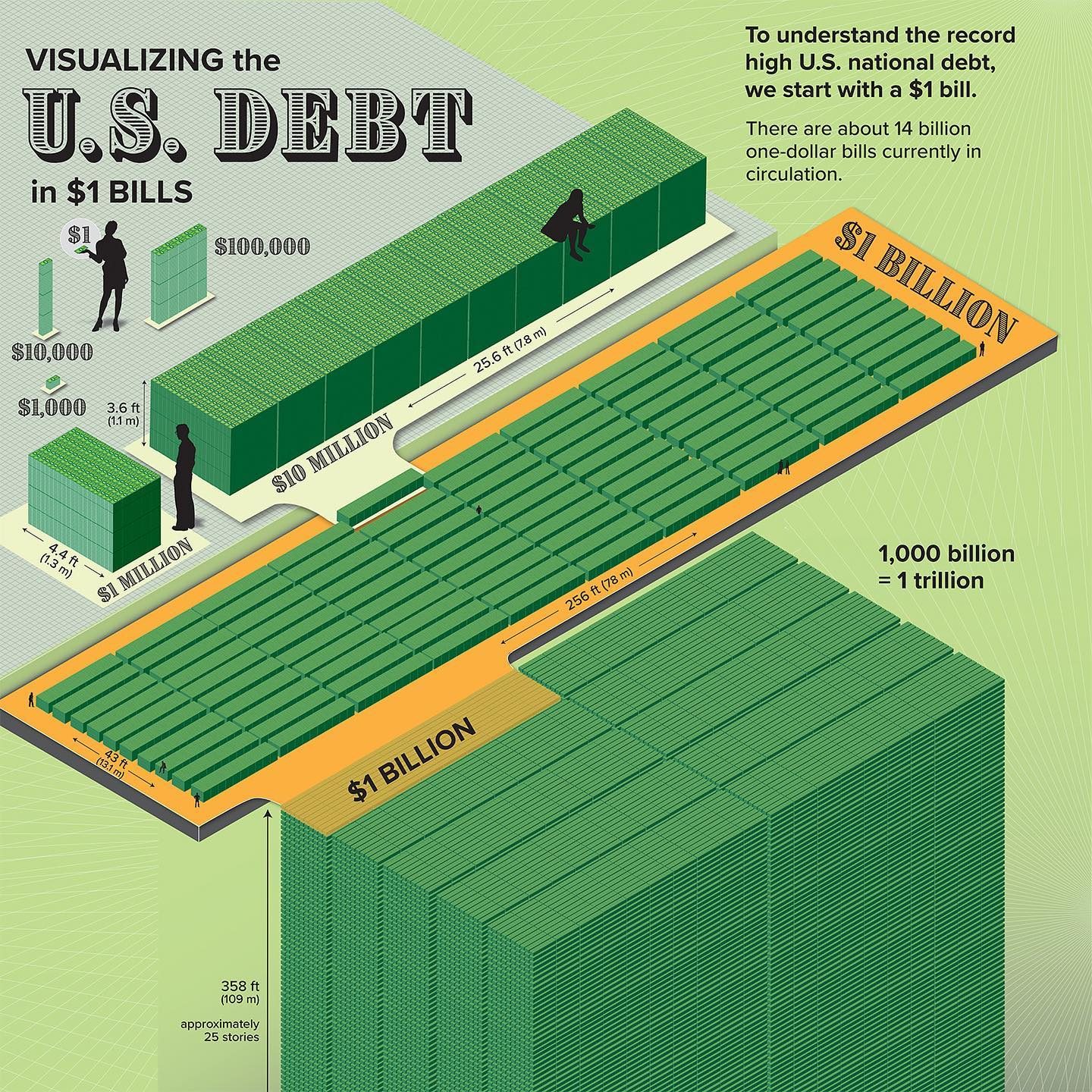
U.S. National Debt Visualization
The U.S. national debt of $31.4 trillion is a staggering figure that can be difficult to comprehend. To put it into perspective, imagine the median U.S. mortgage multiplied by 230 million. That's the scale of the debt we're discussing. Visualizing this amount can help make the enormity of the debt more tangible.
Why This Matters
Understanding the U.S. national debt is crucial for grasping the financial landscape of the country. It impacts government policy, economic stability, and the financial future of citizens. By visualizing the debt, we can better appreciate the scale of government spending and borrowing.
Main Discussion
The Scale of $31.4 Trillion
To fully grasp the magnitude of $31.4 trillion, let's break it down. A single dollar bill is a small piece of paper, but when you start stacking them, the numbers quickly become overwhelming.
- $1 billion is already a towering pile of $1,000 bills, equivalent to a stack approximately 25 stories tall.
- $10,000 in dollar bills is considerably smaller, but imagine a stack of $31.4 trillion. It would reach heights that dwarf the Willis Tower, one of the tallest buildings in the world.
Comparative Analysis
To better understand the debt, let's compare it to familiar metrics:
- Per Capita Debt: The national debt translates to about $94,000 per U.S. citizen. This means each person in the country would need to contribute nearly $94,000 to pay off the total debt.
- Government Spending: In December 2022, maintaining the debt cost $210 billion, which accounts for approximately 15% of the total government spending for the year.
The Debt Ceiling
The debt ceiling, also known as the debt limit, is a cap on the total amount of money the federal government is authorized to borrow. This limit is crucial for understanding the management of the national debt. In January 2023, the U.S. hit the debt ceiling, which means the government had reached its borrowing limit. This cap is set to ensure that the government fulfills its financial obligations through U.S. Treasury securities, such as bills and savings bonds.
Practical Tips
Stay Informed
Keeping track of the national debt and its implications is essential for making informed decisions. Resources like Fiscaldata.treasury.gov and Federalreserve.gov provide detailed data and analyses. These websites can help you stay updated on the latest financial trends and government spending.
Understand the Impact
Understanding the impact of the national debt on your personal finances is crucial. While the debt may seem abstract, it affects interest rates, economic policies, and government services. By staying informed, you can better plan your financial future and make more informed investment decisions.
Engage with Data Visualizations
Visualizations, like the ones created by Julie Peasley, can help make complex financial data more accessible. Engaging with these visual aids can provide a clearer understanding of the scale and impact of the national debt.
Important Takeaways
- The U.S. national debt is a massive figure, totaling $31.4 trillion.
- Visualizing the debt can help make it more understandable. For example, $31.4 trillion in dollar bills would form a stack taller than the Willis Tower.
- The debt ceiling is a critical financial measure that limits the amount the government can borrow.
- Staying informed about the national debt and its implications is essential for personal financial planning and understanding economic policies.
Conclusion
The U.S. national debt is a complex and monumental figure that affects every aspect of the country's financial landscape. While the scale is often difficult to grasp, visualizing the debt can provide a clearer picture of its magnitude. By staying informed and understanding the implications, we can better navigate the financial challenges and opportunities that lie ahead.
Watch the Reel
Questions readers ask
What is the current U.S. national debt and why is it significant?
The current U.S. national debt stands at approximately $31.4 trillion. This figure is significant because it represents the total amount of money that the federal government has borrowed, impacting government policy, economic stability, and the financial future of citizens.
How can visualizing the national debt help in understanding its magnitude?
Visualizing the national debt, such as through stacks of dollar bills or comparisons to government spending, helps to put the $31.4 trillion into a more tangible context. For example, it can be compared to the median U.S. mortgage multiplied by 230 million. This makes the enormity of the debt more comprehensible.
What is the purpose of visualizing trillion-dollar figures in the context of the national debt?
Visualizing trillion-dollar figures, such as the $31.4 trillion national debt, helps to make abstract numbers more relatable. By comparing these figures to everyday items or experiences, like the annual federal spending, it becomes easier to grasp the scale and implications of the debt.
How does the U.S. national debt affect government policy and economic stability?
The U.S. national debt influences government policy by limiting the flexibility of fiscal decisions and can impact economic stability by affecting interest rates and inflation. High levels of debt can also influence the financial future of citizens, as it may lead to increased taxes or reduced government services.
What are some common visual representations used to explain the national debt?
Common visual representations of the national debt include stacks of dollar bills, comparisons to large-scale events like federal spending or national emergencies, and per capita contributions. These visuals help to contextualize the debt in a way that is more relatable and easier to understand.
What is the debt ceiling and how does it relate to the national debt?
The debt ceiling is a legal limit set by Congress on the amount of money that the federal government is authorized to borrow. It relates to the national debt because once the debt reaches the ceiling, the government can no longer issue new debt without congressional approval, which can lead to a potential U.S. debt crisis.
How can individuals stay informed about the national debt and its impact on the economy?
Individuals can stay informed by regularly checking sources like the U.S. Treasury debt management reports, following reliable financial news outlets, and utilizing visual guides to debt. Staying informed allows citizens to better understand the implications of the national debt on their financial future and the economy as a whole.
Recent articles
Fresh deep dives from the latest Reels we unpacked.




Comments
Be the first to comment.